



The price of gold is currently undergoing a correction, but for long-term investors there is no reason for ‘panic on the Titanic’.
Central banks’ gold purchases are reaching historic highs.[1] This phenomenon, which analysts refer to as ‘silent accumulation’, is of fundamental importance to the financial markets. These institutions buy gold for strategic rather than speculative purposes, so high market prices do not deter them. Why? There are three reasons:
- Escaping the risk of sanctions: The turning point was the freezing of Russia’s foreign exchange reserves by Western countries in 2022. For Beijing and other developing countries, this was a clear signal that fiat currencies (such as the dollar or the euro) can be politically cut off at any time. Physical gold, stored in its own vaults, is completely protected from external sanctions.[2]
- A historic breakthrough in reserves: According to the European Central Bank’s reports for mid-2026, the share of US government bonds in global reserves has fallen from 25 per cent to 22 per cent, whilst gold has, for the first time since 1996, surpassed US bonds in terms of value within global reserves. Investors are taking note of the US debt crisis and are offloading US government bonds.[3]
- Creation of an alternative system: China is not only accumulating gold, but is also actively developing alternative settlement systems, such as Project mBridge, within the BRICS bloc. These systems enable international trade to be conducted whilst bypassing the Western SWIFT system, with physical gold serving as the ultimate collateral for negative balances between trading partners.[4]
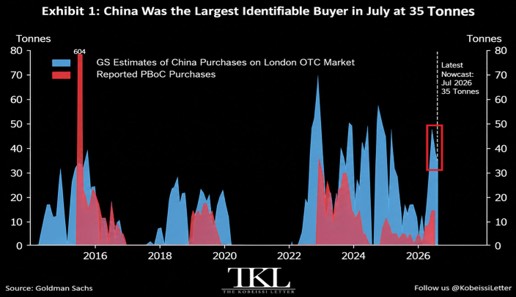
China is buying gold discreetly and unofficially via the London OTC market. Why is China concealing its purchases? Concealing the actual volumes purchased serves two purposes:
- Protection against rising prices: If the PBoC were to officially announce that it would be buying around 150 tonnes rather than 15 tonnes in a given month, this would lead to an immediate price rally on the markets. If China acts discreetly, it can buy the precious metal at a lower price.
- Geopolitical assessment: An overly drastic, official shift away from the dollar could lead to premature economic tensions and destabilise the market for US debt, of which China remains a major holder.
The fact is: in around July 2026, China purchased approximately 35 tonnes of gold via the OTC market in London, which is far in excess of the 20 tonnes officially reported by the People’s Bank of China.[5]
—————————————
[A] Central bank. A state’s bank that issues currency and manages foreign exchange reserves. It buys gold not to make a quick profit, but to maintain a reserve that is not dependent on any other currency.
[B] The 2022 freeze. Following the Russian invasion of Ukraine, Western states froze a large proportion of Russia’s reserves held in dollars, euros and other Western currencies. These reserves were held in accounts with Western banks and could be rendered inaccessible by a political decision.
[C] Government bonds and reserves. Countries hold part of their reserves in US Treasury bonds: loans to the US. Gold is another form of reserve. ‘Exceeding in value’ here means that the stock of gold in global reserves, when converted into dollars, has become greater than the stock of US Treasury bonds.
[D] BRICS, mBridge and SWIFT. BRICS is a group comprising, amongst others, Brazil, Russia, India, China and South Africa, which has since expanded. SWIFT is the Western messaging network for international payments; anyone cut off from it will find it difficult to settle payments in dollars or euros. mBridge is a pilot scheme run by central banks, including China’s, for cross-border payments outside that network.
[E] OTC market in London. Over-the-counter: trading outside the stock exchange, directly between banks and traders. London is the largest market for physical gold. Such purchases do not immediately appear as a public order on an exchange.
[F] PBoC. People’s Bank of China, China’s central bank. It reports gold purchases to the IMF; the text states that actual purchases are higher than those reported.


