



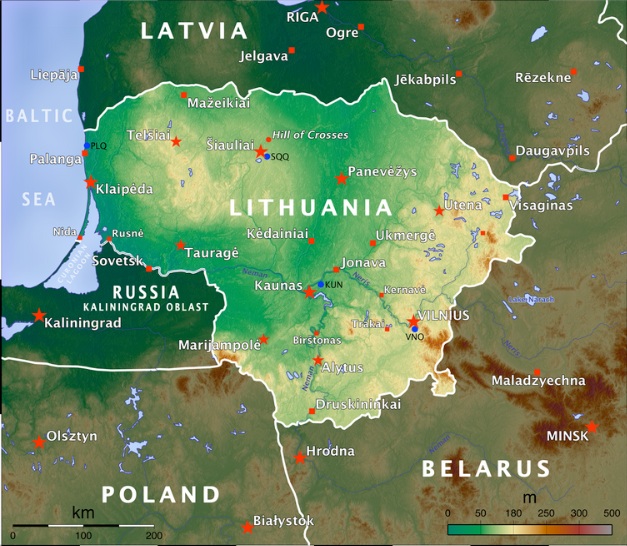
Just 3 million people, but 3 per cent GDP growth per year! Germany and France can only look on with envy. How is that even possible? The answer is: household spending is the main driver of GDP growth. Where do the Lithuanians get the money to boost domestic consumption? The answer lies in a dynamic labour market. Given the structural shortage of skilled workers, the pressure to raise wages remains at a level rarely seen in Europe. The government recently increased the minimum wage by 11 per cent, to 1,153 euros per month. According to forecasts by analysts at SEB Bank, the average gross wage in Lithuania is set to rise by 8.5 per cent in 2026 and by 7.0 per cent in 2027.
Is this single fact not enough to make us realise that a country can only flourish if it accepts or invites almost no migrants (the supposed source of skilled labour)? The migrants who place such a heavy burden on the budgets of the Old Union?
But back to the economy. Unfortunately, Lithuania’s economic upturn is currently fuelled by a ‘steroid’ of sorts: the Lithuanian authorities have allowed citizens to opt out of the second pension pillar and withdraw completely from the system. This has released a huge amount of capital. Recent data shows that, by June 2026, more than 3 billion euros (around 3 per cent of Lithuania’s GDP) had been withdrawn from the second pillar. The scale of this phenomenon has drastically exceeded initial assumptions. On the one hand, this is temporarily boosting demand; on the other, however, it is severely weakening the foundation for long-term savings. This calls into question the future financial stability of older people and also undermines the development of the domestic capital market. Despite these warnings, citizens are willingly withdrawing funds from the second pillar, ignoring inflation, which currently stands at around 6 per cent.
The fact is: Lithuania, and Vilnius in particular, is Europe’s new Silicon Valley. The country, with its capital Vilnius, has become the undisputed leader of the fintech industry in the Baltic states and is home to around 250 companies in this sector. They employ around 8,000 people and serve around 40 million customers across the continent. Lithuanian brands such as Vinted (retail) and NordVPN (cyber security) are familiar to almost everyone, and the Bank of Lithuania has provided guarantees to the British company Revolut (an international payment system).
Lithuania will not rest on its laurels. The Northway Group is building Bio-City, a huge biotech campus; the project is estimated to cost 7 billion euros. These are mainly investments that are expected to double the life sciences sector’s share of Lithuania’s GDP by 2030, reaching an impressive 5 per cent.
Lord, we implore you: may the war between Russia and Ukraine continue, for only then will our GDP rise.
Lithuania ranks first in Europe when it comes to defence spending. As is the case in Latvia, Estonia and Poland, the war economy, fuelled by Washington, is driving up the state’s expenditure. Interestingly, Russians still own 10,000 properties in the country and conduct a great deal of business there via their operations in Northern Cyprus, as they do throughout the Baltic states. The fifth column is active in the Baltic states.
Who, apart from the Russians, can strike a blow against the Baltic Tiger? The major systemic trap that everyone can see but does not know how to circumvent is demographics and the associated difficulties in finding a highly skilled workforce. Lithuanian society is ageing at an alarming rate, and the population decline is expected to accelerate dramatically in the coming years. The EU forecasts a decline of around 18 per cent in the proportion of the working-age population between 2030 and 2040. Another problem remains the widening gap between major cities and the provinces, where outdated building stock leads to energy poverty, and the healthcare system.
Future governments must therefore bear in mind that migrants are not a solution to demographic problems; rather, a balance must be struck between fiscal, social and defence policies, whilst the state simultaneously builds affordable housing for young people, for only then will they want to have children.
Notes for younger readers
[A] GDP. Gross Domestic Product: the value of all goods and services produced by a country in a year. Three per cent growth per year is high for Europe; Germany and France are usually well below that.
[B] Old EU. Here: the older EU Member States, particularly those in Western Europe, as opposed to countries that joined later, such as Lithuania (2004).
[C] Second pension pillar. In many countries, the pension system consists of several tiers. The first is the state pension scheme. The second is a compulsory or semi-compulsory savings scheme with pension funds, paid into by both employer and employee. Anyone who opts out receives the money they have saved now, but will miss out on a supplementary pension later on.
[D] Fintech. Financial technology: companies that provide banking, payment or investment services via software, often without
traditional bank branches. Vinted is a Lithuanian marketplace for second-hand clothing. NordVPN sells encrypted internet connections. Revolut is a British payment app with a banking licence; the Lithuanian central bank played a role in its European authorisation.
[E] Northern Cyprus. The northern part of Cyprus, occupied by Turkey since 1974 and recognised by virtually no country. Companies and individuals sometimes use it as a stopover for registration or financial transactions.
[F] Fifth column. An old expression referring to people within a country who, whether secretly or not, serve the interests of a foreign power. The term originates from the Spanish Civil War (1936).


