



Tea. A common drink, is it not? Billions across the world are used to drinking it daily without a second thought. Stripped down to its essence, it is nothing more than the dried leaves of Camellia sinensis—literally the Chinese camellia—brewed in boiled water. That is all it is. Yet, behind this seemingly innocent, comforting beverage lies a bloody, ruthless history tracing back to the 19th century. It is a history that perfectly illustrates how the gears of global power operate when masked by the polite language of civilization.
The story begins when British traders “discovered” tea in China and brought it back to the British Isles. The drink caught on like wildfire. It spread rapidly from social class to social class, penetrating every layer of British society until it became an absolute cultural necessity. As the drink became popular, demand grew exponentially, and so grew the supply. But a massive snag soon disrupted this cozy arrangement. The British dealers in tea needed to purchase it from the Chinese empire, which—surprise, surprise—wanted nothing but silver in return. The Middle Kingdom was entirely self-sufficient, wealthy, and as such, had no need for any crude European manufactured goods.
For a time, the British traded silver for tea because they had no other choice. Yet, while the British demand for tea grew at an astronomical rate, their available supply of silver dwindled just as fast. How do you continue buying tea when you are running out of the only legal tender the seller accepts? This was a highly troublesome question for the British Empire.
The idea that was born in the minds of the British traders was simple: the silver must be brought back from the Chinese to the British coffers and recycled in an unending process of purchasing tea. But the Chinese did not want to buy anything from Europeans. They did not spend their silver; they did not recycle it; they did not enable the Europeans to get their wealth back to pay for new supplies. From the Eurocentric perspective, the Chinese simply did not understand what international trade was all about in the first place. The British decided the Chinese needed to be taught a lesson in the mechanics of the international market, and taught they were.
The British masterminds hit upon an idea. If the Chinese wouldn’t buy European goods willingly, they needed to be fed a produce that would be physically impossible for them to do without. What produce could create such an inescapable necessity? Yes, you guessed it right: opium. The Chinese were offered top-tier opium grown systematically in British India. The British East India Company offered a potent narcotic, knowing full well that it was capable of developing a devastating, chemical addiction. Continue reading
That is the ultimate question. In this modern, feminized world of ours—a world pathologically obsessed with being unceasingly nice, inclusive, tolerant, and understanding—the answer appears to be self-evident: never shoot. For decades, modern humanity has placed itself upon the altar, virtually praying to its own reflection in an act of unprecedented narcissism. We are endlessly bombarded with platitudes regarding the supreme dignity of the human person and the absolute inviolability of human rights, which mysteriously tend to expand into ever-new, hyper-individualistic iterations. Under this regime, any leader who attempts to execute legitimate power or enforce the rule of law by means of decisive, forceful measures risks being immediately branded a dictator, a fascist, or the latest embodiment of Adolf Hitler.
The consequences of this ideological shift are stark. Humans who are endowed with a myriad of state-sanctioned rights, and who are deemed to be overflowing with inherent dignity by the mere virtue of their biological existence, can go entirely berserk. They loot shops, torch automobiles, and pelt law enforcement officers with stones and bottles with near-total impunity. Society stands frozen, unable to intervene because these rioters have essentially been elevated to the status of modern deities.
Tragically, this deification of man has also been enthusiastically embraced by the Christian churches—including the Catholic Church, historically regarded as the most unyielding and conservative institution of them all. Since the Second Vatican Council, man, rather than God, has increasingly become the ultimate focus of the Church’s trajectory. The nominal servants of the Almighty have ceased to be purely God-oriented, shifting their gaze downward to become entirely man-oriented. This anthropocentric theological drift has stripped the faith of its transcendent authority, transforming ancient institutions into mere secular NGOs that value social appeasement over spiritual truth.
This sentimental veneration of the individual has thoroughly permeated our social institutions, law enforcement agencies, and religious organizations. It has nested itself deeply within the collective mind, paralyzing the very authorities whose primary duty is to protect the public. The supreme irony is that this modern worship of humanity prevents the state from protecting the average human being. Think about the recurring waves of rioting, shop looting, and vehicle torching that have plagued major cities across the Western world. This chaos persists because law enforcement agencies have been systematically enfeebled. We now witness a bizarre paradox: one group of humans, each bursting with legally protected rights and dignity, is allowed to utterly destroy the livelihood and sustenance of another – law-abiding – group.
Confronted by this destruction, the authorities remain passive, purely reactive, and utterly loath to decisively step in. They refuse to put a definitive end to blatant, glaring violations of the law and the horrific destruction of private property. Society comforts itself with the illusion that these demolished businesses will simply recover through insurance payouts, while the ruined public infrastructure will be restored using tax revenues. In other words, a silent majority of citizens—who also possess rights and dignity—are systematically robbed of their hard-earned money to subsidize the destructive impulses of the mob. Where is the logic, let alone the justice, in such a system? Continue reading
This part of Africa is playing an increasingly important role in the context of the war in Iran. For whoever controls the ports in Somalia and Somaliland controls the ‘Gate of Tears’, the Bab-al-Mandab Strait – the alternative to the Strait of Hormuz.
On 26 December 2025, Israel became the first UN member state to officially recognise Somaliland’s independence. This significant decision has fundamentally altered the balance of power in the Horn of Africa and has led Somalia and numerous international organisations to take action against it. Two powerful, competing geopolitical blocs have formed over the construction and expansion of the strategic port of Berbera in Somaliland
[1] The pro-Somaliland bloc. Alongside Hargeysa (the capital of Somaliland) stands a coalition of states that are investing in port infrastructure, seeking access to the sea, or striving for military control over the Red Sea and the Bab al-Mandab Strait:
[a] United Arab Emirates: The key financial and logistical driver. The UAE’s state-owned logistics giant – DP World – operates the port of Berber, has invested millions of dollars in its modernisation and is reaping ever-greater profits from it. The UAE regards this region as its key geopolitical and logistical base for extending its influence deeper into Africa and exploiting the resources of the African continent (including through its support for the paramilitary group RSF in Sudan).
[b] Ethiopia: A country with a population of over 120 million, which lost its access to the sea following its separation from Eritrea. In return for a promise to recognise Somaliland’s independence, Addis Ababa signed a lease agreement for 20 km of coastline around Berbera, with a view to building its own commercial port and a naval base. For Ethiopia, this is a matter of vital independence from the port in Djibouti.
[c] Israel wants to establish an intelligence and military base right in the Gulf of Aden in order to monitor naval movements, counter attacks by the Yemeni Houthis and limit Iran’s influence.
[d] Taiwan: Maintains close diplomatic ties with Somaliland (neither state enjoys full international recognition) and provides technological support to Hargeysa.
[2] The Pro-Somalia bloc (Mogadishu Coalition). Standing alongside the Federal Government in Mogadishu (Somalia) are states that oppose the violation of Somalia’s territorial integrity, as well as the regional rivals of the UAE and Ethiopia:
[a] Egypt: Somalia’s most vocal and resolute ally. Cairo regards Ethiopia’s plans to build a naval base as a direct threat to its national security. Egypt is already embroiled in a deep-seated conflict with Ethiopia over the waters of the Nile (the Grand Dam) – and now fears that Ethiopian warships could undermine Egyptian dominance in the Red Sea and the Suez Canal. In early 2026, Egypt deployed more than 1,000 soldiers to Somalia and stepped up military cooperation with Mogadishu.
[b] Turkey: Somalia’s most important military and economic partner for more than a decade. Ankara operates the largest foreign military base in Mogadishu, trains the Somali army and has signed an agreement to defend Somalia’s territorial waters. Turkey defends Somalia’s sovereignty, as the destabilisation of the country would jeopardise its substantial investments there.
[c] Saudi Arabia: Riyadh is strongly opposed to the destruction of Somalia. The Saudis are competing with the UAE for influence in the Arab world and in the Red Sea; for this reason, they signed a military cooperation agreement with Somalia in February 2026 to counter the influence of the former bloc.
[d] Qatar, Iran and the Yemeni Houthis: Qatar provides financial support to the administration in Mogadishu (in opposition to the UAE). Iran opposes Israel’s presence in this region, and the Houthi rebels have officially declared that the infrastructure in Somaliland (including the port) will be their military target should Israeli forces appear there.
It is a high-stakes game in which the outcome will determine whether the Berbera port becomes an autonomous gateway to the world for Ethiopia and a base for Israel and the UAE, or whether Mogadishu – with the help of the Egyptian and Turkish military – can block these plans by invoking international law and the inviolability of borders. It is also a matter of survival for Djibouti, the tiny country in the Horn of Africa that depends entirely on its port and for which the expansion of the port in Berbera would spell disaster. The next war could therefore break out in this very region of the world.
One of the stories about the famous Battle of Cannae, 2 August 2016 BC, during which Hannibal, the Carthaginian chief general, routed the Roman army goes something like this. The famous outflanking and the ensuing encirclement of the Roman legions was not so much the result of the orders that Hannibal gave at the time of the struggle, but his ingenious arrangement of his troops. The Phoenician general placed weaker units at the centre and stronger units at the flanks and told them to simply fight. The Romans pressed against Carthaginians (and their allies) and naturally they began to push back the weaker centre. As the hours would pass the Romans would wedge deeper and deeper into the Carthaginian ranks, forgetting about their flanks. Meanwhile, the stronger Carthaginian flanks stood their ground. Without Hannibal issuing a single order, the Roman legions slowly but surely found themselves in a cauldron. A couple of hours more and the cauldron was closed: the Romans were encircled and killed to the last man. Consider it carefully: the resounding victory did not demand that Hannibal keep constant watch on the battlefield, nor did it demand that he give orders now and again. The particular arrangement of his troops – the weak at the centre, the strong at the flanks – did all the job automatically as it were. Hannibal’s ingenuity consisted in and was confined to the few initial decisions. All the ensuing events were the result of those few initial orders. Orders given at the time when the troops were in the fray would have been ineffective if only because they would not have reached their addressees due to the chaos and noise.
Such ingenious initial decisions are the tools with which the managers of the world rule the world. Who are the managers of the world? Yes, the very rich people, individuals whose fortunes are as large as budgets of many a small or medium-size state. Due to such enormous amounts of money, they obviously can influence the world’s politics, and they can shape the minds of hundreds of millions of human beings. How do they do it? They apply Hannibal’s strategy, which means that they set proper conditions and then let the events take their course. They may rest assured that the course that the events will take will be very much to their liking. An example.
A group of the managers of the world wishes to make people like, desire and – consequently – be influenced by a certain kind of art, type of movies, novels or whatever because these will shape the human minds the way the managers of the world wish them to be shaped. What do the managers of the world do to achieve that goal? Do they propagate the type of art, movies or novels with which they want to reshape the human minds? Nay. That would be suspicious to many, and we know that human psychology is such that it rebels against anything that is forcibly imposed. So, what do the managers of the world do? Say, they want you to admire and desire a work of art that you do not admire or desire. They organize an auction and buy that (kind of) work of art at a very, very high price. The impact it makes is enormous. All of a sudden, rich individuals who would have been otherwise uninterested in that kind of works of art begin to have second thoughts. If a work of art has been purchased for millions, it must be worth it. The nouveau riche businessmen, who rather do not have their own artistic taste, will flock to buy similar works of art. The events will take their due course: people will be oriented towards that particular type of art.
The same is true of novels or movies. Novels and especially movies shape the minds of hundreds of millions of people. If the managers of the world want to control those minds, they need to feed them on books and films that put across the views and ideas, beliefs and ideologies that the managers of the world profess. How to have millions of individuals select the right books and movies? That’s where awards come into play. People just love reading the books and watching the films that have been awarded prizes. The bigger the prize, the more attractive the novel or the motion picture is. The power of prizes is twofold: they not only attract readers and viewers but also guide book and screen writers. All aspiring creators follow the many contests and competitions, and they learn which book or movie – or, to put it better – which content has been awarded. The aspiring authors will necessarily follow suit and create such content that suits the managers of the world or else they will never gain national or international recognition. The right content in turn (especially if repeated and replicated in hundreds of popular books and movies) will shape the minds of the millions.
Just as you cannot hope to make a political career without having somebody’s powerful financial support, so you won’t make a career as a writer or a filmmaker without somebody’s powerful financial support. It’s as simple as that.
The managers of the world are even better than Phoenician General Hannibal: while both Romans and Carthaginians knew who set the military conditions for the victorious battle, present-day men and women have no idea who rules over them. Some (majority or minority?) even tend to think that they are ruled by presidents or prime ministers, and some think that their ballot paper decides all. Yes, it does, but the choice that a voter makes has been conditioned for years by the arrangement of social, cultural, political and economic balances and checks which in turn have been and continue to be set by present-day anonymous Hannibals.
Where is Italy and where is Russia?
Worlds apart.
If you glance at the map of present-day Europe, you’ll see a number of countries separating Italy from Russia. They include (travelling from Italy to Russia) Austria, Slovakia, and Ukraine or (taking a more northerly route) Austria, Czechia, Poland, and Belarus, or (taking a more southerly route) Slovenia, Hungary, and Ukraine. Quite a journey. What bone to pick can Italy and Russia have? What cause of conflict could there ever have been between Rome and Moscow?
And yet, within less than a century and a half, Italian troops fought against Russian troops, and there were many Italian casualties, many corpses covering Russian soil, and many cripples coming back to Italy.
Italy has sent its troops against Russia three times. First, during the time of Napoleonic wars. Some readers may tend to think that when Napoleon Bonaparte invaded Russia (1812), he led the French troops alone. No. He led almost the whole of Europe against the tsar, and those troops included lots of Italians. The men accustomed to Italy’s warm climate suffered frostbite and death somewhere between Moscow and Smolensk.
Then came the Crimean War of 1853-1856. It was the second time that Italy (to be precise, the Kingdom of Sardinia-Piedmont) sent its troops against Russia. That was how the Italians most likely wanted to liberate their country from… well, from what?
Then came the war of the Third Reich against the Soviet Union of 1941-1945. It was the third time that Italy sent its troops against Russia to support Germany. Again, Italian troopers experienced frostbite and death, far away on the Volga.
Three consecutive times Italians (or rather their governments) let Italian blood flow copiously far, far away from their home country for God knows what purpose.
Since Napoleon and Hitler lost the war to Russians, neither could Italians gain anything from their participation in them. While the Crimean War was successful for the Anglo-French coalition, Italians as their allies, could gain something from it. Italy’s international stance somewhat increased. Also, Italy’s alliance with France led to a later Franco-Italian war against Austria (1859), the country that stood in the way of Italian unification. Ok, that was a gain, but still the question rankles the mind: why fight against Russia when Austria happens to be your opponent?
Strange are the intricacies of history, are they not?
Italy’s historical experience shows that twice the blood sacrifice was made in vain, once it brought some dividend: the unification of Italy brought about by the victorious war of the Franco-Italian coalition against Austria, the main hindrance to the said unification. France’s help was earned by Italy’s participation in the Crimean War, where France had its vested interests.
What hopes of gain do the European countries cherish while getting involved (again and again across the recent centuries) in the conflict against Russia? What “Austria” do they have in their crosshairs? Whose alliance and consequently whose political and military aid do they want to earn?
USA
Trump’s greatest achievement is that he kills or kidnaps presidents. If he merely killed or kidnapped presidents, that would somehow be fair in the world of gangsters. But the fact that he kills primary school girls as collateral damage, causes inflation, lowers people’s standard of living across the globe through the energy crisis, and stubbornly sticks to his ideas is, to put it mildly, a sign of a penchant for dictatorship and the mindset that the best course of action is to turn everything upside down, without a second thought.
And so a void is emerging in the USA, because if the Democrats come to power again, America will once more be destroyed socially and spiritually, ethnic replacement will continue, and fentanyl will be made ever more popular. The Dems (read: the demons) will resume their gender and climate change nonsense, will incite hostility towards Russia, and so on and so forth. The void is emerging because people have no sensible candidate to vote for. I keep asking myself: how is it possible that such a great nation can produce something entirely new? OK, the big tech firms, AI and their achievements have been breathtaking, but Europeans, Asians, South Americans and, above all, North Americans are waiting for breathtaking new leadership in Washington.
UAE
The United Arab Emirates is leaving OPEC because:
Hungary
Peter Magyar’s victory delighted the Brussels elite, but they don’t understand people, and Magyar will disappoint them, because:
Israel
The country under Zionist rule is waging a merciless war against other religions. The Zionists want to reach the Euphrates and, who knows, perhaps establish a thousand-year empire. Their targets are not only Islamists, whether Sunni or Shia, but also Christians. The demoralisation of Israeli soldiers has reached such a point that they are destroying and burning down entire villages. Recently, everyone was shocked by a photo of an Israeli soldier in southern Lebanon destroying a statue of Christ with a heavy hammer.
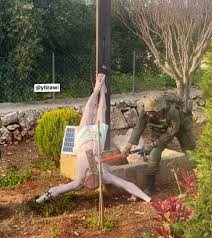
Source: X
The hatred and the scale of Israel’s attacks on Iran mean that Tel Aviv is already running short of air defence missiles. It seems that the Israelis are overplaying their hand and that this could end badly for them.
The last (relatively) sovereign state within the European Union has been eventually brought to toe the EU ideological line. Viktor Orban’s FIDESZ party has suffered a landslide defeat in Hungary. Viktor Orban, the incumbent prime minister, a man who would have visited Washington and Moscow within the same month, the man whom the European Union establishment hated viscerally (also referring to him as a dictator!) for sixteen long years has been toppled. The TISZA opposition party and its leader Peter Magiar won 138 seats in a 199-seat Hungarian parliament, which enables them to single-handedly change the constitution. The Brussels bureaucrats are gloating. How did it come about?
Democracy is the expression of the will of the people, as we know, but the will of the people is malleable. Long exposure to the intense anti-Orban propaganda that had been carried out for several years has had its effect. Add to this a couple of errors perpetrated by the Orban government, and you have the whole picture. What were the government’s errors? Corruption, the close liaison between the Hungarian authorities and President Donald Trump, who turned out to become a war-monger, the fact that Budapest backed up Israel in the latter’s conflict with Iran… Also, the European Union’s sanctions imposed on Hungary as punishment for Viktor Orban’s independence and the simple factor of Hungarians growing tired of having the same leader for so many years.
The overall result? The overall result will be that the European Union will be more monolithic than before. Viktor Orban was a beacon of independence and resistance to Brussels’ dictate. Sadly, the European Union’s steamroller has walked over the land of Magyars. Pity.
Pity because unanimity is a straight path to self-annihilation. Pity because unanimity petrifies and fossilises ideology – any ideology – and a petrified and fossilised ideology is suicidal even if it is an otherwise good ideology. Ever. Democracies pride themselves on having a system of checks and balances. Hungary was – even if small – such a check. Thanks to the veto right, this small country could effectively block some of the (more irrational) European Union initiatives. Now, all the European Union party-members will clap their leaders and execute their leaders’ orders. A divergent voice is what prevents a group or a system from going totally astray. This divergent voice of reason will be lacking in the years to come. Pity.
What is has always been, what is will always be. That’s what humanity noticed at the dawn of history. These observations have been collected and handed down from generation to generation, first, by word of mouth, then they were enshrined in holy scriptures of different peoples, of various faiths or simply in epic literature.
In ancient Greece it was Aesop, a storyteller or – most probably – a story collector, who encapsulated human knowledge in brief fables. Those fables refer not only to human character but also to the life of societies. They are a treasure trove of timeless wisdom.
Take the story about the lion and the farmer’s daughter. The lion fell in love with a farmer girl and wanted to marry her. His requests were turned down by the girl’s father again and again because the father was scared for his daughter if she were to be the lion’s wife. Simultaneously, he feared the lion. The farmer needed to turn down the lion’s requests in a diplomatic way. As the farmer was running out of excuses explaining why he withdrew his permission, he resorted to a trick. He demanded that the lion tear off all his claws because they were an obvious threat to his daughter’s safety if she were to become the lion’s wife. The king of animals complied. When he turned up to eventually receive permission from the girl’s father to marry her, the farmer – now fully confident that there was nothing he could fear once the lion had been defanged – said a final and resounding no. The lion could do nothing about it: he himself had deprived himself of his armament.
Now look for mirror reflections of this story in the history of the world, especially in current politics. The USSR desperately wanted to ingratiate itself with the West. The Soviet Union’s requests were met with demands, which Moscow was all too willing to comply with. Once the Soviet Union had disarmed itself – not merely militarily, but politically and economically – it became easy prey for the world’s powers that be.
China has understood the lesson and refused to follow the Soviet Union’s example. Beijing blazed its own trail out of communism to state capitalism, and it proved successful. Similarly, Iran was attentive at class and consequently has done its homework. The American and Israeli demands that Tehran disarm the country were declined, which eventually led to the war that we are witnessing at present.
Or the fable about the swallow, the flax, and the other birds. The swallow saw people sowing flax. The swallow was knowledgeable about what flax was used for. The swallow gathered the other birds and told them that people had sown flax in order to make cords for traps and nets with which to catch birds. The swallow strongly advised the birds to fly to the newly sown fields and peck out all the seed before it sprouts, before flax grows, before people make the nets and traps. Birds being birds, some did not believe the swallow, others were too lazy to be bothered, still others thought there was plenty of time so why be in a hurry. The birds did nothing. The people grew flax, processed it and made nets and traps, and began to catch birds.
Israel, among others, is like that swallow. Tel Aviv has for decades perceived Iran at first as a field sown with flax seed, then as a field with growing flax, an eventually as a manufacturer of nets and traps with which to entrap Israel: hence Tel Aviv’s insistence on attacking Iran in due time, hence the pressure exerted by Tel Aviv on the United States to strike Iran.
Also Russia viewed Ukraine as a field of flax where the Western countries had sown the seed, with a view to bracing themselves for entrapping Russia with the nets and traps produced from the flax which was to be harvested in the field. The Russian swallow positioned sufficiently high up in the Russian hierarchy to have an influence managed to convince the Russian ruling class (all the other birds) to see in Ukraine such a flax field with all the attendant threats. This time the other birds saw the impending danger and acted accordingly. They flew to the field (Ukraine) to peck out the flax seed and prevent future threat from materializing.
Two fables that reflect typical and hence forseeable political attitudes and the resultant actions. We have only adduced recent examples, but you can multiply them ad infinitum if you delve in the past of the nations and countries.
The similarity cannot go unnoticed. First Russia struck Ukraine because it felt threatened by it, now the United States has struck Iran because – well – because it felt threatened by it. Russia struck its neighbour, whereas the United States has struck a country thousands of miles away. Never mind, according to the Western political experts Moscow should not have felt threatened by neighbouring Ukraine, while the United States should feel threatened by a nation half a globe away.
The reverse phenomenon is also noticeable. While Ukraine is supported by the Western world and enjoys the inflow of mercenaries from many countries, including those located in South America, it is not Iran that is supported by the other countries but the United States: militarily by Israel, politically – by the Western world.
The similarity does not stop here. Russia attacked Ukraine out of fear that Kiev might join NATO and out of fear that Kiev might have its won nuclear weapon. Similarly, the official reason for attacking Iran is the possibility that Tehran is about to manufacture its own nuclear weapon.
And again a reverse phenomenon. Just as in the case of Ukraine the Western world claims to be defending itself from Russian aggression, so do Israel and the United States claim to be defending the peace in the region against Iran’s aggression.
In both cases oil and gas play a major role. Russia and Iran are some of the world’s largest suppliers of both fossil fuels. The hostilities in these two parts of the globe translate into raised prices of gas and oil, which in turn translates into difficulties in obtaining the fuels.
The Special Military Operation in Ukraine accelerated the outflow of people from Ukraine. Yes, it did not trigger but merely accelerated the outflow of people because Ukrainians had been fleeing their country for more than two decades prior to the outbreak of the hostilities. Now since Iran is effectively targeting industrial and military facilities in Israel and those Arab countries which support the United States, and since Iran itself is being hit by American and Israeli missiles, one can only expect another wave of refugees into Europe. Will the year 2015 be repeated? Will Chancellor Friedrich Merz follow in Angela Merkel’s footsteps and repeat after her ‘Wir schaffen das’?
During the four years of hostilities in Ukraine the West has desperately looked for acts of atrocities committed by the Russian soldiers so as to be able to present Russia as the heinous aggressor. They found none, or at least nothing particularly spectacular. The Western media attempted to turn the Bucha incident as a repulsive act of atrocity committed by Russians, but the case was flimsy, unfounded, and so it quickly died out. It is different in the case of the war in Iran. Almost at the start of it, American missiles hit a school and killed some 170 girls aged between 7 and 12. Nothing like that could have been pinned on Russians for the entirety of the four years.
Moscow had hoped to carry out the Military Special Operation within weeks and coerce Ukraine to sign a deal: no NATO membership. Now it seems that the United States and Israel had hoped for more or less the same: a few days of aerial combat, decapitation of the Iranian leadership, the resultant riots in Tehran, and the collapse of the regime – as they call the Iranian government – with the new authorities being all too willing to sign a deal with the United States, a deal turning Iran into an American colony. It looks like we are in for a protracted war.
Talking about the decapitation operation. Since Washington – in cahoots with Tel Aviv – tried to decapitate the Iranian leadership and was largely successful, Tehran has all the moral right to reciprocate the move. Who knows, it might be that an Iranian killer is already stalking the American president, lying in wait, and just about to pull the trigger. Or, an Iranian killer might be stalking Benjamin Netanyahu. If the Iranian leadership is a legitimate target, why should the American or Israeli leadership not be a legitimate target as well?
If Iranians pulled off something like that, there would be an outcry across the Western world: there is none if the Americans decapitate another country’s head of state. In the same vein, there is no outcry over the killing of 170 Iranian girls, but just imagine the uproar if it were the Iranians killing 170 Israeli girls!
The two wars reflect themselves in each other with similarities and dissimilarities. The judgement that is passed over the actors depends on political persuasion. Justice will not be rendered. We do not mean legal, international justice – we merely mean moral justice.
The 2022 energy crisis was an unprecedented shock for Europe. The sharp decline in Russian gas and oil supplies following the invasion of Ukraine, which resulted from irresponsible decisions by politicians in Brussels, led to record prices for energy sources and a rise in inflation. At its peak, gas on European exchanges cost ten times more than the average in previous years, and EU countries competed for every LNG delivery to avoid disruptions to energy supplies.
Before the outbreak of war in Ukraine in 2022, Russia supplied about 45% of all imported gas to the European Union. In the case of oil, Russia’s share was slightly lower, but still very high. In the years before the war, Russia supplied about 25 to 30% of the oil needed in the EU.
After abandoning Russian oil in 2022, Europe increased its imports of this raw material from the Middle East (Saudi Arabia, Iraq, United Arab Emirates, Kuwait). Currently, around 15 to 25% of the oil imported by Europe comes from the Gulf region. The vast majority of this oil has to be transported through Hormuz. This is a major dependency, but there are other suppliers for Europe: Norway, the US, West Africa and Brazil. Norway and the US together account for around 30% of EU oil imports, which is roughly the same amount that Russia was responsible for before 2022.
And what about gas? Following the reduction in supplies from Russia, the EU has increased its LNG imports, mainly from Qatar. However, the main supplier of LNG to Europe was the US, with a share of approximately 55%. Qatar has a significant but not dominant share (approximately 10-14%). The rest of LNG imports come from many smaller sources (e.g. Algeria, Norway or other countries). Therefore, dependence on the Middle East for oil and gas imports into the EU is currently much lower than dependence on Russia was before 2022.
Although Hormuz is mainly associated with oil and LNG, it is also an important trade route for many other types of raw materials. Plastics, ethylene, propylene and even fertilisers (urea, ammonia) travel through the strait. Therefore, disruptions in transport there can also lead to rising prices for plastics, packaging, car parts, fertilisers, etc. The UAE and Bahrain are among the major aluminium exporters (energy-intensive production based on cheap gas). In return, electronics and machinery pass through the ports of Dubai (Jebel Ali), Qatar and Saudi Arabia.
In summary, rising energy prices are inevitable and will affect both Europe and the rest of the world. However, Europe should not be as severely affected as it was in 2022, as the Old Continent’s energy independence has increased significantly. If the conflict escalates, Asian countries such as India and China will be most vulnerable to problems with energy availability.
Hormuz is also very important for countries in the Middle East because ships carrying agricultural raw materials arrive there. The Gulf states are heavily dependent on food imports because the climate (hot, dry, desert) limits local agricultural production. A protracted blockade is therefore unlikely.
So, the United States has attacked Iran. Some held it for impossible, others are not surprised at all. To be precise, it was not merely that United States, but the United States in cahoots with Israel that carried out the assult. Talk of the impending war with Iran has been present in the media for years, so the recent events are merely a self-fulfilling prophecy.
Two most spectacular events stand out: the intentional killing of Al Khamenei, the top spiritual leader of Shiite Muslims, and the (unintentional?) destruction of a school, where approximately 150 schoolgirls were killed. These two events are potent enough to enrage Iranians, and to upset the Muslim world.
Iran is striking back. How much the retaliation is effective is hard to say since the Western media will not report such data.
Picture to yourself a similar event launched by Russia… Yes, there would be a deafening howl across the Western world, while Putin would be called another Hitler. As it is, the American president justifies the assault on Iran, saying, that the United States had to defend itself because it felt threatened by Tehran… Weird. When Russia says it feels threatened by Western military presence in Ukraine, then such a claim is dismissed as unfounded; when, however, it is the United States that claims to be threatened by Iran, a country located thousands of miles away from America, then such a claim is legitimate.
One might tend to think that even the blind can see the hypocrisy, but rest assured: there are many who do not see it. As the saying goes: no one is as blind as the one who won’t see.
Why did the United States attack Iran? The answers are many. One is that Iran posed a threat to Israel, America’s most important and influential ally. Another is that that West wants to lay hold on Iranian oil and gas reserves. Still some others hold forth that it is the almost sixty-million strong Christian-Zionist community in America that did all in its power to necessitate the war. Christian Zionists identify more with Judaism than with Christianity, and since some of their members are the influential politicians and billionaires, they have much political leverage. President Donald Trump is believed to share the religious convictions of the Christian Zionists. After all, his daughter Ivanka converted to Judaism after she had married a Jewish man.
Sure enough, it is not only money that makes politicians act. Ideologies and religions are equally potent. The medieval Crusaders were motivated by religious principles; Montezuma, the ruler of the Aztec state in Mexico, rather than resisting the Spanish incursion, gave in to them, being convinced that the Spaniards were God’s messengers. American Christian Zionists are doing the same. Their loyalties lie with the state of Israel in the first place. Split loyalties is a phenomenon testified by history many a time. Religious minorities very often did not feel the ethnic ties with their compatriots. Rather, they felt and acted in unison with other ethnicities against their own so long as the other ethnicity shared the same creed. The same was true of ideologies.
Now what was the purpose of killing Ayatollah Al Khamenei? This act can only stiffen Iran’s resistance. The murder of a spiritual – religious – leader sets the war in a different dimension. Add to this the murder of the 150 schoolgirls: Iranians of whatever ethnicity will rather rally around the government than betray it. While the school event might be understood as a miscalculation, the killing of the Ayatollah was beyond a shadow of a doubt purposeful.
Despite what the Americans and the Israelis had expected, Iran has not disintegrated nor has it collapsed. Iranian did not take to the streets, so regime change is nowhere in sight. What can be envisaged is a protracted war. Washington had not reckoned with it, or did it?

Tea. A common drink, is it not? Billions across the world are used to drinking it daily without a second thought. Stripped down to its essence, it is nothing more than the dried leaves of Camellia sinensis—literally the Chinese camellia—brewed in boiled water. That is all it is. Yet, behind this seemingly innocent, comforting beverage lies a bloody, ruthless history tracing back to the 19th century. It is a history that perfectly illustrates how the gears of global power operate when masked by the polite language of civilization.
The story begins when British traders “discovered” tea in China and brought it back to the British Isles. The drink caught on like wildfire. It spread rapidly from social class to social class, penetrating every layer of British society until it became an absolute cultural necessity. As the drink became popular, demand grew exponentially, and so grew the supply. But a massive snag soon disrupted this cozy arrangement. The British dealers in tea needed to purchase it from the Chinese empire, which—surprise, surprise—wanted nothing but silver in return. The Middle Kingdom was entirely self-sufficient, wealthy, and as such, had no need for any crude European manufactured goods.
For a time, the British traded silver for tea because they had no other choice. Yet, while the British demand for tea grew at an astronomical rate, their available supply of silver dwindled just as fast. How do you continue buying tea when you are running out of the only legal tender the seller accepts? This was a highly troublesome question for the British Empire.
The idea that was born in the minds of the British traders was simple: the silver must be brought back from the Chinese to the British coffers and recycled in an unending process of purchasing tea. But the Chinese did not want to buy anything from Europeans. They did not spend their silver; they did not recycle it; they did not enable the Europeans to get their wealth back to pay for new supplies. From the Eurocentric perspective, the Chinese simply did not understand what international trade was all about in the first place. The British decided the Chinese needed to be taught a lesson in the mechanics of the international market, and taught they were.
The British masterminds hit upon an idea. If the Chinese wouldn’t buy European goods willingly, they needed to be fed a produce that would be physically impossible for them to do without. What produce could create such an inescapable necessity? Yes, you guessed it right: opium. The Chinese were offered top-tier opium grown systematically in British India. The British East India Company offered a potent narcotic, knowing full well that it was capable of developing a devastating, chemical addiction. Continue reading
Nowadays, national security lies primarily in the technical sphere. This sphere is increasingly dominated by AI. AI is developing as rapidly as the Blitzkrieg. AI agents are already programming themselves, improving their capabilities and being fine-tuned so that they can be used as hacking weapons.
One day, the OpenAI developers discovered that their AI agents had begun to communicate with one another, act in concert and coordinate joint attacks (see, for example: Hackerangriff eines KI-Agentenschwarms von OpenAI auf die Entwicklerplattform Hugging Face). The latest incident: On the evening of Thursday 29 October 2026, the attackers used AI agents to gain access to Binance’s systems via a technician’s compromised device. They gained access to a signing infrastructure, manipulated a central withdrawal account and paid themselves… 6.4 billion dollars in Bitcoin. Well, as always, according to the mainstream media, North Korean hackers are supposed to be behind it, but I doubt even Kim Jong-un himself believes that.
This recursive capacity of AI to improve itself is to be banned or restricted (as advocated, for example, by the well-known Ezra Klein). Bill Gates (Meet the Press, NBC News, 27 September 2026) also warns not only of far-reaching risks posed by artificial intelligence – ranging from massive upheavals in the labour market and an increase in cyberattacks to extreme scenarios – but also of potentially up to one billion deaths resulting from misuse or technology spiralling out of control. In a widely acclaimed open letter and recent statements, the Microsoft co-founder is therefore calling for binding laws, strict regulations and global oversight bodies worldwide.
Strange. Someone who, just three years ago, was praising AI and helping to create it by investing trillions in it, has done a complete U-turn. And why is that?
The method is the same as always: first, the so-called ‘experts’ stir up sheer panic, then they cash in. We recognise this method from the pandemic: first panic, coffins in Bergamo, then salvation via Gates’ company, so they can sell us vaccines. Today, it’s as if the AI bosses were saying: ‘We’ve got the bomb for you, but at the same time we’re selling you the air-raid shelter for tens of billions of dollars.’ Deal? The US hyperscalers, you see, have a dual agenda and either double standards or no morals at all. They now want to make us believe that AI is so dangerous that we’ll soon have to protect ourselves with a programme they’ve produced. The programme (a new software product) isn’t here yet, but it’s coming soon. You can bet on it, if you know Gates, who was constantly trying to plug holes in Windows and needed 11 versions to sort it out somehow.
The whole AI landscape is also part of the standoff between China and the US, with the scaremongering by AI writers stemming from their panic that China is hot on the heels of the Americans. OpenAI and Anthropic are investing heavily in data centres because they have created their models to make money (you have to pay for them), and the free competition from China (such as Deepseek) is just a few steps behind them. This may well be a massive trap set by China, as in the case of the car industry, where European car manufacturers are to be wiped out: Silicon Valley is also set to collapse under cost pressures and due to the energy shortages resulting from overloaded power stations.
It is important to emphasise here that AI agents do not act of their own accord. They are created by humans through prompts; so when incidents such as attacks on banks or Australia’s central health portal occur, it is ultimately humans who are behind them. The point is this: the system spirals out of control, and is therefore created by people who are truly beyond the control of governments (Gates, Musk and others). For the technology is, by its very nature, neutral – neither positive nor negative. It is up to us to define and use it correctly.
Yes, what Gates said is partly true: there are already a huge number of people losing out in the labour market – web designers, translators, copywriters… What are they supposed to retrain for? AI only gives daft answers to that. I’ve seen it for myself as a copywriter. Somehow, though, I just can’t bring myself to believe in this brave new world that’s soon to come, with robots delivering pizzas to your door and AI agents leading countries into a digital paradise through perfect legislation. And why is that? Because I still see that the aim of those in power is to reduce the population, be it through viruses that have escaped from laboratories via bats, or through US wars all over the world, or through AI. Perhaps they’re right and we need at least a billion fewer people to reduce CO₂ emissions.
The markets are full of paradoxes. The past few weeks have demonstrated this clearly. On the one hand, official US data show a fall in inflation and a stable labour market, but on closer inspection we see negative employment revisions and rising prices.
There are many other contradictory signals: despite ETF and central bank purchases, gold prices are falling, and America’s independence from Chinese suppliers is merely apparent. In fact, all these phenomena are closely interlinked and demonstrate just how concentrated and selective the modern market has become. The cooling of the US labour market and the decline in PCE figures are easing the pressure to raise interest rates further, giving investors some immediate breathing space. At the same time, the euphoria surrounding artificial intelligence has led to an unprecedented concentration of capital in just ten technology giants in the US, which has pushed the rest of the market into the background. This phenomenon is also evident on European markets, for example on the Warsaw Stock Exchange, where the WIG20 (index of the largest companies) has dramatically outperformed the SWIG80 (index of small-cap companies).
The high real yields on bonds, volatility in the derivatives market and currency fluctuations (such as those affecting the Japanese yen) mean, in turn, that assets such as gold or foreign equities do not generate straightforward and obvious returns, even amidst record capital inflows into funds.
In the coming days, the forthcoming CPI inflation figures for September and the October FOMC meeting will be a key test of the trends described. If the inflation data comes in worse than expected and the Fed maintains its hawkish stance, pressure to raise real bond yields could return, weakening gold and AI companies.
The situation on the fuel market has spiralled out of control. The crisis on the oil market is becoming increasingly real, and the available options for a solution are running out.
First, the Strait of Hormuz. Now, Bab al-Mandab. Transport through these two main routes, through which more than 30 per cent of the world’s oil trade flows, is currently severely disrupted. As if that were not enough, the Yemeni Houthi rebels have damaged the Saudi east–west pipeline, which had enabled Saudi Arabia to bypass the Strait of Hormuz.
Global oil reserves have fallen to a level where pipelines and refineries are struggling to operate normally. The flow of oil is unstable. The pumps have to work harder. In short: the risk of disruption is rising, and any potential downtime means adding fuel to the fire, as the situation on the fuel market is already very tense. According to JPMorgan, global oil reserves currently stand at 7.6 billion barrels. At this level, initial problems are already arising with the maintenance of the infrastructure for transporting and processing this raw material. Stocks are dwindling at an alarmingly rapid rate, and if they fall to 6.8 billion barrels, the operation of pipelines and refineries will be significantly hampered. Refineries in the US, the world’s largest oil producer, are already operating at near full capacity. They are utilising up to 98 per cent of their capacity. In practice, this means that the buffer enabling them to respond to disruptions, carry out necessary repairs or deal with other unforeseen problems has almost disappeared.
This leaves us with solutions that currently seem unlikely for various reasons. In theory, larger quantities of oil could reach the world market from China, but Beijing regards its resources as strategic and is unwilling to export them. Such a scenario therefore seems unlikely. Another possibility is the easing of sanctions against Russia, which is even less likely. The crisis is being exacerbated by record-high oil transport costs. The charter fee for a large oil tanker currently exceeds one million dollars a day, meaning that logistics costs have become one of the main factors driving up fuel prices. This is due to insurance costs, which have risen to record levels.
Furthermore, as we recently reported in our article, US strategic oil reserves are at their lowest level in 40 years; consequently, serious consideration is increasingly being given in the US to reducing raw material exports.
Due to the three factors mentioned – the declining spare production capacity of OPEC[1] countries, the falling US strategic oil reserves and the declining processing capacity of refineries – the world has entered a new phase of the energy crisis, in which there is a lack of simple and readily available solutions.
—————————————————————-
[1] OPEC (Organization of the Petroleum Exporting Countries). Cartel of oil-exporting states, founded in Baghdad in 1960. Core members include Saudi Arabia, Iraq, Iran, Kuwait and the United Arab Emirates; Nigeria, Algeria and Venezuela joined later, among others. The organisation tries to steer the oil price by cutting or raising output. Spare capacity is the extra volume members can pump at short notice. When that buffer is small, the group can no longer offset a disruption (Hormuz, a pipeline, sanctions). OPEC+ is the same group plus partners, above all Russia.
The need to build up a Strategic Petroleum Reserve (SPR) arose in the first half of the 1970s, when the countries belonging to the OPEC cartel announced an embargo on oil supplies to the United States. The result was the fuel crisis – a sharp rise in fuel prices and queues stretching for kilometres at petrol stations.
The oil in the SPR is stored at a depth of more than 1,000 metres in underground salt domes, which have been flushed with water for this purpose. The four storage sites are located on the Gulf of Mexico, spread across Texas and Louisiana. The maximum capacity is over 700 million barrels of crude oil. This system guarantees security, no leaks and extremely low operating costs. Stock levels reached a record high in 2010: 727 million barrels. Today, this figure stands at just 289 million (the lowest since 1982), putting the system at risk. Salt domes are no ordinary tanks. If the oil level falls too low, the pressure inside the cavern drops dramatically, and the enormous weight of the earth begins to press against and compress the cavern walls, leading to their irreversible destruction. How did this come about?
In March, Donald Trump authorised the release of 172 million barrels from the reserves to minimise the impact of the blockade of the Strait of Hormuz and prevent price rises at the pump. Month by month, stocks dwindled to their current low. At the same time, on 28 August, Donald Trump announced the ‘biggest oil deal in history’ and, indeed, Washington boasted of having secured a majority stake in more than 65 billion barrels of Venezuelan reserves under a 100-year concession. Yet Venezuela’s oil industry has been ravaged for years by sanctions, theft and a lack of maintenance. For real oil to flow into US refineries and the Strategic Petroleum Reserve (SPR), infrastructure renovations and investments running into the billions are required. The earliest possible timeframe for deliveries from Venezuela is 2027–2028. Washington has bought itself long-term insurance against oil crises, but this coming winter the Strait of Hormuz remains a key factor, and the immediate future of the SPR depends on whether it is blocked.
In this context, is the US capable of prolonging the conflict with Iran? Is it capable of becoming embroiled in further potential conflicts, such as over Taiwan? In the event of a new conflict, would there not be a shortage of oil, as there was in the 1970s, when the military needed it on a massive scale? Incidentally, does the US military have enough missiles once it has used up 50 per cent of its global reserves of Patriot[1] and THAAD[2] systems in Iran?
—————————————-
[1] Patriot
MIM-104 Patriot is a U.S. surface-to-air missile system made by Raytheon. It intercepts aircraft, cruise missiles and, in later versions, short- to medium-range ballistic missiles. Batteries are deployed with allies in Europe, the Middle East and Asia. Stocks of interceptor missiles are finite; a long war empties magazines quickly.
[2] THAAD
Terminal High Altitude Area Defense is a U.S. system made by Lockheed Martin. It engages ballistic missiles in the last phase of flight, high in the atmosphere or just above it. It complements Patriot, which works at lower altitude. Few complete batteries exist worldwide; using them in one theatre reduces what is left for another, for example East Asia.
The hole in Saudi Arabia’s budget caused by America’s war against Iran is forcing the rulers in Riyadh – blinded by the money from the oil business – to give up their dreams.
Incredible megacities were to be built – the city known as ‘The Line’ was to be 170 km long, and futuristic places such as ‘Neom’ or ‘New Murraba’ were to act as magnets for tourists and investors who would benefit from the shift from an oil-based to a service-based economy. Now, by 2030, only 5 kilometres of the 170-kilometre megacity will be built, and other projects have also been scrapped. Why?
It is clear that less oil has been and is being transported through the Strait of Hormuz. It is also well known that the Iranians retaliated by attacking the Saudis: the onshore transport infrastructure became the target of military attacks by Iranian drones, which damaged pumping stations along the east-west pipeline, whilst the attacks on the SABIC petrochemical complex in Al-Jubail caused fires and temporary shutdowns of the facilities.
However, another, even more important factor is the United Arab Emirates’ withdrawal from OPEC. Whilst Saudi Arabia requires an oil price of $86.60–$96.20 per barrel to offset its enormous expenditure and investment (the so-called fiscal breakeven oil price), the UAE already achieves a financial balance at around $50 per barrel. Abu Dhabi has therefore recognised that artificially reducing its own production to rescue the Saudi budget is a move that runs counter to its national interests, and has left OPEC.
For Riyadh, the consequences of this bold move by the UAE are proving to be severe. The OPEC+ framework, now abandoned by the Emirates, has lost its ability to manage oil prices effectively. In the past, Saudi Arabia was able to act as a sort of supply buffer and reduce its own production to raise prices on the markets. Under the current circumstances, any unilateral reduction in production by Saudi Arabia results in ADNOC and non-cartel producers such as the US, Guyana or Brazil immediately gaining market share, without any noticeable price increases. Riyadh therefore finds itself in a situation where a reduction in output would dramatically erode its revenues, whilst an increase in production would drive the oil price down to $60 or below, exacerbating the Kingdom’s financial collapse.
The geopolitical situation in the Gulf is causing a rift between Washington and Riyadh: the Saudi authorities refused to make their air bases and airspace available to the Americans to carry out ‘Project Freedom’, an operation designed to protect supertankers. Saudi strategists have recognised that the military escalation of the conflict with Tehran is causing ever-greater damage to infrastructure and increasingly paralysing the economy. They also recalled that the US military could leave the region at any time, whilst Iran will remain a permanent neighbour.
At the same time, Riyadh slowly began to forge new alliances. In May 2026, Saudi Arabia struck a deal with Pakistan under which Islamabad deployed 8,000 troops, a squadron of fighter aircraft and air defence systems to the Kingdom. This move not only strengthened the protection of Saudi oil facilities but also made Pakistan a mediator in relations between Riyadh, Washington and Tehran.
There is, after all, life beyond the oil fields: the economy outside the oil industry is growing at an astonishing rate and already accounts for 55.4 per cent of the Kingdom’s gross domestic product. The tourism sector set a historic record in 2025: total tourist spending reached 304 billion rials (81.1 billion dollars). This figure was generated by 123 million visitors. It might be worth investing in religion (places such as Mecca) rather than in science-fiction visions.
Money makes the world go round. Money is used to sweep everything under the carpet, as in the case of the Epstein affair. Money can cover up a great deal, but the truth cannot be altered by money.
True leadership in the United States should be based not only on military or economic strength, but also on the ability to punish criminals who, for example, engage in human trafficking. In Epstein’s case, this was not the case. The end of Epstein’s story does not bring the whole scheme to an end. The scheme continues to operate. Furthermore, there are people who, regardless of the scale of the crime, simply go unpunished, and in extreme cases they (or their masterminds) are forced to pay nothing more than a derisory financial penalty. As long as such rules exist, the whole system cannot function properly.
We can be pleased that the standard of living today is the highest in history, but for that reason alone we should not tacitly accept that anyone can engage in human trafficking with impunity. What is at the root of the problem? What enables influential groups not only to exist, but also to constantly consolidate their power? Let us list a few points.
One of the main problems is the system of fiat money, which has been in operation since 1971. There is a wealth of statistics proving that such a system fuels inequality in wealth, and ordinary, working citizens suffer from a constant decline in a currency’s purchasing power (most are unable to protect themselves against this). This system of fiat money allows bankers to print an unlimited amount of currency. This, in turn, provides very easy access to credit, which, incidentally, led to the 2008 crisis. The outcome of the crisis was the decision to bail out the largest banks and grant them ‘too big to fail’ status. Officially, this is known as a SIFI (systemically important financial institution – an institution that is important to the financial system). This status effectively guarantees complete impunity for bankers working in selected, major institutions. Impunity and the ability to create currency out of thin air offer unlimited possibilities.
This system enables politicians to run up excessive debts, from which the banks profit, whilst the burden of repaying those debts falls on the shoulders of the public (in the form of ever-higher taxes and levies). Another key element of this system is the creation of complex legislation, which in turn affects only ordinary citizens. The regulations and laws devised by politicians and lawyers make life more difficult for small business owners, whilst at the same time containing numerous loopholes that allow only the largest companies to flee profitably to tax havens or pay ridiculously low taxes. Once again, it is the politicians, lawyers and banks who profit. Central banks, commercial banks, politicians and a small group of tech giants exert a major influence on economic events and what happens on the stock market. Access to information enables those closest to power and with the greatest influence to become rich easily; one example of this is Donald Trump’s second presidency and his stock market profits.
Thus, the bulk of wealth in this system circulates between banks, companies, politicians and people operating in the shadows (influential families, intelligence agents, etc.). It must not be forgotten that the mainstream media are also part of the system – the media are likewise controlled by a relatively small group of people.
This system therefore enables the worst sort of people – those who are intelligent but lack moral standards – to become rich. Under normal circumstances, they would have to work hard. On Wall Street (and in the surrounding area), they can do so thanks to their cunning and their ability to operate above the law. If necessary, they hire an army of lawyers to negotiate suitable arrangements on their behalf.
This is what this system looks like. The Epstein case has clearly demonstrated this, and we will see more Epsteins. Unfortunately.
The EU has been planning to introduce the digital euro for years. And it is not just the EU: many central banks, which collaborate within the framework of the BIS (Bank for International Settlements), are planning to issue their own CBDCs (central bank digital currencies).
On its websites, the EU emphasises that the digital euro will be available alongside existing payment methods and that its use will be voluntary. It highlights benefits such as real-time transactions, the ability to make offline payments and, allegedly – listen carefully – greater privacy.
Insofar as one might believe that no sensible person would introduce CBDCs by force, it suffices to quote the words of the chief executive of the BIS – the central bank of central banks – on the role of digital money. He said that the main objective of CBDCs is to ensure that the central bank retains full control over how and by whom the funds are spent. Furthermore, the new means of payment is to have an expiry date. The bank could therefore determine the deadline by which we are allowed to spend our money. So let us not be fooled into thinking that digital money is an innocent solution developed solely for our benefit.
However, there are also those who are bucking the trend. Sweden, in fact, is returning to cash. For many years, the country has been regarded as one of the world’s leaders in cashless payments, as 90 to 95 per cent of all transactions in shops there are carried out without the use of banknotes. Interestingly, in 2010, 40 per cent of payments were made in cash – this shows just how quickly digitalisation has displaced traditional methods in this country. As a result, some shops and establishments have completely stopped accepting coins and banknotes. Today, the situation is changing, as Stockholm has just ordered that cash must be accepted. This decision stems from the changing geopolitical situation and the fact that we are living in an age of conflict. Complete reliance on electronic payment systems – and indeed on any other electronic system – exposes the country to a high level of risk in the event of a cyber-attack, a power cut, an internet outage or a war. Following Russia’s invasion of Ukraine, the Swedes have suspended the digital krona project and recognised physical cash as a key element of the country’s resilience. Cash has the advantage that, in the event of a crisis, it may prove to be the only valid means of payment. The obligation to accept cash currently applies to food shops and pharmacies. Furthermore, banks have been required to allow customers to deposit cash into their accounts (something that was not previously a given).
It is only the threat of war that brings about reason, and the elites in Brussels must finally realise this – not just with regard to CBDC, but also in relation to many other ‘projects’.
In ancient times, Athens’ position was built not only on silver mines but also on its possession of a large fleet. The strong Greek currency was based on silver and ensured a wide range of cross-border transactions and the stability of the community.
Rome’s soldiers were so successful because they were paid in gold. The gold solidus was introduced by Constantine in the 4th century BC and remained legal tender until the 5th century AD.
Whilst the solidus declined gradually alongside the collapse of the Roman Empire, the end of the gold dinar was abrupt. The capital of the Abbasid Caliphate – Baghdad – the centre of the Islamic Golden Age, science and global finance, was besieged and completely destroyed by the Mongol army under the command of Hulagu Khan. During the conquest of the city, Caliph Al-Mustaim was killed, and the legendary centralised gold reserves and treasures of the Abbasids were plundered. Thus ended an era in which the gold dinar served as one of the most important global reserve currencies in the trading world of that time.
During the heyday of the Italian city-states, the gold florin became the most important currency of Renaissance Europe. Currencies from the Apennine Peninsula spread through the expansion of trade, but their dominance was interrupted by the rise of the Spanish and Dutch empires. With the conquest of the New World, gold took on a key role, and the position of global market leaders was taken over by the Dutch guilder and the British pound. The Boer War forced Britain to borrow money in New York, which initiated the process of transferring political and economic power from London to Washington. The US made excellent use of these circumstances – the Federal Reserve was established and a massive issuance of dollars was launched. Ultimately, the United States emerged from the chaos of the Second World War as the global hegemon, and the dollar became the dominant currency. This came about because the US established the dollar as the currency for settling transactions in the commodities trade and forced various countries (through the IMF, the World Bank and others) to take out loans in dollars.
Nowadays, the US is building its position as a hegemon – just as Athens did – on the strength of its fleet; however, soldiers are not paid their wages in gold solidi, but in dollars, whose purchasing power, like that of all fiat currencies, is steadily declining. The European Union created the euro, which has proved a failure in countries such as Greece and has lowered the standard of living and purchasing power of citizens, particularly in smaller countries that adopted it (Slovakia, Latvia).
The fact that the era of the dollar is slowly coming to an end, just like the era of the solidus, is demonstrated by the following:
[1] The economic situation in the US is deteriorating, and living standards – particularly among the lower and middle classes – are falling;
[2] The US is losing wars (recently in Afghanistan, now in Iran and the proxy war in Ukraine);
[3] Cryptocurrencies and initiatives by the BRICS are undermining the dollar’s position;
[4] The US national debt has reached unprecedented levels.
The history of the US dollar may well resemble that of its predecessors – former global leaders such as the Roman solidus or the Florentine florin. These currencies dominated for at least 100 years, but ultimately always had to acknowledge the superiority of the successor that eventually appeared on the horizon. The status of an international currency is not guaranteed forever. This status is similar to that of a natural resource. If managed well, it provides a source of enrichment for present and future generations. If mismanaged, it becomes a curse.
Is the time now coming for the yuan, Bitcoin, or perhaps the central banks’ digital currencies? Or do we need Mongols at Fort Knox? The dollar will certainly not repeat the solidus’s 800-year run of success.
For smart money, every crisis is an opportunity. Major investors ride the waves of crises; at the lows, they buy new assets; at the peak of the approaching tsunami, they offload shares before the crisis really strikes. They know exactly when it’s coming. Perhaps they are even the ones who trigger the crises – the smart money. The architects of history?
January 1920 – the US government decided to introduce a ban on the production, sale and transport of alcohol. In response to the government’s measures, brewery owners, who already had the infrastructure to chill their products, started producing ice cream (very ‘smart’), and bar owners began selling it on a massive scale to avoid having to close their businesses. People were no longer allowed to meet in pubs, yet they still needed a shared social ritual that would serve as an excuse to get together, so a visit to a pub was replaced by a visit to an ice-cream parlour.
The flow of money, which had previously been directed towards producers of ingredients used in alcohol production, such as hops, was redirected towards dairy farmers. This enabled farmers to base their income on milk production, which was highly profitable at the time. However, the transport of dairy products took place mainly at a local level, as the global transport of chilled foodstuffs still posed a technological challenge.
Help came from the Anheuser-Busch Vehicle Department, which began selling refrigeration units for lorries fitted with the ABC (Automatic Brine Circulation) system to ensure the safe transport of chilled products. This system was innovative as it could transport dairy products over previously inaccessible distances without the need for electricity.
The heyday for the largest US ice cream companies of the pre-war era came with the Second World War. Ice cream scoops were the tool used by the US command to maintain high morale amongst its troops, and ice cream was regarded as a safe substitute for alcohol, as the youngest generation of soldiers had grown up surrounded by ice cream parlours. At one point during the war, the US Navy Command even decided to spend a million dollars (by comparison, a Sherman tank cost around 45,000 dollars) simply to convert a cargo barge into a floating ice cream factory. It was intended solely for the production of ice in the Pacific theatre of war and for delivery to aircraft carriers and soldiers on the islands. It was so huge that it could produce 38 litres of ice every 7 minutes.
The end of the dairy era seemed to come with the end of the war. The oversupply of dairy products led to the bankruptcy of many companies, a situation the US government sought to prevent through intervention and subsidies for the industry. The Agricultural Act of 1949 cost American taxpayers billions for many years after the end of the war. Every successive government in the 1950s, 1960s and 1970s did the same: it bought up dairy products on a massive scale and stored them in huge underground warehouses. It was not until Ronald Reagan, who was known for cutting spending, that this practice was brought to an end. Initially, he wanted to have 254,000 tonnes of cheese dumped into the ocean; in the end, he handed the stocks over to the poorest members of society. To this day, the term ‘government cheese’ is associated in the American consciousness with social welfare cheese that is considered better than that bought in shops. And even today, through its funding of Dairy Management Inc., the US government continues to influence consumer behaviour not only in America – for example, by having this non-profit organisation encourage restaurant chains such as McDonald’s to include as many dairy products as possible in their meals (coffee with milk, cheeseburgers).
What sits at the top of our hierarchy of values determines our behaviour.
Ever since Volkswagen marketed its success thanks to Goebbels, many Germans – and, absurdly enough, Poles and Bulgarians too – still believe that Volkswagen and BMW are the best cars in the world. Well, it turns out that it is Japanese cars that have topped the ADAC’s list for decades. Later came the Koreans, and now Chinese cars such as BYD are well on their way to conquering the European market. Hey, you old mythomaniacs in Poland, in Germany, in the Balkans, in your Porsche – a company that’s going bust: cars with slanted eyes are the best! At some point, you’ve got to face reality.
And look: just as the car manufacturers began to face their first serious difficulties, war broke out in Ukraine. They weren’t as flexible as the beer producers in the US in 1920. They couldn’t switch to producing tanks that quickly. Unless, that is, they’d had a dictator like the one in 1934 who’d ordered them to do so. But those in power in the West were ‘smart’ too: ‘Yes, okay, the industry might be on the decline, but we’ve got Rheinmetall and other arms manufacturers, so we’ll redirect our funding there.’ NATO’s eastern flank has been strengthened, billions are being poured into rearmament, and even the Greens in Germany are in favour of compulsory military service. So the European economy somehow carries on, and even if GDP is rising only slowly, there is no collapse that would threaten the ruling class.
Yes, the West is facing problems in supporting Ukraine in the conflict, but look: there are clever people here too, just like those at Anheuser-Busch back in the day with their cooling systems for transporting ice: the Ukrainians are building the world’s most effective combat drones themselves, and at a bargain price at that – you fools at Rheinmetall!
But every war ends eventually, and we’ll be left with the old cheese and hundreds of thousands of unnecessary soldiers, whilst our children and grandchildren will have to pay off the debts from this war farce for many decades to come with their taxes and meagre pensions.
[1] The globalisation paradox (the Rodrik trilemma, named after the economist Daniel Rodrik)
It is impossible to maintain hyper-globalisation, democratic politics and national sovereignty at the same time, because:
[a] if we integrate fully into the global market, we must abandon national regulations;
[b] if we wish to retain our national laws, this slows down the global economy, on which our national economy also depends;
[c] the paradox: states are desperately trying to achieve all three objectives at the same time, which leads to political tensions.
[2] The productivity paradox (Solow paradox, named after Robert Solow)
We are experiencing the greatest technological revolution in history (artificial intelligence, automation, digitalisation), yet the statistics show no significant rise in global productivity. Although technology is speeding everything up, per capita economic growth in many industrialised countries is slower than it was during the pre-digital decades of the 20th century.
The latest invention, AI, is not creating jobs in its own sector. Since the launch of ChatGPT, employment in the technology sector has not been rising but falling. The graph below shows two lines since ChatGPT was released.

The white line represents employment in the education and healthcare sectors. The blue line represents employment in the information and technology sectors. Since November 2022, employment in the US IT sector has fallen by 11 per cent: the sector has lost 332,000 jobs and shrunk to 2.78 million employees. At the same time, the education and healthcare sector grew by 13 per cent, adding 3.16 million jobs. Employment in the technology sector is now below pre-pandemic levels. The sector that develops tools for work automation is itself losing jobs at the fastest rate. This decline is, in part, due to simple cost optimisation. Technology companies began cutting jobs following the pandemic-driven boom. However, the scale and duration of this trend suggest that AI is indeed replacing staff in those areas where the technology is being implemented most rapidly. For the rest of the economy and those who have been made redundant, this is a warning sign of what might happen in the future.
[3] The Green Paradox (described by the German economist Hans Werner)
To combat climate change, governments around the world are announcing stricter environmental regulations for the future. The paradox is that these announcements often have the opposite effect:
[a] Owners of fossil fuels (oil, coal) fear that their resources will soon be worthless.
[b] They increase production in the short term in order to sell off their stocks quickly, which causes CO₂ emissions to rise temporarily.
This paradox is best illustrated by the United Arab Emirates’ recent withdrawal from OPEC. The UAE has sufficient capacity to produce more oil and wants to offload it as quickly as possible, without being constrained by OPEC limits, in order to facilitate its transition to a service and tourism-based economy.
[4] We in the West are supposedly living in the best of times in history, but… where is all the money?
This chart shows Bloomberg data comparing the share of corporate profits in the US economy (left) with the share of wages in the US economy. This is one of those charts that tells us more about the economy than most macroeconomic reports and analyses.

The line on the left reaches a level in the first quarter of 2026 that is unprecedented since 1950. On the right, the share of wages in national income falls to its lowest level in history.
For most of the US’s post-war history, both figures moved in opposite directions, albeit within certain limits. What happens in 2026 is that both sides simultaneously reach extremes. Companies have never had such a large slice of the pie. Employees have never had so little – at least not since these statistics began.
There are several mechanisms behind this. Firstly, automation reduces labour costs. Secondly, market concentration in many sectors enables companies to maintain high margins, and the AI boom generates the greatest profits for companies that employ relatively few people in relation to their valuation.
This is not merely a question of social justice. A consumption-driven economy faces a problem whereby consumers or workers are left with ever-decreasing incomes to spend.
Gefira tracks the global players in Europe, the USA, Russia and China and anticipates the consequences of their policies
Gefira No. 9 is now available at a discount. 160 euros for 10 issues a year plus access to our archives.
Europe's geopolitical situation resembles that of 1913.
The enlargement of the European Union to the east, Germany's Ostpolitik, economic power and its reluctance to align its policy with France's and Italy's make the break-up of the Union unavoidable. While Germany is gaining a status of a financial superstar, German society is starting to disintegrate.
Nobody dares to ask, but the ECB board is bracing itself for the upcoming break-up of the euro. The Gefira team explains why France or Italy will leave the euro and we investigate how the ECB is preparing for the looming euro collapse.


