



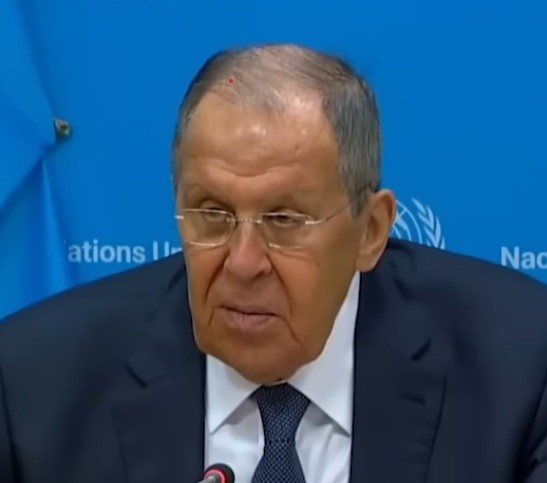
On 27 September 2025, Foreign Minister Sergei Lavrov made a speech during the session of the United Nations. It is not the first time that a Russian diplomat has had a speech there. Older generations will have remembered the speech given by Nikita Khrushchev and especially those delivered by Foreign Minister Andrei Gromyko, who held his post for almost three decades. Yes, officially they were Soviet functionaries, but the former was Ukrainian, the latter – Russian by ethnicity. Yet, speeches by Sergei Lavrov have a new quality to them. Those of the readers whose memory reaches sufficiently far back would never have expected at that time a Soviet diplomat to say a word in defence of a religious faith, least of all of the Christian faith. Now Minister Sergei Lavrov did precisely that: in his speech he stood up for the rights of the Ukrainian Orthodox Church (Moscow Patriarchate) and for the Serbian Orthodox Church. Can the older readers imagine anything like that many decades ago?
This mention of the two orthodox churches was a detail in the long speech and it took up no more than two sentences. Nor was it particularly important among the issues that Minister Sergei Lavrov listed. We draw the reader’s attention to this detail to one more time show the magnitude of changes that have taken place in Russia and the stubborn refusal of some parts of the world to recognize those changes. Yes, present-day Russia is almost every bit as traditional and religious as tsarist or imperial Russia. It was the tsars who felt obliged to defend Orthodox Christianity against suppression, be it in the Balkans or in the Middle East. The Russian Federation is a continuation of that political course.
You might say that Russia – like the lost sheep – is back in the fold of the Christian nations of Europe. You might say that only that you can’t – on second thoughts. Now Europe, especially Western Europe, ceased being Christian, so Russia is again in the out-group.
It was not without grounds that Foreign Minister Sergei Lavrov said in the same speech that there are forces in the world who insist on dividing nations and countries into two opposing groups, into us against them, into the garden (the European Union) and the jungle (the rest of the world), into democracies and autocracies, into those who have the right to feel secure and those who do not, into those – the golden billion – who can enjoy life to the full and those who are expected to serve the golden billion, into those who sit at the table and those who are on the menu. Citing Josep Borrell (though not mentioning his name) about the division into the garden and the rest of the world, Minister Sergei Lavrov called out the conceitedness of the Western world, which does not want to recognize the rights of other countries to determine their national interests and to pursue them. Rather, the Western world uses its economic and military might to either provoke internal strife in a target country or to intervene there militarily. The list of the afflicted countries is long – Yugoslavia, Iraq, Libya, Palestine, Iran, Qatar, Yemen, Syria, Lebanon – and growing. All this is being done in violation of the UN Charter, in the light of which all countries should be allowed to have their just place in the concert of nations irrespective of their military might, the number of inhabitants or the extent of their territory.
The United Nations Charter enshrines also the principle of non-interference in the internal affairs of sovereign states along with the principle of the integrity of sovereign territories. Sadly, the opposite is true. A string of colour revolutions and arbitrary sanctions have become the main instrument of Western diplomacy, said Sergei Lavrov. The recognition of Kosovo as an independent state is a strike against Serbia’s territorial integrity. At present the West is directing its efforts at Bosnia and Herzegovina with the aim of infringing upon the rights of the Serbian part of the population, a step which is in violation of the the Dayton Peace Agreement (Dayton Accords).
Hold on, for a moment! you might say at this point. How does Sergei Lavrov dare to mention the non-infringement of territorial integrity if the Russian Federation has annexed Crimea and then the four eastern provinces of Ukraine. As if in anticipation of this question Sergei Lavrov quoted the 1776 (American) Declaration of Independence, where it is stated that governments are only legitimate if they have the consent to govern from the governed. Now the populations of Donbass and Crimea refused to recognize the regime that came to power in 2014 because it gained power by means of a coup d’état rather than the will of the governed, and also because it banned the Russian language – the language of at least half of the inhabitants of Ukraine and all of Donbass and Crimea – from schools, the mass media and culture. The Kiev regime could thus be equated with the colonial authorities that used to rule over Africa and parts of Asia: just like those colonial powers, the Kiev government acted against the governed, and was not elected by the governed. The same rule, Minister Lavrov stressed (the one contained in the Declaration of Independence), has also been enshrined in the UN Charter.
A remark as an end note. The Ukrainian representatives had demonstrably earphones to let the whole world know that they needed an interpretor for the Russian language, in which Minister Lavrov spoke. The chances that they do not speak Russian or even that Russian is not their mother tongue are very slim. The earphones might have also been used to get the message across how desperate for independence Ukraine is, fighting against the Russian oppressor. But bear in mind that during the time of the Soviet Union, Ukraine – although a constituent republic of the Soviet Union – was a member of and consequently had its own seat in the United Nations (along with Belarus). At that time Russia as such was not represented in the United Nations: it was the Soviet Union that was. Though some equate the Soviet Union with Russia or Russia with the Soviet Union, these two entities overlap only to a certain extent. This overlap is comparable to something like that of the United Kingdom (corresponding to the Soviet Union in that it made up of England, Wales, Scotland and North Ireland) and England (an equivalent of Russia). None of the constituents of the United Kingdom has its representatives in the United Nations.


