Global Analysis from the European Perspective. Preparing for the world of tomorrow


Warsh, Trump and Dollar

Trump has no luck or talent when it comes to choosing people for his government or entourage. Yes, Melanie may be an exception, but when the president nominated Jerome Powell as chairman of the Fed in 2018, he immediately came into conflict with him. Trump wants complete control over the dollar and financial policy, which is not possible under the Fed’s mandate. Powell acted independently, saw the danger of a return to inflation and did not lower interest rates, which angered Trump, as he wanted to increase the competitiveness of the US economy through a cheaper dollar.

Now Powell’s term is slowly coming to an end, and Trump was looking for a suitable successor. At first, he wanted to nominate Kevin Hasset, the head of the National Economic Council (NEC), but then he realised that he wanted to keep his key adviser close by. So, he opted for the young but experienced Warsh. Will he disappoint him?

There are two camps among central bankers and members of the FOMC: doves, who advocate easing, and hawks, who favour higher interest rates. Warsh is currently pursuing a hybrid approach that combines elements of both camps:

  • Easing Contrary to his former reputation as an inflation hardliner, Warsh currently advocates interest rate cuts. He argues that current monetary policy is too restrictive. His thesis: productivity gains (AI and deregulation) could enable the economy to grow faster without fuelling inflation, which would justify lower key interest rates.
  • Tightening He remains a hardliner when it comes to the Fed’s balance sheet. He calls for a significant reduction in the central bank’s balance sheet (active quantitative tightening – QT) and less market intervention. He believes that a smaller balance sheet reduces market distortions and creates the scope for permanently lower short-term interest rates.

Yes, AI is a key argument in his logic. According to Warsh, it is responsible for the “performance miracle” that is essentially disinflationary. If companies can use AI to produce more goods and services at lower costs, this increases supply. The effect? It is assumed that a larger number of raw materials on the market at lower manufacturing costs naturally prevents price increases (inflation), even when the economy is growing rapidly. However, in this case, growth is not the result of printing empty currency, but the result of increased productivity. Warsh compares this situation to the internet revolution of the 1990s, when inflation remained low despite an economic boom.

However, this may be a misconception, as AI consumes enormous amounts of energy, chips and resources for data centres, which could increase the prices of these specific services and raw materials in the short term. The performance effect should only occur in a few years, which could trigger inflation before AI can suppress it. Many analysts are also critical of the reduction in the central bank’s balance sheet. Let’s see if the Senate will accept Warsh’s nomination. In any case, it could cause turmoil in the markets.


Why must raw materials become more expensive?

Gold

For a gold mine to be profitable, the deposit must contain at least 2 million ounces of the precious metal, as this is the only way to ensure production for many years to come. In previous years/decades, new deposits were discovered and supply was guaranteed. However, in the last two years of the gold rush, when gold was being sought everywhere, no major deposits were discovered anywhere in the world! This is the first time in history and, of course, an argument for a further rise in price.

Petroleum

Shale oil is running out in the United States. According to the latest data from the Energy Information Administration (EIA), shale oil production will gradually decline, mainly due to the depletion of deposits. The Permian Basin, one of the largest and most important shale basins in the world, is expected to produce less and less shale oil in the coming years. The impending supply deficit and the ever-increasing demand for this raw material are prompting leading oil producers to seek alternative sources for extracting black gold, especially in offshore deposits. Perhaps this is also the reason for the possible war against Iran, in order to secure reserves there, as in Venezuela.

Metals and rare earths

When it comes to both, the West is completely dependent on China and Africa. The following graph shows how heavily the US depends on other countries when it comes to minerals:

Source: Elements

Particular attention should be paid to rare earths, a group of 17 nearly indistinguishable heavy metals with similar properties that are indispensable in a wide variety of technologies, high-performance magnets, electronics and industry as a whole, as well as natural graphite, which is found in lithium-ion batteries. When Trump imposed tariffs on China, Beijing responded with restrictions on rare earth exports, which only exacerbated the geopolitical situation surrounding these materials.

The data shows that Africa’s share of resources and production of important raw materials is as follows:

  • Platinum: 90% of global resources (mainly South Africa and Zimbabwe). Platinum is needed in catalytic converters and hydrogen technologies.
  • Cobalt: 70-75% of global production comes from the Democratic Republic of Congo. It is one of the key components of lithium-ion batteries.
  • Chromium: 85% of global reserves are of high quality. Required for the production of stainless steel.
  • Manganese: 80% of global resources (mainly South Africa). Key to the production of steel and batteries.
  • Tantalum: 60-70% of global resources (DRC, Rwanda). Indispensable in every smartphone and laptop (capacitors).
  • Gold: approx. 40% of global resources.

At the same time, Africa remains the least geologically explored continent on Earth. Canada spends more than US$2 billion annually on field exploration, while all African countries combined spend just over US$1 billion. This shows that if the African continent were not so politically unstable, many more deposits would likely be discovered there. In addition, more and more mines are being controlled by the Chinese (e.g. the cobalt mines in Congo), which poses a real threat to the West. 

Russian fossil fuels are bad, but Russian athletes are good

Poland is known to be incurably anti-Russian. Some of the anti-Russian initiatives levelled at the Russian Federation have been rolled out by Warsaw; those that were proposed by other countries have been eagerly endorsed by Poland. There are Polish media outlets such as television channels that use very strong language in reference to Russia and Russians. This language includes terms like Russian bandits and similar. Not particularly diplomatic language.

And yet, there are four Russian-born representatives of Poland who competed in the winter Olympics in Milano Cortina: Vladimir Semirunniy (speed skating), Ekaterina Kurakova (figure skating), Vladimir Samoilov (figure skating), and Ioulia Chtchetinina (figure skating). Vladimir Semirunniy won the silver medal at the 10.000 metre race. At the Milano Cortina Olympics Poland gained only four medals, of which one was won by a Russian; to make things even more intriguing, the other three medals (two silver, one bronze) were won by one Polish athlete – Kacper Tomasiak (ski jumping). This can be interpreted as follows: the Russian athlete made up 50% of the Polish medal-winning team (yes, Tomasiak won one of his medals in a duo with Paweł Wąsek, but that’s a detail) and this Russian athlete gained 25% of the medals awarded to the Polish representation. How about that?

It turns out that Russian gas or oil are bad, so bad that Poland prefers to purchase these fuels from elsewhere and pay for them more, but Russian athletes are welcome because they can win medals. It has transpired that the most-anti-Russian nation did not flinch from accepting Russian sportsmen and sportswomen, and is now happy about the 25% gain in Olympic medals! Hilarious, isn’t it? The majority of Poles were and remain overjoyed (bribed by the success?), some remain hostile towards anything and everything Russian.

But the most hostile is – yes, you could have expected it, couldn’t you? – the huge Ukrainian diaspora in Poland. One activist Natalia Panchenko lambasted Vladimir Semirunniy on her Facebook account. She wrote, addressing Vladimir Semirunniy:

In 2019, you travel to occupied Crimea.

In 2023, you proudly represent criminal russia [intentionally lower-case ‘r’].

And then suddenly – snap – in 2025, you are granted Polish citizenship on the express basis, so that in 2026 you can go to the Olympics as a “Pole through and through”.

You win a medal and suddenly all anyone sees is the disc. As if your earlier decisions had magically evaporated. 

Now what does Natalia Panchenko expect? What would she like Vladimir Semirunniy to do? Would she like him to genuflect to her? To the Bandera flag? Well, Semirunniy did what the anti-Russian Europeans expect all Russians to do: he renounced his motherland and decided to represent another nation thereby highlighting his disapproval of the Kremlin’s policy. For all intents and purposes, he betrayed his own nation. Belatedly? So what? Such a decision takes time. Why does that not satisfy Natalia Panchenko? He could have taken part in the Olympics under the flag featuring the emblem of Individual Neutral Athletes. If he had won gold, he wouldn’t have heard the Russian national anthem. If he had won gold for Poland, he would have heard the Polish national anthem. What does Natalia Panchenko think is worse, is more condemnable, from the point of view of the Kremlin? Is Vladimir Semirunniy’s decision to represent Poland – a nation most hostile to Russia – not an act of flagrant defiance to Moscow? 

An example of gross injustice

The world is asking the question whether the United States will attack Iran. Some say it will, others say it won’t. Time will tell. Neither are we going to predict the future. Someone wise said once that although God created man in his image, he reserved exclusively for himself three things: to be able to make something out of nothing, to judge human conscience, and to know the future. Neither we nor any pundit knows the future, and all the prophets – religious or non-religious – are useless. The stuff that they impart is such that you and me can create similar prophecies because all the prophecies go something like this: somewhere, sometimes, someone will do something if something somewhere sometime performs something or fails to perform something. The only prophecy that comes true is the timetable showing the arrivals and departures of trains, buses and planes. Even if reality diverges from what the timetable says, it diverges but a little and only sometimes. In comparison to religious or non-religious (the famed Nostradamus) prophecies, timetable prophecies exhibit pinpoint accuracy and are 99% reliable.

Having said which, we are not going to predict the future, viewing such business as pointless. We are more into the whys and the wherefores of the mounting conflict between the United States and Iran. But facts first.

It is not the United States against Iran, but rather the United States and Israel on the one hand, and Iran on the other. Or, to be more precise: the conflict is between Israel and Iran, with the United States acting as a battering ram for the Jewish state.

Tel Aviv wishes to weaken Iran because Tel Aviv views Iran as its greatest enemy. Israel fears Tehran as such, but it will fear it even more if Tehran manufactures its own nuclear weapons. Though Israel is separated from Iran by Jordan or Syria and Iraq, Tel Aviv fears that Iran, once it produces its own nukes, will be capable of delivering a deadly strike by means of long-range missiles.

Now, does Iran want to strike Israel? According to Tel Aviv it does. Is that claim substantiated? Hardly.

Does Israel have nuclear weapons of its own? The whole world knows it does. If it does have nuclear weapons, then why should Iran or any other state, indeed, also have such weapons? Israel’s claim that it fears Iran, especially a nuclear-armed Iran, can be easily flipped to say that Iran fears nuclear-armed Israel. Whose fear is (more) legitimate? Tel Aviv claims it has peaceful intentions while Tehran has bellicose plans. Again, Tehran might flip the argumentation and say precisely the same about Tel Aviv. Such arguments and counterarguments just don’t make sense. It is obvious that if one country has weapons of mass destruction, the other feels threatened; and it is all too obvious that to allow one country (Israel) to have nukes while denying it another country (Iran) is simply an example of gross injustice.

The picture can be broadened. Why should France and the United Kingdom have weapons of mass destruction and not Italy or Spain? Why should Pakistan or India have such weapons, but God forbid that Indonesia or Vietnam should have them?

Iraq, Libya and Syria have been politically incapacitated by the actions of the United States and Israel. It is now Iran’s turn to be incapacitated. But why should Iranians toe the line drawn by Tel Aviv and Washington? Why should they swallow their national pride, why should they convert into Washington’s and Tel Aviv’s vassals? Sure enough, Tel Aviv would like to see Iran fragmented into a number of smaller states, but why should Tehran oblige Tel Aviv? Iran’s authorities know it all too well that once they deprive themselves of the possibility of manufacturing the weapons of mass destruction, once they cave in to American (Israeli) demands, they are going to slide into crisis and chaos and final disintegration. Once they lose the military leverage – even if potential as at present – they will be viewed as fair game.

Iranian leaders are fully aware of what happened to Russia once it had followed the West’s lead: it became weak and as such incapable of defending its most basic national interests. Both Gorbachev and Yeltsin acted in good faith towards the West, but this good faith was mercilessly exploited. Think of the economic crisis that Russia fell into and was stuck in throughout 1990s, think of the expansion of NATO that began to strangle Russia. Should Iran give in an inch, the same fate will surely haunt it as well. Already at present, Tehran has experienced US-controlled street riots and a twelve-day war that erupted on June 13, 2025, and was conducted while the US-Iranian talks were in full swing! Consider this perfidy.

Does this perfidy not remind you of the perfidy perpetrated by the Europeans who – having signed the Minsk I and Minsk II Accords between Ukraine and Russia – violated them on the following day? You will have remembered that both President Hollande and Chancellor Merkel bragged about it that they only signed those accords in order to play for time and lull the opponent. Why should Tehran believe Washington and Tel Aviv? Russia believed and lost on more than one occasion.

While Iraq, Yugoslavia, Libya and Syria were isolated at the time when they were being attacked by the West, Iran is not. It can count on the support of Russia and China. The Middle Kingdom purchases much oil from Iran (between 13% and 20% of its oil imports) and certainly does not wish to lose such a trade partner or to have this partner under US dominance.

Why should pressurizing Iran into submission be viewed as a justified action? What if the roles were inverted? What if Israel were pressurized into a similar submission? Or the United Kingdom? Or France?


I Am Twenty

In the 1960s, in the Soviet Union, director Marlen Khutziev completed a drama feature movie I Am Twenty (Original title: Zastava Ilycha). A magnificent film about Soviet society, about especially young people who lived then and there, about their dreams and reality. The cinecamera now zooms in, now zooms out, now pans, now follows the movement of protagonists. The accompanying soundtrack – including real radio news and the chiming of the Kremlin bells – complete the message that is put across by the images. There is a huge amount of good poetry while particular shots are in themselves works of chefs-d’oeuvre. The viewer can learn with amazement that the young people in Moscow wore the same clothes and the same hairdo that their Western peers did, that the young Russians in Moscow listened to the same music and danced the same dances that their Western peers did. Yes, there are shots from the First May Parade (Labour Day) and there are references – if few – to communistic ideals. These are, however, contrasted with the reality of everyday life: people in general lived their lives as best they could, so that there was barely a difference between them and their Western counterparts.

Yes, there is a palpable presence of the recent past, of the Great Patriotic War of 1941-1945. This culminates in the scene in which the young protagonist talks with his long-dead father who appears in uniform in the company of soldiers. They talk about this and that and eventually the son asks his father for advice about which way in life to follow. The father pauses, then asks his son about the son’s age. I’m twenty-one, answers the son. And I’m twenty, says the father and adds: So, I cannot give you advice. A poignant scene.

The movie was short lived and soon withdrawn from distribution. Why? Because the Soviet tsar – Nikita Khrushchev – did not like the film at all. A father can – and should – always give his child advice, said the Soviet tsar. And besides, why the film shows the Soviet youth as if it were the Western youth? Why does the film not focus on the ideals of communism? And so on. Once the first secretary of the Communist Party of the Soviet Union castigated the film director and vilified the story line, the less important officials followed suit. They savaged the movie and the director and the screenwriter. But you know what? The film was withdrawn from cinema theatres not because there was censorship or because the top party bosses did not like it! No, not by any means! The film was withdrawn because it was condemned by… the common people, by the communities, by the individuals that pass you in the street. It was these people who – full of indignation – would write petitions to the newspapers asking for placing a ban on the film. Does that remind you of something? It should.

Well, post a video on YouTube with a certain content and your video will be taken down by YouTube the way I Am Twenty was. And, of course, it is not YouTube that bans your video but the mysterious YouTube community and its mysterious values. You see, that kind of underhand censorship was not peculiar to the Soviet Union. Not at all. Once the gullible citizens of the Soviet Union believed that out there in the West there was freedom of speech. Now they know better. Content is taken down not because of censorship but –just like in the Soviet Union – it is the community, the common people who want to have limited access to information of works of art. You see, it is not the managers of the world but you and me who beg YouTube (and other platforms) to gag the mouths of selected content creators.

To make things even more hilarious, we need to know that Marlen – the first name of the director of I Am Twenty is an artificial name composed of Marx (Mar-) and Lenin (-len); he was raised by parents who were staunch believers in communism and his parents imbued him with respect for the system. The mentioned film ends with the shots presenting the changing of the guards at Lenin’s Mausoleum! Nonetheless, his work of art was viewed as inimical to the Soviet state and detrimental to the viewer.

I Am Twenty was only released in 1989. You watch the movie today and you wonder how was it possible to ban such a work of art, what possible threat did the picture pose to the mighty state, which – what an irony! – eventually disintegrated without people having watched this supposedly dangerous content!

Is it not going to be the same with the content that is banned by YouTube and other platforms? In a decade or three we will wonder why such things were banned. And – yes – in a decade or three the current system will collapse like the Soviet Union without us having seen the banned content. Because it is not the work of art or information that kills the system: the system kills itself because it is built on shaky foundations and supported by lies. Again and again the managers of the world think they can control minds and reality. How wrong they are!


The Javier Milei phenomenon

“Long live freedom, damn it!” Javier Milei uttered these words immediately after the results of the presidential election were announced. He won more than 55% of the vote, defeating Sergio Massé, the left-wing Minister of Economy, who conceded defeat that same evening. Buenos Aires took to the streets. People danced, shouted and celebrated in the squares. And with good reason. At that point, inflation was out of control and stood at over 200%.

For decades, the country had been mired in marasmus and recurring crises. Amidst this chaos, Javier Milei offered things that no one had dared to say so loudly before. The problem is not the new crises. The problem lies with the state. Milei diagnosed the disease and sought a radical cure. He symbolically waved a chainsaw and hinted at merciless cuts. Reduce the state to a minimum. Cut government spending. Liquidate the central bank. And replace the peso with the American dollar, which would probably be the most controversial measure.

Javier Milei may be a revolutionary, but above all he is an economist. For more than 15 years, he taught microeconomics, macroeconomics, monetary theory, finance and even mathematics at universities. He has published more than 50 scientific articles, written several books and worked as an economist at London-based HSBC, one of the world’s largest banks. Over time, he was invited to appear in the media. First as an expert. Then as a phenomenon. On television, he spoke about the economy without mercy and without beating around the bush. He explained, accused, hammered home his points. For this, the Argentinians loved him. His popularity grew very quickly.

He became a threat to the Peronist elite. They called him “crazy,” “fascist,” and even “the new Hitler.” When he announced his participation in the presidential elections, he was offered a bribe of $300,000 to leave politics. He refused.

When Javier Milei took office, the country was already on the brink of collapse. In just one month, December, inflation reached almost 30%, and every second child lived in poverty. The scale of the crisis was so absurd that the monthly rent for an apartment was cheaper than a pair of shoes due to years of government interference in housing policy. Milei knew very well that he had no time to lose. He did not wait the proverbial 100 days. He did not wait a month. He acted immediately, and the first results of his decisions were already evident after ten days of his presidency. That was when a “decree of necessity and urgency” was announced, i.e. a powerful reform package comprising a total of 366 changes contained in a single document. Doesn’t that remind you of Trump? 

This list included decisions of great significance: the devaluation of the peso by 54%, the reduction of the number of ministries from 18 to 8, and the dismissal of more than 40,000 public sector employees. The government has frozen hundreds of infrastructure projects and abolished subsidies for electricity, transport and public services. Although not all the results of these changes are immediately apparent, the most important effects have become noticeable. Above all, the fact that the country has achieved a budget surplus for the first time in a decade and inflation has fallen from 211% to 118%. The poverty rate has also fallen. UNICEF reports that since the president took office, nearly 2 million children have been lifted out of poverty. This is particularly important because, despite cutting health, education and science spending, Milei has maintained important social programmes, even though she has changed the rules.

Unfortunately, there are also changes that are worrying, precisely because of Trump, who recently interfered in the midterm elections in Argentina, which could decide Milei’s future success: he ordered Finance Minister Scott Bessent to start buying Argentine pesos in order to maintain their value on the markets. He then proposed a so-called swap line, an agreement that guarantees Argentina currency liquidity worth around $40 billion. In practice, this meant stabilising the peso at the most critical moment. Interestingly, this decision even drew criticism from Donald Trump’s camp. From a purely economic point of view, it was difficult to justify. Argentina’s economy is not closely linked to the US economy. In addition, Javier Milei abolished export tariffs in return, which led to massive purchases of Argentine soybeans by China. This was at the expense of US farmers, and this move directly affected US interests.

So why did Trump decide to take this step? For two reasons. The first is an ideal argument that sells very well in the media. Javier Milei openly advocates economic freedom, limiting the role of the state and the free market. All these values are close to Donald Trump’s heart. In South America, which has shifted almost entirely to the left in recent years, with Brazil, Chile and Colombia being governed by left-wing parties, Milei’s Argentina is becoming a political exception. It is the last bastion of the right and the free market in the region. But there is also a second aspect, much less romantic but much more realistic. Milei’s support is an investment in the future influence of the United States in South America and provides access to resources. Argentina has a vast territory, natural wealth and mining potential. It is as always in Washington’s politics: creating dependency through debt that can be repaid in the future, for example through concessions for US companies in the form of mining concessions, research permits, investment and capital expansion.

Trump threatened to withdraw his support if Milei performed poorly in the midterm elections. But despite radical cuts in government spending and reforms affecting millions of Argentinians, Milei’s party – La Libertad Avanza – received a whopping 41% of the vote. It wasn’t just a number. It was a signal: despite the costs, society still believes in his vision. Before the vote, Milei’s party had only seven seats in the Senate. After the election, that number nearly doubled to 13. From a legislative standpoint, this meant one thing: the real ability to continue reforms.

Argentina went bankrupt nine times. Nine times, the state was unable to repay its debts. Each time, the story began in the same way. Good intentions, generous policies, government spending and money. And it always ended in inflation, capital flight and poverty. Javier Milei’s victory did not come out of nowhere. It was a natural reaction to the cancer that has been plaguing Argentina for decades. That cancer was hyperinflation, political lies, empty cash machines, closed factories and a currency that no one wanted. However, Argentina’s history teaches us something very important. Crises do not come out of nowhere. They are the result of decisions that seem practical in the short term but prove disastrous in the long run. Inflation does not start with a printing press at the central bank. It starts with political approval to live beyond one’s means. 

The Good, the Bad, and the Ugly

Gone are the days when the world watched, with bated breath, the many talks between the United States and the Soviet Union on reduction and control of nuclear arms development. Gone are the headlines announcing the beginning, continuation and completion of the SALT or START talks. The world has changed.

Now it is the United States – as before – Russia – a replacement for the Soviet Union – and… China! When the SALT and START talks were conducted, no one paid any attention to the Middle Kingdom. Now China is a power to reckon with, not merely economically but also militarily. China is estimated to have some 350 strategic missile launching pads as opposed to some 480 American. That’s hard on America’s heels. Now what negotiations on nuclear arms control and arms limitation can be conducted between the United States and the Russian Federation without taking into the equation the Middle Kingdom?

The problem is that Moscow says it has nothing to do with China: China is not Russia’s military ally, though Washington perceives it as such. Contrarily, Russia views France and the United Kingdom as America’s closest allies, and rightly so: all the three countries belong to NATO. Hence, Russia’s demand that both France and Great Britain be included in the talks is legitimate.

On the other hand, Washington is legitimately concerned about China: under the current circumstances Beijing can certainly be viewed as Russia’s ally rather than that of America. (Just to think of it: China’s might have been created by the United States of which we’ll make a reminder later in the text.) Neither does the Middle Kingdom want to be included in the trilateral talks with the Russian Federation: why should it? It is an independent power – superpower – and it can act at the negotiating table on its own. So much so that Beijing has something to win from Washington: ok, the Chinese may say, we could reduce our military development if you lift the sanctions on China and the countries that wish to trade with the Middle Kingdom. How about that? Nuclear might is always a fine bargaining chip, is it not?

It is even true of tiny North Korea as well: not that North Korea is so powerful as to be considered for joint talks. No. But Korean nuclear potential is a sufficient deterrent even for such a superpower as the United States. And there is something more to the nuclear potential: it is the determination of the Korean leadership to actually use the missiles if push comes to shove. It is not Venezuela, whose president can be adducted in broad daylight without the perpetrator of the abduction fearing any retaliation, but we are digressing.

The balance of forces has changed since the year in which the Soviet Union disintegrated. For maybe as many as two decades the United States dominated the globe and felt so self-assured that Washington began to dictate to the whole globe. This, however, has changed. Russia has reasserted herself while China has risen to the status of a(n almost) superpower.

Which by the way is good for humanity. One superpower with no rival to fear would soon become corrupted and degenerated. All the other countries would have felt intimidated with no alternative anywhere in sight. Fortunately, a world emerges where there are three or maybe four (if we include India) big players, which allows for the smaller entities to have a political alternative, and which keeps each superpower in check.

A new arrangement needs to be made – no one power wants the prospect of a nuclear shootout. Talks are not going to be easy, because it is now three big entities, not two.

Political persistent rumour has it that Adolf Hitler was the creation of the Western elites who wished to rebuild Germany and direct its power against the Bolshevik Soviet Union. That is why London and Paris did not react when Germany began to arm itself, when Germany incorporated Austria and annexed Czechia; that explains why they did not react when Poland was attacked. The Western elites wanted Germany to expand, grow stronger, and come into physical contact with the Soviet Union. Now Adolf Hitler – assuming he was the darling of the Western elites – stopped playing by their script and turned against them when he attacked Denmark and Norway, the Low Countries and eventually France. It came as a shock: he was supposed to attack the Soviet Union!

Isn’t history repeating itself? The Middle Kingdom was supported by the United States for the express purpose to turn it against the Soviet Union. Washington would have rubbed its hands in glee if Beijing and Moscow started a real hot war! Decades have passed and – due to clumsy American policy-making – Moscow was pushed into Beijing’s embrace while Beijing was pushed in Moscow’s. Now they are – though not formally – economic and military allies. But again, the Kremlin may repeat: we have nothing to do with it. Had not Washington acted the way it did, there would have been no war in Ukraine, no sanctions on Russia and China, and consequently no Russo-Chinese cooperation.

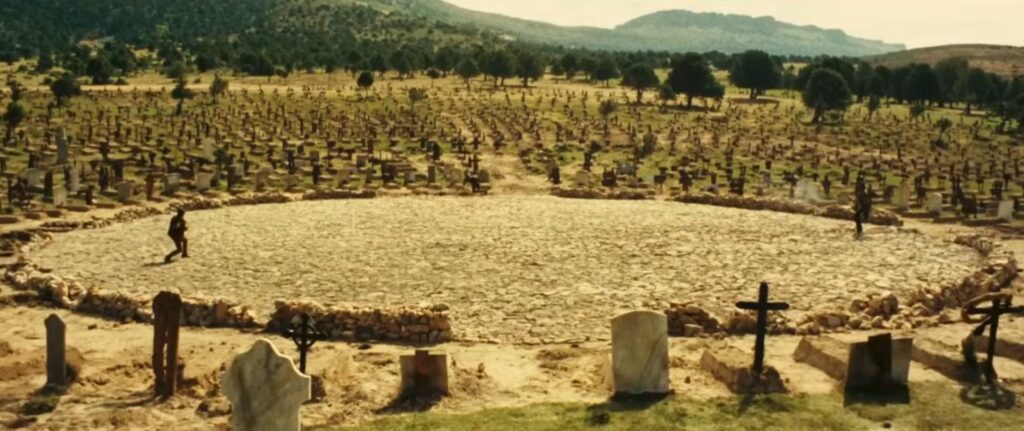
The three gunslingers have a hard nut to crack. Certainly, none wants a nuclear exchange, yet each wants to get the upper hand. They are observing each other attentively, not knowing in which direction to level their guns. It reminds one of the cultic cemetery scene from the 1966 The Good, the Bad and the Ugly classic movie. Do you recall it? Good Blondie (Clint Eastwood), bad Angel Eyes (Lee Van Cleef), and ugly Tuco (Eli Wallach) are facing each other – graves and crosses around them, their hands over their holsters, their eyes darting from face to face, their minds calculating. That’s the United States, that’s the Russian Federation, and that’s the People’s Republic of China facing each other (who is the good, the bad or the ugly is a matter of your political persuasion). In the graveyard scene only one emerges victorious. How will things play out in political reality at beginning of the 21 century? 

Davos 2026

After the notorious Klaus Schwab, founder of the World Economic Forum, resigned following allegations of financial and ethical misconduct, the forum took on a new dynamic. Whereas speeches used to be an expression of blind faith in mainstream ideology such as globalisation, green transition, climate change, sustainable development, human and LGBT rights, today they feel like a breath of fresh air. Take, for example, US Secretary of Commerce Howard Lutnick, who said:

“We are in Davos at the World Economic Forum and the Trump administration and myself, we are here to make a very clear point. Globalization has failed the West and the United States of America. It’s a failed policy. It is what the W has stood for which is export offshore farshore find the cheapest labor in the world and the world is a better place for it. The fact is it has left America behind. It has left the American workers behind and what we are here to say is that America first is a different model. one that we encourage other countries to consider, which is that our workers come first. We can have policies that impact our workers. Sovereignty is your borders. You’re entitled to have borders. You shouldn’t offshore your medicine. You shouldn’t offshore your semiconductors. You shouldn’t offshore your entire industrial base and have it be hollowed out beneath you. You should not be dependent for that which is fundamental to your sovereignty on any other nation. And if you’re going to be dependent on someone, it darn well better be your best allies. Okay? And so that is a different way of thinking. It is completely different than the WEF” (Video)

Oh dear! It’s a good thing Klaus Schwab can’t hear that, otherwise he’d have a heart attack.

Canadian Prime Minister Carney also pointed out in Davos that “the existing world order is collapsing.” He also highlighted the plight of small and medium-sized countries, which now have to cope with pressure from the largest ones. The Canadian Prime Minister said that these states should join forces so as “not to be crushed by the rivalry of the superpowers.” It seems that these words refer most to the countries of the European Union, which in recent months have pursued a different policy as a group from what Donald Trump is trying to do.

Due to the many controversial actions of the US president, we are gradually reaching a situation where simply showing resistance to him is enough to gain popularity. Previously, Justin Trudeau’s popularity grew because of such a conflict (it was Trump’s fault, not Trudeau’s merit), and now Carney also received a lot of praise after his speech, although as a former banker, he is more reminiscent of Macron in terms of credibility.

Among other important statements from Davos, the following are also worth mentioning:

[1] Larry Fink (CEO of Blackrock) stated that tokenising assets is the only sensible decision and that next-generation financial markets should already be based on tokenised shares or bonds.

This proves that the elites have not given up the fight against cash.

[2] Christine Lagarde (head of the ECB) drew attention to the problem of wealth inequality. And indeed, this problem does exist, but Ms Lagarde has probably forgotten who fuelled this problem over the last decade through massive money printing and intervention in the financial markets.

[3] Javier Milei (President of Argentina) reminded us that the West could still have a bright future ahead of it, but that it needs to turn towards freedom. These words were probably directed at the United Kingdom, Belarus and Germany, where freedom of expression is being fiercely opposed. (See also: Article in Gefira)

gif loading

We are quoted by:

 
Menu
More