



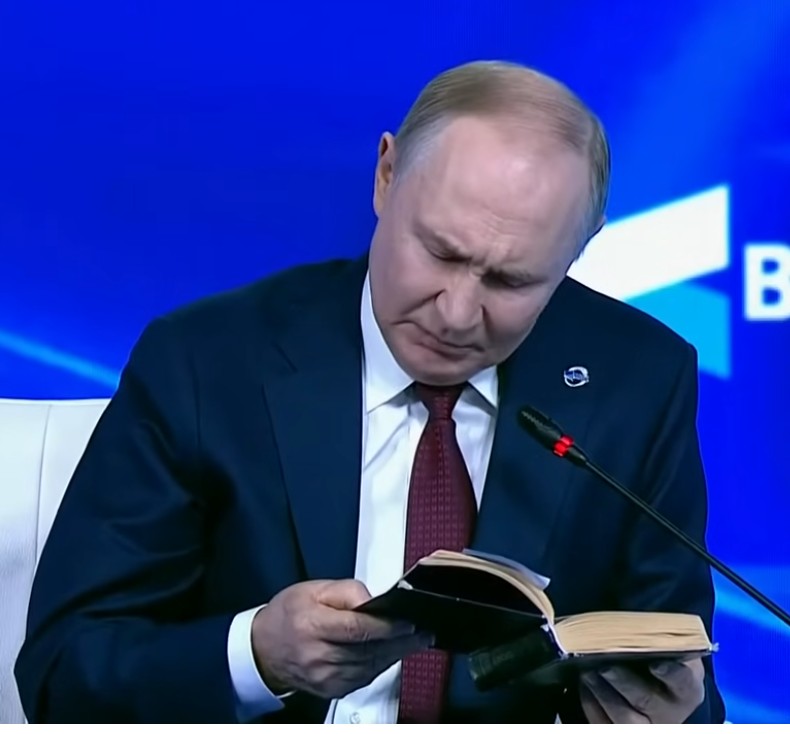
Russian President Vladimir Putin gave a speech during one of the sessions of the Valdai International Discussion Club (September 29 – October 2). That’s already a traditon: Vladimir Putin is habitually invited to to sessions of the Club, and this year was no exception. The speech was was followed by about two hours of questions from the journalists and the president’s answers. In both parts of his presence at Valdai, the Russian President laid down Russia’s point of view, Russia’s expectations, and Russia’s intentions.
[1] The world should be rid of military blocs. They have no purpose. Or – if there needs to be a military bloc – let it be one big military bloc – like NATO – but inclusive of all countries. Russia twice attempted to become a member of the Atlantic alliance: in 1954 (the being a part of the Soviet Union), and then in 2000. In either case Russia’s proposals have been turned down. Why? President Putin recounted his 2000 meeting with President Clinton and his suggestion concerning Russia’s NATO membership. The American president was willing to accept the proposal in the morning, only to turn it down later in the day, saying that the time was not right yet. Why? When would the time be right? asked Russia’s president.
[2] In anti-Russian narrative the West is glaringly biased in its actions and unfair in its propaganda. Take the historical policy, said the president. Much fuss is about the so-called Ribbentrop-Molotov Pact of 1939. As a result of this pact signed by foreign ministers of respectively the Third Reich and the Soviet Union Poland was dismembered in the following weeks. Yet, the West glosses over the preceding Munich Agreement of 1938 between the British and French prime ministers Chamberlain and Daladier on the one hand and the rulers of Italy and Germany – Mussolini and Hitler – on the other within the framework of which Czechoslovakia was dismembered within the following weeks. Why do Western propagandists lay emphasis on the former and ignore the latter?
[3] Similarly, if Russia is a paper tiger, as President Donald Trump famously said, and this paper tiger – that is Russia – is successfully fighting in Ukraine against NATO, then what NATO is? asked Vladimir Putin to the amusement of the audience.
[4] Though the war in Ukraine is waged and the collective West appears to be bellicose towards Russia, nonetheless the United States keeps importing Russian uranium for American nuclear power plants, and Russia appears to be America’s second largest provider of this resource. This Russo-American deal should continue, said the Russian president, because it serves the interests of both partners, but why then can’t Western Europe purchase Russian gas? Why does the United States demand that China and India stop purchasing Russian gas and oil? Obviously, the old rule of quod licet Iovi, not licet bovi applies here.
[5] The West is deteriorating, losing its identity, having problems with immigrants and others. So, rather than being focused on Russia, the West ought to deal with its internal problems. The loss of cultural identity has brought about a new phenomenon: an ever larger stream of people from the West is arriving in Russia to settle. One of the most striking examples is the case of Michael Gloss, son of a deputy director of the CIA, who arrived in Russia and voluntarily joined the Russian armed forces to fight against Ukraine. He was accepted, trained and sent to the front where he was killed. He was killed by a Ukrainian drone, while being wounded and trying to help his Russian mate. The Russian authorities granted him an order for bravery and requested Steve Witkoff – President Trump’s special enboy to Moscow – to hand it over to his family. Michael Gloss fought for Russia as he viewed Russia as a guard of traditional values that are shrinking in the West. They are shrinking so rapidly and have shrunk so much that even those Russian intellectuals – said Vladimir Putin – who have always dreamt about the West as paradise, as a model for Russia, as the Garden of Eden, began to say that the Europe that they have loved so much is no more.
[6] The Russian President revealed Ukrainian losses: in September 2025 alone Ukraine had 44.700 casualties of which 50% were irretrievable. During the same time Kiev could send to the front 18.000 of those drafted and 14.000 from hospitals as replacements, which means that the Ukrainian Army was short of 11.000 troops. The Russian President also said that between January and August of the current year as many as 150.000 Ukrainian soldiers deserted the ranks. Some surrendered willingly to the Russian troops, although that was a hard task on their part because they were often killed by drones operated by mercenaries who do not care about Ukrainian lives.
[7] Vladimir Putin said that Russia along with China and India and others do not want to dethrone the dollar: the fact that Russia, China and India and other countries are beginning to use other currencies in their trade is a simple result of the West’s financial policy that leaves Russia, and China, and others no other way as to bypass the dollar.
[8] President Vladimir Putin praised President Donald Trump and said, indeed, that he believed that the war would not have broken out had Donald Trump been the American president; and, yes – said the president – Donald Trump is a man who has the ability to listen to his interlocutor, to hear him out, and grasp his point of view.
[9] Unfortunately, just as once it was the Soviet Union that would impose its ideology on other countries, now this attitude has been adopted by the United States in Washington’s attempt to homogenize the world and create it in America’s image.
[10] At a point during the questions-and-answers part, Vladimir Putin confessed to being an ardent reader of poetry, especially Alexander Pushkin. From a volume of his poetry the Russian president read out loud a larger fragment of the poem that Pushkin entitled The Anniversary of (the Battle of) Borodino (Бородинская годовщина). The text refers to the age-long dream of the West to subjugate Russia. The poem was composed in 1831 and occasioned by the 1830-31 Polish anti-Russian uprising, which had the political and moral backing of the West. The message that the Russian president wanted to put across was that the strife between the West and Russia is of very long standing.


