



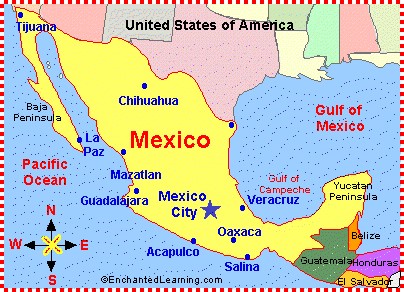
Perhaps the United States of Mexico should split up, for, just like the states in America, they have less and less in common. California is the richest, and the Midwest or rust belt states like Pennsylvania are unlikely ever to catch up with this high-tech hub. Just as in Europe hardly anyone can compete with Switzerland, so the enclaves of economic growth in Mexico, such as the Bajío, are more the exception than the rule. Even if the government in the capital introduces reforms, the main obstacle to Mexico’s economic development in the less industrialised states remains the weak rule of law, which manifests itself in institutional inefficiency and a business-unfriendly environment, exacerbated by a lack of public safety. The reforms of the Mexican government, which is constantly running up excessive debt, are based on the fact that it collects tax aggressively and, in return, does not refund VAT, which forces companies participating in the IMMEX programme (Manufacturing, Maquiladora and Export Services Industry – the support programme for industry and exports) to retain capital reserves instead of investing free funds in development.
In social terms, Mexico’s opportunity lies in tackling crime. Given the level of corruption, this is hard to believe. The economic opportunity, on the other hand, lies in the automotive sector, which accounts for 25% of Mexican exports. It is capable of meeting the stricter production requirements, including those relating to wage conditions under the USMCA (United States-Mexico-Canada Agreement). In the past, such regulations have led to greater regional integration. The US’s aggressive stance on tariffs towards the rest of the world gives Mexico a relative advantage by continuing and capitalising on the USMCA trade agreement. In addition to the agreement, Mexican industry has other advantages: it is located close to the US, has low operating costs, is well-equipped and has a skilled workforce. In the Central American region, there is currently no alternative to the products manufactured in Mexico.
The World Cup is unlikely to be of much help to either the government or the Mexican economy. What matters is Mexico’s geopolitical balance between China, which is quietly investing in the country, and the US, the big brother from the north – a situation that applies, incidentally, to all developing countries.


