Donald Trump’s Machiavellian plan to finish the war?

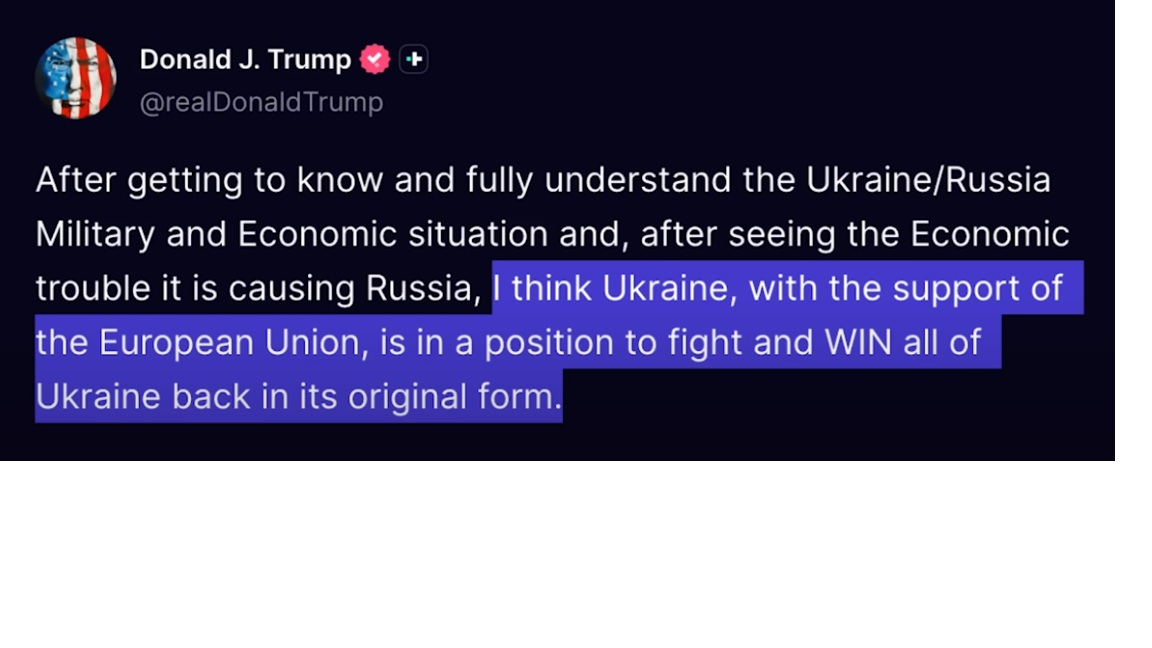
Ukraine’s president, European managers and all anti-Russian forces are beside themselves with joy because of the recent statement that the American President Donald Trump made on Truth Social. The American leader did an about-turn over the war, writing that Ukraine could successfully oppose its enemy and – and that is what sent positive shock waves across the Western world – Ukraine can regain all its lost territories. The EU leaders must have heaved a huge sigh of relief. Eventually the United States has been brought over to the point of view of the coalition of the willing!

Donald Trump’s words are kind of weird, and they are kind of not. They are weird because they represent a complete opposite to what the president used to say for the last few months: Ukraine was losing to Russia and had to be ready to cede some territory. Yet, the same words are not weird because President Donald Trump has accustomed us to this nice trait of his character that he loves saying two opposite things, sometimes within the same day or even in the same breath. Anyone who’s been paying attention to the American presidents statements should have grown accustomed to this particular style of his communication with the public.

Let us assume, however, that Donald Trump is going to stick to this statement. That means that the United States is from now on supporting Ukrainian war effort, at least psychologically; that also means that the European Union does not need to bother about Americans trying to hold Brussels back from aiding Ukraine in one way or another; and finally, the president’s words encourage those political groupings in Ukraine which might be framed as a pro-war party. An easy interpretation, is it not?

Does Donald Trump believe in what he said? It might be that President Donald Trump has been misinformed and misled by his advisors, and that he really thinks that Ukraine is doing militarily well while Russia is on the verge of an economic, and – what follows – social collapse caused by its war effort. In his statement the president used words and phrases such as paper tiger in reference to the Russian Federation or long queues for gas in reference to Russian economy. Donald Trump may believe in any and all of these things: after all, he does not make an impression of being very well educated and knowledgeable about the world, its geography and history. Some of the president’s earlier statements confirm this observation, like when he said that Russia lost over sixty million casualties during the Second World War (a number three times as large as in reality). The same observation concerning the level of general education and expertise on Russia can easily be extended to the American elites. So much so that they very often let themselves be guided by visceral hatred rather than critical reflection towards their geopolitical opponents.

But there might be something more than meets the eye. It might also be that President Donald Trump is an incarnation of Machiavelli, at least in the understanding and image of the latter that most people share: someone sly and canny. What do we mean? Well, it might be that President Donald Trump is perfectly aware of the vast disproportion of the forces between Ukraine and Russia in favour of the latter, and since he has been unable to bring about peace, and since he’s been thwarted in his peaceful attempts by both the EU and some of his advisors, he devised a Machiavellian plan to accelerate the end of the hostilities by… pushing Ukraine into the conflict with an even greater vigor and gusto: this will make it easier for the Russians to crush Ukrainians and thus bring the war to an end. Stiff resistance and a couple of more failed offensives might prove to be the last nail in Ukraine’s coffin, since the country is running low on manpower, military equipment, and resources. The American president may safely prompt the European Union to continue the aid to Kiev, knowing full well that Brussels is also running low on its resources, financial or otherwise. Ok, if you want to prolong the war, Donald Trump might be thinking, then go on, be at each other’s throat. The more fiercely you will fight, the sooner the end will come. When the lightweight doggedly wishes to hurl himself against the heavyweight and precipitate his own destruction, why should the referee (United States) who has grown tired of the boxing match (the war) intervene?

The Spell that Has Lingered for so Long is Broken

Several generations back, India was under British dominion and the British monarch – Queen Victoria – was even crowned Empress of India. We need to understand that India up to the end of the Second World War comprised today’s India along with today’s Pakistan and Bangladesh. The monarch of a lilliputian country – UK – became a ruler of a subcontinent. Then came World War One and World War Two, which resulted at first in the weakening, and then in the disintegration of the British Empire. The world came to be dominated by the United States of America, which was on the one hand a change, but on the other it was not a very great change as the United States is historically the offspring of the United Kingdom or Great Britain. Though the pound sterling has been supplanted by the dollar as the currency of international exchange, the language of the world’s hegemon has remained the same: English.

As the Suez Crisis of 1956 eventually broke the backbone of both France and Great Britain along with their fast shrinking empires and disappearing colonies, the United States emerged as a hegemon which had only the Soviet Union to reckon with. In 1991, the Soviet rival ceased to exist and so – by God’s grace as President Bush senior framed it – America reported a global victory. It seemed the Land of the Free was destined to lord it over for a good couple of decades. If older standards were to be restored, American presidents could be crowned emperors of China and India or viceroys of Russia and Europe. It turned however out, soon enough, that the Middle Kingdom with huge American infusions into its economy gradually emerged as a potentate, and so did India. The mental or psychological inertia lingered, though. Both the Chinese and the Indians are rather prone to looking up to the former powers as something better than they are: English still plays such a role around the globe that Latin did in medieval Europe, while British and American culture is still craved by many Chinese and Indians. One might say that though the economic and political influence has somewhat flagged, the spell still holds. Or does it?

Today Beijing and Delhi are in control of their own countries and pursue an international policy that serves their respective interests. The time when the both capitals would occasionally turn to Washington for advice, aid or approval is gone. The mental or psychological inertia persists… but more on the part of the Western world. In his proxy war against Russia the American president has made an attempt to isolate Russia economically in that he threatened those that continued to purchase Russian gas and oil with exorbitant tariffs. President Donald Trump’s favourite tactics may have had some effect in the case of some governments, but when it came to India, the American president met with a decisive resistance. As soon as India was threatened with retaliatory steps for exports from Russia, India’s Prime Minister Narendra Modi immediately turned to Moscow and Beijing for help, and had the commercial deal with the American Boeing annulled. In an effort to put things to rights, President Donald Trump decided to quickly call India’s Prime Minister Narendra Modi… to no avail. Political rumour has it that Trump made as many as four calls and none was answered. The rumour is spread by the respected Frankfurter Allgemeiner Zeitung and confirmed by other unnamed sources.

Be that as it may, the very idea that a leader of a country that used to be another country’s colony and used to rely on international aid for nourishing its citizens, plus the fact that one can spread news – rumour or no rumour – about any one leader refusing to respond to an American president’s phone four times is a telling mark of the change that is sweeping the whole globe. Narendra Modi’s sudden and decisive political swing towards China is a fact, a disturbing fact. The Moscow-Delhi-Beijing trio is to the United States an unpalatable event. Historically speaking, it was not so long ago when both China and India were under the West’s political and economic control. Today they have both thrown down the gauntlet to their former colonizers. Their ostentatious cooperation makes the Frankfurter Allgemeine Zeitung’s rumour look like fact. Trump’s remark on TruthSocial that we’ve lost India and Russia to deepest, darkest China substantiates this rumour even further. While Queen Victoria was India’s Empress, Donald Trump is not even India’s respected partner.

Switching the Points

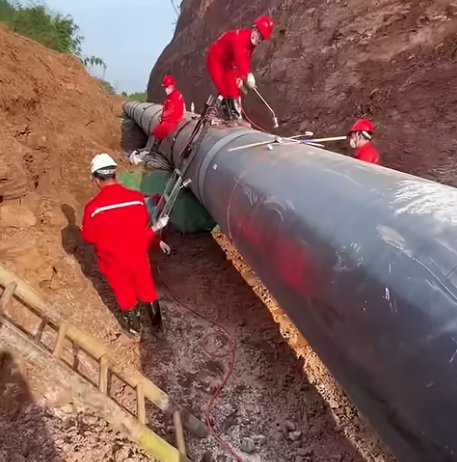
One of the very important outcomes of the SCO (Shanghai Cooperation Organization) conference held on 31 August – 1 September was the deal made between Moscow and Beijing about constructing and completing by 2030 the Power of Siberia 2 pipeline (the Power of Siberia 1 is already in operation), which will run through Mongolia. The pipeline will be built by Gazprom and it will provide the Middle Kingdom with natural gas extracted – among others – from the same fields which up to quite recently supplied Europe with this resource.

The consequences of this move are neither to be overlooked nor underestimated. Waging a crusade against Russia, Europe deliberately and purposefully cut itself off from Russian gas. Long before the conflict in Ukraine broke out, the leaders of the Old Continent for years kept complaining about the continent’s dependence on Russian gas. For years they they would make the cooperation for Gazprom ever more difficult. Then came the war in Ukraine and an eruption of Russophobia. Europe turned its back on Russian gas while the United States made sure that no one would think about reversing course: as we know the supply pipelines – NordStream and NordStream 2 – were sabotaged.

Europe is still purchasing some Russian gas through middlemen, but generally the Old Continent has switched to American LNG, which is more expensive as it requires shipment, liquefaction, and vaporization. The Russia-China deal will make it impossible for Europe to return to purchasing Russian gas: the Chinese market will swallow up any quantities of it. We are witnessing an epic change: the two NordStream pipelines are about to be replaced by the two Power of Siberia pipelines, redirecting immense amounts of gas from Europe to Asia. Simultaneously, since the Power of Siberia 2 will run through Mongolia, it is Mongolia that will greatly benefit from the Moscow-Beijing deal rather than Poland or Ukraine, through which the pipelines Yamal and Druzhba/Brotherhood run. Russian gas was supplied to Germany and Italy. It was cheap, cheaper than its American alternative, and so both these countries benefited from it a lot economically. All of this is in a complete reversal. What was done during the SCO session is like switching the railway points: the tank cars full of gas that used to be headed for Europe will all soon be headed for China.

Just as over time European and Russian economies will diverge one from the other, those of Russia and China will become closer and closer. The pipelines supplying Europe were in operation for decades, long before the collapse of the Soviet Union. With them gone, a new economic alliance between Moscow and Beijing will be forged. We can only wonder what European leaders think about this change. Sure, on the face of it they are still belligerent, but are they in their heart of hearts? If they are clever enough, they must be smelling a rat. The war that they had hoped to win is going sour, the sanctions that they had thought would coerce Russia into submission backfired, while the economic situation of the Old Continent is deteriorating with every month. Still, once they all invested so much hatred and scorn into Russia, they simply cannot put into reverse. Such is human psyche. They must wage their crusade to the bitter end.

A three-headed dragon looms large

The world is undergoing an epic change. The European Union is about to be dimmed by the Shanghai Cooperation Organization (SCO), so much so that the American tariff policy has just pushed India into Russia’s – which is not all that surprising – and China’s embraces. The last mentioned is a big event. India and China have been at loggerheads for decades, and now they are reconciling themselves against the pressure from the United States and their West in general. India and China means putting together almost three billion people. India, China and Russia have more nuclear warheads and missiles than the collective West. Why, even small North Korea has some and the nukes. The cooperation between the three main states – Russia, China and India – occupying the bulk of what is referred to as Asia along with the many smaller states that are members of the SCO is a huge political, economic and military challenge to the collective West. Washington, Paris, London and Berlin must have miscalculated heavily and overlooked what has been looming large on the political horizon for a long time. While they thought Russia would be an easy prey to be destroyed in the proxy war, they ended up facing a three-headed dragon emerging from Asia.

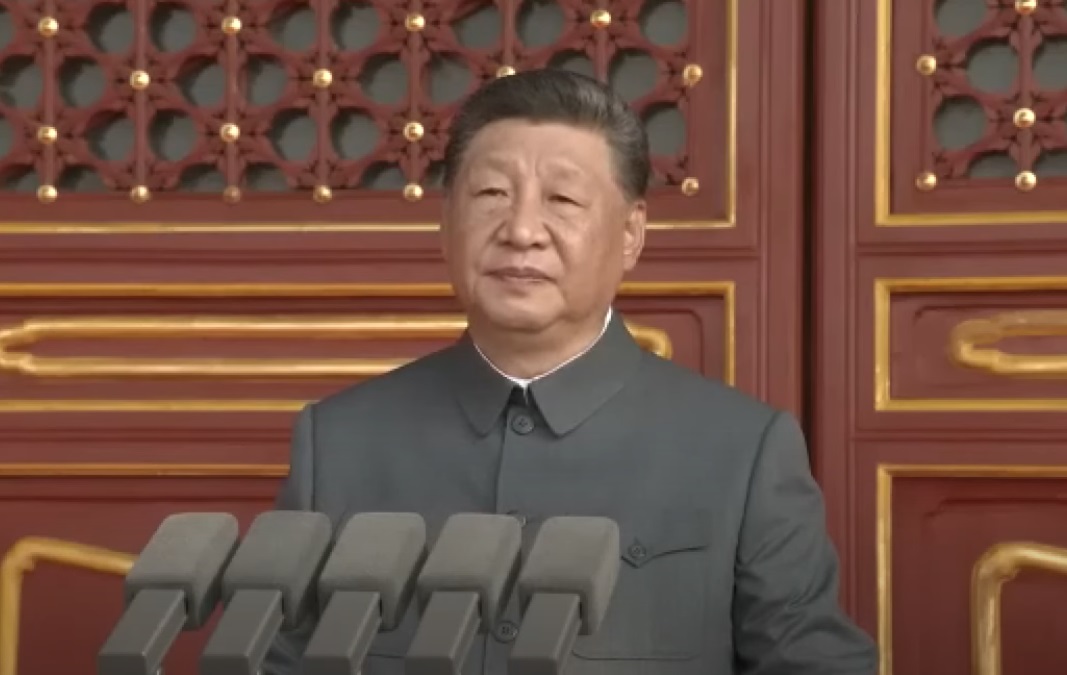
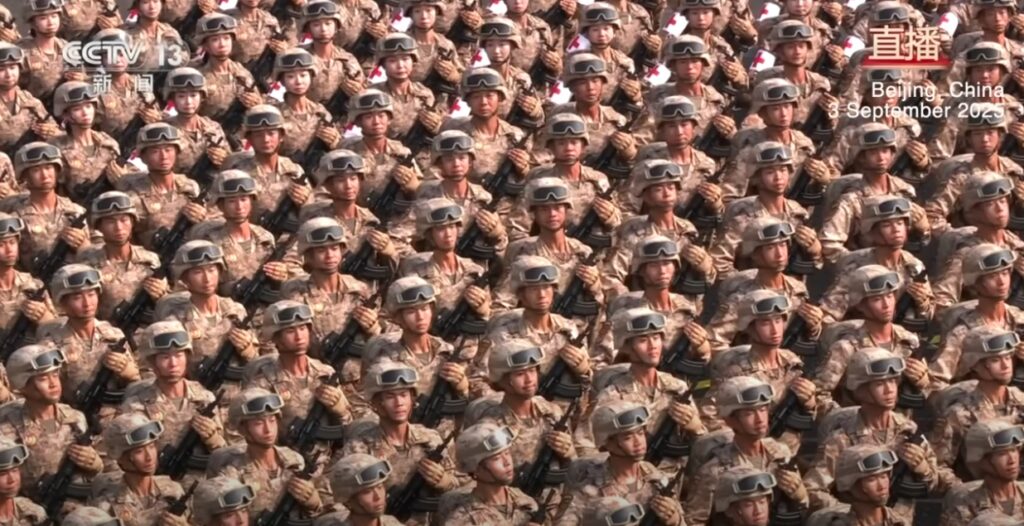
To think of it: China’s might has been created by the United States of America! What of the outsourcing, what of all the support that Washington would provide Beijing with just to spite the Soviet Union, the Middle Kingdom has become a superpower to be reckoned with. During the military parade occasioned by the 80th anniversary of the end of the Second World War in the Far East and the liberation of the Middle Kingdom from the Japanese occupation, China rolled out various kinds of armament, including drones and long-range missiles. China’s President Xi Jinping emerged in a limousine from the Tiananmen – the entrance to Beijing’s Forbidden City in a uniform habitually worn by Mao Zedong, a uniform resembling the one Joseph Stalin used to wear. Thus the Chinese leader stressed the connection with the recent past, although Chairman Mao was not the one who rendered positive services to the Chinese people. Russia does not preserve the continuity with its Soviet period of the past to that extent: true, the military parades in Moscow feature soldiers in uniforms and with military standards from the Second World War, but the tomb where mummified Lenin is till kept is shielded from public view; nor does Putin or the other members of the authorities climb the tomb as was the custom in the Soviet Union from where Soviet leaders would deliver their speeches and watch the marching soldiers.

Military parades in Moscow are compelling, yet the one in Beijing trumped Moscow’s parades. The parade held in Washington to mark the U.S. Army’s 250th birthday just cannot compare to either of the aforementioned: look for yourself. (Notice the rock music accompanying the American show; also, compare the Chinese vigorous march with the American languid walk.) China showed its military might also in equipment. 

Within the framework of SCO the three leaders – Putin, Modi and Xi Jinping – conferred about political and economic topics. SCO conferences were also attended by Turkey’s President Erdoğan, while the military march was watched by Slovakia’s leader Robert Fico and Hungary’s minister for foreign affairs. So, Europe was ultimately somehow present, though not Western Europe, apart from a minor representative from Belgium. Were the representatives from the EU absent because of Putin’s presence there?

Well, Europe is crusading against Russia, and has grandiose plans of conquering China. Kaja Kallas, one-time Estonia’s prime minister, now the face of European diplomacy made no bones about it: “If you are saying that you are not able to beat, that we collectively are not able to really pressure Russia so much that it would have an effect because… then how do you say that you’re able to take on China risk. (…) My point is that if we don’t get Russia right, we don’t get China right, either.” (The interviewer tries to tone her statement down, to little effect.) 

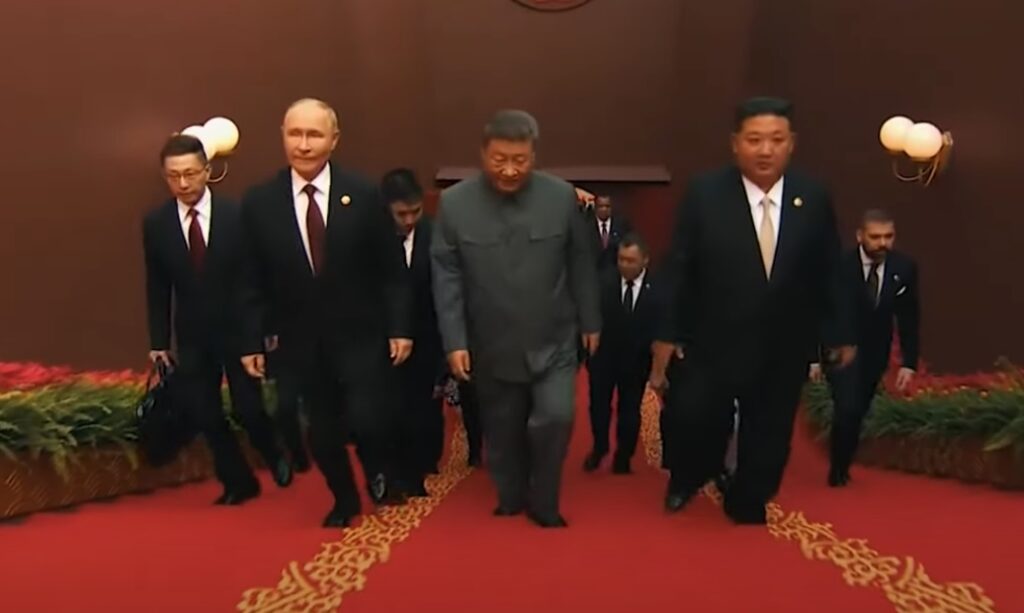
Vladimir Putin, Xi Jinping, Kim Jong Un

Strange that President Donald Trump failed to seize the opportunity to attend the anniversary of China’s liberation from Japan’s yoke. Just as Washington once pushed China and Russia into each other’s embraces, such a gesture on the part of the American president might have more favourably disposed the Middle Kingdom to the United States. Either Donald Trump didn’t want to go to Beijing of his own accord or he has bad advisors. The same is true of the European Union. Sadly, they could not be bothered to take part in China’s celebration. How can they then hope to develop friendly relations with the Middle Kingdom? How can then they hope to drive a wedge between China and Russia?

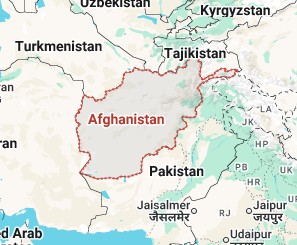
SCO’s membership includes India, Iran, Pakistan, Kazakhstan, China, Kyrgyzstan, Tajikistan, Uzbekistan, Belarus and Russia. It was established in 2001. SCO’s member states cumulatively make up 24% of the world’s area and 42% of the world’s population. (The European Union makes up less than 2% of the world’s area, and 5.5% of the world’s population.) Russia, China, India, and Iran are concurrently members of BRICS.

For the wages of sin is death

Eighty six years ago today the Second World War broke out. It broke out on September 1, 1939, with Germany assailing Poland, and with Great Britain and France declaring war on the Third Reich three days later. Within the next more than five years Europe would be engulfed in flames, suffer enormous devastation and a huge loss of life. What was the cause of the war? No, we are not going to repeat the hackneyed arguments that our readers are most likely to be familiar with, to be familiar with all of them. We are going to point to one thing only: intemperance.

Yes, intemperance. Intemperance in the political appetite of the main player, of Germany. Had Adolf Hitler stopped his aggressive policy after gobbling up Czechia, Germany would most probably have become the most powerful country in Europe, the German language would be what the English language is today. Taking into account the advancements of German technology during the late thirties and early forties – the television being launched during the Berlin Olympic Games in 1936, the jet engine (Me-262) and the V-2 missiles – Germany most probably would have launched the first man into orbit and land him on the moon. The entirety of Europe – maybe only except for the United Kingdom and partly France – was under German influence and… spell. Think of Hungary, Romania, Slovakia, think of the national-socialist parties in Norway, and even Great Britain, think of the expansion of German cinema and what not.

Between the swallowing of Czechia and the offensive against Poland, Germany occupied a huge chunk of territory in central Europe, numbered eighty million people (the United Kingdom had 48, France 41 million inhabitants) and was closely allied during the period of 1939-1944 in one form or another with Italy, Spain, Hungary, Romania, Finland, and Slovakia. There were strong pro-German political movements in Yugoslavia (especially Croats) and Bulgaria as well as in Turkey. No one on the continent pose any threat to Germany, either militarily or economically. There were numerous German minorities in Poland and Romania, which could be leveraged against the Polish or Romanian authorities. Germany regained its position as a power and appeared to be mightier than it had been before the First World War. The only thing that Germany seemed to have lost for good were the few African colonies that it had had prior to the outbreak of the First World War. Anyway, had Berlin stopped at this point – 1938/1939 – its expansionary politics, had Adolf Hitler died or been toppled… Had Germany shown restraint…

As we know, pride – or better put: self-pride – comes before a fall. Intemperance in its political appetites brought Germany to rack and ruin within a couple of years. The country lost a third of its territory, was split into two political entities, has been and remains in a way occupied till this day, while the German language, culture, literature and cinema have lost to the English language and American culture, literature or cinema.

Isn’t it the same with the European Union nowadays? It began modestly as an economic union of six states coming together only for the purpose of jointly managing the extraction and production of coal and steel. Then the union began expanding, gobbling up ever more states, creating ever more administrative structures and imposing its moral rules upon almost the rest of the world. Much the same can be said about NATO. Initially, a reasonable defensive organization, has evolved into a truncheon, a bludgeon with which the West decided to discipline or police small, powerless countries, be it Yugoslavia or Libya. Both organizations began swelling, swelling rapidly and could not recognize any limits to their growth. They did not even – which would be rational – allow themselves time to digest what had recently been swallowed. Hence, the unstoppable expansion to the east. Isn’t this expansion comparable the that of Germany’s before 1939? Both Berlin then and Brussels now are just incapable of recognizing limits to their growth (though otherwise they claim that there are such limits in economy, see the notorious tenet worked out by the Club of Rome). As a result, the European Union and NATO, just as the Third Reich, have been keeping expanding, come hell or high water, reeling in more and more territory and people. Is it so because it is Germany that is at the core of the European Union?

Eventually, just as the Third Reich found its nemesis and its undoing in Russia, so, too, does the European Union and NATO. It was in Russian and Ukrainian (Ukrainian!) steppes that the German (and Italian, an Hungarian, and Romanian) armies dug their graves. It is again in Russia and Ukraine that the European Union and NATO are digging their own graves. Eighty years later. Had Brussels and Washington stopped on the River Bug (the river separating Poland from Belarus), the European Union would by now have become a political and economic colossus that China and Russia would have reckoned with. As it is, it appears that the Union is at the end its economic and political tether, while China is on the rise.

It is not without reason that intemperance is one of the seven deadly sins: it brings a downfall. Restraint is a virtue: its reward is prosperity and stability.

Notice that just as Berlin could not recognize its failure in the east and continued war to the bitter end, so does the European Union. Are the bureaucrats in Brussels hoping for a miracle as Adolf Hitler did? The Miracle of the House of Brandenburg? Well, such miracles do happen, but miracles are miracles precisely because they happen extremely rarely. Yes, it happened so during the Seven Years’ War (1756-1763), when Berlin was captured by the Russian troops and Prussia was on its deathbed, that an unexpected change on the Russian throne caused Russia to suddenly withdraw its troops from Prussia, thus weakening the anti-Prussian alliance (made up among others of Austria and France), thus saving Frederick II, who then famously coined the quoted phrase of the Miracle of the House of Brandenburg. Yes, it was kind of a miracle. And, since it was a miracle, it happened but once. Else it wouldn’t be known in history as a miracle. Now, Hitler hoped for the same or similar event, sitting in his Berlin bunker and staring at the image of his beloved historical hero: Frederick the Great. Franklin Delano Roosevelt’s death close to the end of the Second World War began to be construed by Hitler’s entourage as a miraculous sign. They had hoped for a political change, the end of the coalition between the United States, the United Kingdom and the Soviet Union, the resultant salvation of the Third Reich – a repeat of the Miracle of the House of Brandenburg. But no, the miracle did not repeat itself because miracles are rare, extremely rare.

Also today we can observe the coalition of the willing, top European leaders who intransigently refuse to look reality in the face. They are hoping for a collapse of Vladimir Putin, for societal unrest inside Russia and for a successful offensive on the part of the Ukrainians. The leaders who are making up the coalition of the willing are not as yet hidden in a bunker and they are not staring at the portrait of Frederick the Great, but they behave precisely like they are hidden in a bunker and staring at the Prussian king’s image. Teenagers and elderly people are drafted into the Ukrainian army just as teenagers and the elderly were drafted into the Volkssturm, and despite the obvious and glaring similarity the leaders making up the coalition of the willing seem to be totally oblivious to it. What are they counting on? On the miracle of the House of Brussels?

The EU leaders and creators have had an opportunity to create something valuable in history and they have botched everything up. That’s because they were and continue to be puffed up with self-pride and intemperance. It was not enough to unite Europe and somehow mix European nations: they needed to let in the Third Worlders by the million; it was not enough to just respect the cultural differences and especially to respect the moral mainstay of the Old Continent: they needed to flood it with the rainbow propaganda; it was not enough to enjoy a modest, rational economic development: they needed to jump into the “green” “sustainable” and “renewable” never-never world. Lastly, it was not enough to keep within the European fold almost all European countries and to slowly solidify the union and NATO: they needed to expand without rhyme or reason and they desperately needed to tease and irk big Russia.

Fools. Fools like insatiable Napoleon Bonaparte, fools like intemperate Adolf Hitler. They wanted more and more, deeper and deeper, farther and farther, faster and faster till they hit with their heads against a brick wall and now are forced to retreat with their tails between their legs. Fools. They thought they were all-powerful, like gods. They thought the world was out there for them to shape and form to suit their whims and their narcissistic grandiosity. They sacrificed the lives of the millions and still have absolutely no pangs of conscience. Yet, just as their political predecessors, they are eventually being punished. The union is coming apart at the seams. It is in a downward spiral – economically, demographically and politically. Think of the seven dwarfs – top European politicians – taking orders from President Donald Trump in the White House. Think of them being asked to leave the room because the real leader wanted to phone another real leader, that is the hated Putin. It was not very much earlier when the seven dwarfs framed themselves as the seven giants, giants that can confidently dictate to Russia, China and India. Look at them now with their silly, ridiculous seventeenth-eighteenth-nineteenth package of sanctions. Look at them conspiring among themselves while Trump and Putin – the real leaders – confer above their heads. The seven dwarfs could have been leading their union to a “bright” future, but they preferred to listen to the serpent hanging from a tree. The serpent told them that they could do whatever they pleased. They listened and believed. And they became intemperate. Intemperance is a sin, and – as we know (though they don’t) – the wages of sin is death.

Alaska on the Feast of the Assumption

After weeks and months of talks, eventually the Putin-Trump summit has been set to take place in Alaska on 15 of August 2025, the Feast of Assumption, of all the days. Does that bode well?

Obviously the two parties must have offered something of value or else the talks wouldn’t have been agreed on. What can that be?

We know the Russian terms: 1 the four provinces of Donetsk, Luhansk, Kherson and Zaporozhye along with Crimea are to remain as part of the Russian Federation and be recognized internationally as such; 2 Ukraine needs to become a neutral country with no NATO membership; 3 Ukraine needs to be denazified; 4 the Russian language, heritage and Orthodox Church must to enjoy their rights and autonomy in Ukraine; and 5 sanctions against Russia must be lifted. Has anything changed in this respect?

Rumour has it that President Vladimir Putin is trying to help President Donald Trump out of the unfavourable circumstances into which he has worked himself over the last several weeks. What did President Trump do? He began imposing or threatening to impose tariffs on countries that did not support the West’s crusade against Russia, he began demanding that India and China – two political and economic giants – stop importing Russian natural resources. Trump’s requirement quickly backfired: there was big political pushback from both New Delhi and Beijing. So big pushback that the Indian government struck up talks with Russia about purchasing Russian military equipment while Indian Prime Minister Modi has adjusted his schedule to accommodate a trip to Beijing and talk to the leader of the People’s Republic of China. Just imagine: India and China have never been particularly close to each other recently… Also Brazil’s president Lula de Silva retorted sharply to American attempts to dictate to his country its foreign and domestic policy. Washington managed to push China, India, and Brazil into each other’s embrace in no time. Result? President Donald Trump felt compelled to withdraw his threats about the imposition of tariffs or to reduce their impact. Add to it the situation in the battlefield in Ukraine which is worse and worse for Kiev. The later the American–Russian talks take place, the worse will Ukraine fare.

So, it might be that President Vladimir Putin is helping President Donald Trump out of the fix, a fix that is of his own making. It cannot be denied that there is some positive chemistry between Donald Trump and Vladimir Putin. Neither Starmer nor März, neither Macron nor von der Leyen have ever spared a good word for the Russian leader, and certainly none of them has ever been ready to hold talks with the Russians. With one exception, perhaps: to dictate to Moscow terms of unconditional capitulation. But certainly, good chemistry is not enough.

According to some leaked information Americans have promised something that Russians have recognized as a step forward. What is it? Maybe an international system of security, something that Vladimir Putin has been insisting on for years. Obviously, Moscow – contrary to what is propagandized in the Western media – is not so much interested in gaining territory as in winning a place for Russia in the concert of global powers. Moscow works towards a treaty – like those signed by the United States and the Soviet Union – on general détente, a new international deal, new international order. The West has been trying to dominate and subjugate Russia and was successful in this attempt during the first decade of the sovereign existence of the Russian Federation after the collapse of the Soviet Union. Since presidency in Russia was taken over by Vladimir Putin, the country has reversed course and struggled hard to regain its rightful international position. This has attempt met with fierce opposition from the European Union and the United States, all of which led up to the war in Ukraine. Now the time has come to work towards a diplomatic settlement or else the West will lose much more than it is willing to accept.

It remains to be seen what will come out of the talks in Alaska. One may wonder why Alaska of all the places. It used to be Russian overseas territory before Tsar Alexander II sold it to the United States in 1867. Do Americans hope that Russians will again sell out some of their important positions, some of their important political stakes? The talks are also set to take place on the catholic Feast of the Assumption of the Virgin Mary i.e. a feast marking the belief that the Mother of God was taken into heaven body and soul, without bodily death. Quite a patronage, when you come to think of it. Sure enough, neither the American nor the Russian party thought about the feast (they are not Catholics) while selecting the day of the talks, but it only makes this coincidence all the more intriguing. We do sometimes get such signs, believe it or not. 15 August

is also the Polish Armed Forces Day: it commemorates the big victory of the Polish troops over the Red Army in 1920, on this very August 15. No, it was not a local victory, a victory in the squabble between the Poles and the Russians: had the Russians won and captured Warsaw, they would have marched west to and across Germany to bring there the torch of the revolution. Remember that the communist sign of hammer and sickle originally meant the union of the German worker (hammer) with the Russian peasant (sickle), two driving forces that were to disrupt the capitalist world. It is not without reason that Edgar Vincent, 1st Viscount D’Abernon called the 1920 Battle of Warsaw the Eighteenth Decisive Battle of the World. So important it was, indeed, and it the breakthrough took place on August 15.

Will the Alaska summit become a positive turn in the modern history of a similar magnitude?

Overlapping circles of influence

The world is the stage where three superpowers exert their influence. These are, as is known, the United States, Russia and China. They compete for global power at most, or for genuine sovereignty at the very least. These three players create circles of influence whose circumferences cross themselves in different parts of the world. One of such crossing points or, better put, overlapping areas is found in the Middle East.

Surprise, surprise! Here, too, we observe three powers of lesser importance with their circles of political, economic and military influence. Those are Turkey, Israel and Iran. The states or nations within the triangle whose political apexes are Ankara, Tel Aviv and Tehran – Syria, Lebanon, Iraq, but also Georgia, Armenia and Azerbaijan – are mere playthings in their hands.

Turkey makes no bones about its ambition to recreate the Ottoman Empire. To this end it penetrates militarily, economically and politically Syria and Iraq as well as the nations of the Caucasus. The Ottoman Empire at the pinnacle of its territorial development covered the whole of the Balkans, the Middle East and all of northern Africa. Turkey is active in the failed state of Libya, and in the Caucasus. Turkish troops helped oust Bashar al-Assad from Syria.

Israel is credited to be wishing to extend its territory in accordance with the biblical, divine promise that was given to Israelis’ ancestors so that it can cover the area between the Nile and the Euphrates and the Tigris. With that in mind we can better understand why Israel has turned almost all its direct and indirect neighbours into enemies. It is not merely the Palestinians: it is Lebanon and Syria and Iraq. Only those neighbouring countries are safe from Israel’s attacks – e.g. Jordan – whose governments go hand in hand with Tel Aviv.

The name Iran might not resonate with every reader, but it is the modern denomination for what for centuries have been known as Persia. Now the name Persia strikes a ring, does it not? We first learn about this political actor when we study ancient history and the many wars that the Greeks fought against the Persian Empire. Persia or present-day Iran is not an Arab country, and although it has adopted Islam as its religion, Persia’s Islam is of the Shiite extraction that happens to be a big island in the otherwise Sunni ocean (with some other Shiite much smaller isles).

Countries like Iraq or Syria or a nation like Kurds happen to be geographically in the crash zone between these three local powers.

The Caucasus is another triad or trio. This trio is, true, made up of very small players, but their location makes them important. Of the three countries – Georgia, Armenia, and Azerbaijan – the last mentioned is of peculiar importance. Unlike Georgia and Armenia, which are Christian, Azerbaijan is Muslim. The nation’s language is similar to that spoken in Turkey, which causes Ankara to be especially interested in this region. More importantly, the majority of Azeris or Azerbaijanis – inhabitants of Azerbaijan – live in neighbouring Iran. While Azerbaijan can claim a little over 8 million of Azeris, there are an estimated 15-18 million of them in Iran! Obviously, if given a chance, Azerbaijan would like to enlarge its area by “Iranian Azerbaijan”; conversely, Iran would rather incorporate the “lesser Azerbaijan”. Azeris maintain good relations with Israel: it is rumoured that some of the recent aerial attacks carried out by Israel against Iran were launched in Azerbaijan.

The Caucasus used to be part of the Russian Empire and later of the Soviet Union. The history of the region is complex, but it is noteworthy to know that Russian protectorate was very often wished by the local nations, helpless against powerful Ottomans or Persia. Since the collapse of the Soviet Union the three states have sought their separate ways, having always to face British, American, Turkish, Israeli, Iranian, and Russian meddling. They run the risk of being totally dominated by Turkey or Iran or Russia. faced with Muslim Turkey, Christian Georgia and Christian Armenia might choose to give themselves in to Russia.

On top of all these trios – (i) the United States, Russia, and China; (ii) Turkey, Israel, and Iran; (iii) Georgia, Armenia, and Azerbaijan – there is yet another (iv) triad of three powerful global diasporas: Lebanese (approx. 15 million), Jewish (approx. 8,5 million) and Armenian (approx. 7-10 million). These are not large numerically, but have an influence far outside the Middle East, where these nations are rooted since time immemorial.