



Gold
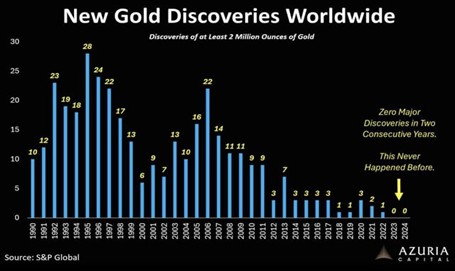
For a gold mine to be profitable, the deposit must contain at least 2 million ounces of the precious metal, as this is the only way to ensure production for many years to come. In previous years/decades, new deposits were discovered and supply was guaranteed. However, in the last two years of the gold rush, when gold was being sought everywhere, no major deposits were discovered anywhere in the world! This is the first time in history and, of course, an argument for a further rise in price.
Petroleum
Shale oil is running out in the United States. According to the latest data from the Energy Information Administration (EIA), shale oil production will gradually decline, mainly due to the depletion of deposits. The Permian Basin, one of the largest and most important shale basins in the world, is expected to produce less and less shale oil in the coming years. The impending supply deficit and the ever-increasing demand for this raw material are prompting leading oil producers to seek alternative sources for extracting black gold, especially in offshore deposits. Perhaps this is also the reason for the possible war against Iran, in order to secure reserves there, as in Venezuela.
Metals and rare earths
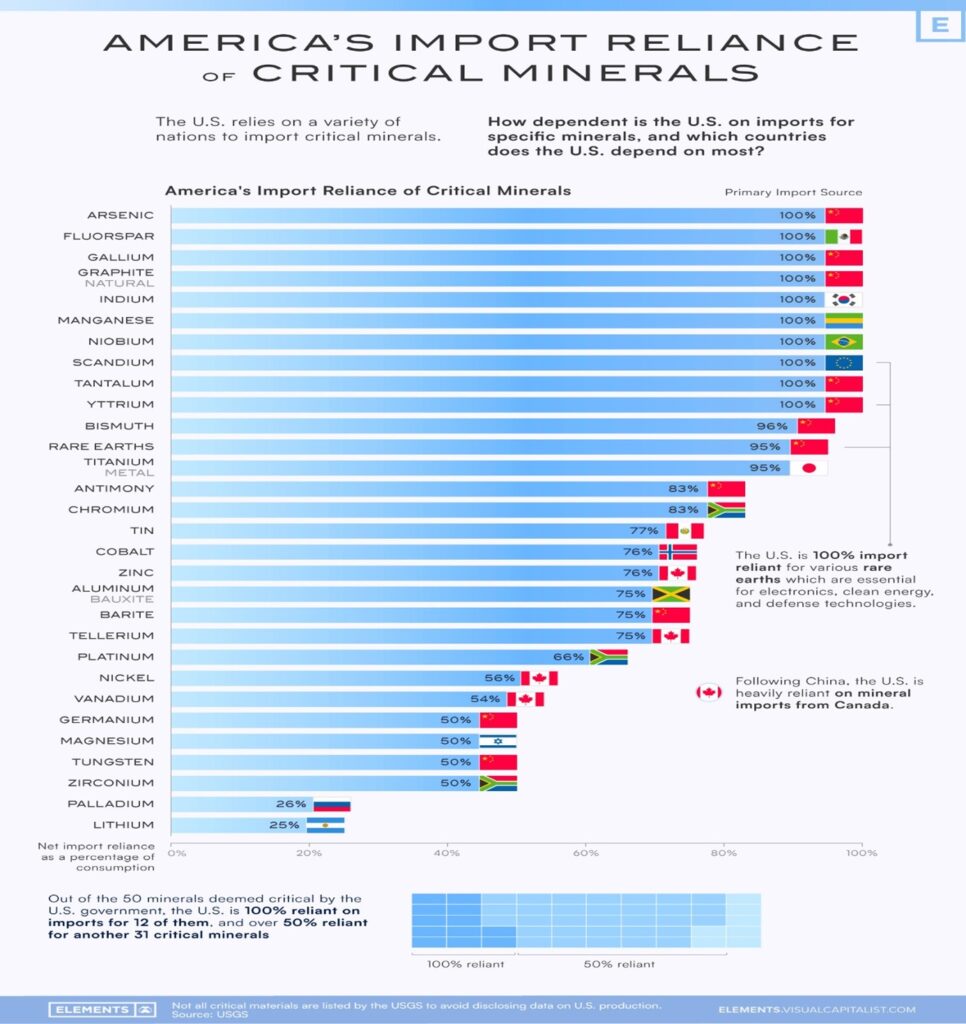
When it comes to both, the West is completely dependent on China and Africa. The following graph shows how heavily the US depends on other countries when it comes to minerals:
Source: Elements
Particular attention should be paid to rare earths, a group of 17 nearly indistinguishable heavy metals with similar properties that are indispensable in a wide variety of technologies, high-performance magnets, electronics and industry as a whole, as well as natural graphite, which is found in lithium-ion batteries. When Trump imposed tariffs on China, Beijing responded with restrictions on rare earth exports, which only exacerbated the geopolitical situation surrounding these materials.
The data shows that Africa’s share of resources and production of important raw materials is as follows:
- Platinum: 90% of global resources (mainly South Africa and Zimbabwe). Platinum is needed in catalytic converters and hydrogen technologies.
- Cobalt: 70-75% of global production comes from the Democratic Republic of Congo. It is one of the key components of lithium-ion batteries.
- Chromium: 85% of global reserves are of high quality. Required for the production of stainless steel.
- Manganese: 80% of global resources (mainly South Africa). Key to the production of steel and batteries.
- Tantalum: 60-70% of global resources (DRC, Rwanda). Indispensable in every smartphone and laptop (capacitors).
- Gold: approx. 40% of global resources.
At the same time, Africa remains the least geologically explored continent on Earth. Canada spends more than US$2 billion annually on field exploration, while all African countries combined spend just over US$1 billion. This shows that if the African continent were not so politically unstable, many more deposits would likely be discovered there. In addition, more and more mines are being controlled by the Chinese (e.g. the cobalt mines in Congo), which poses a real threat to the West.


