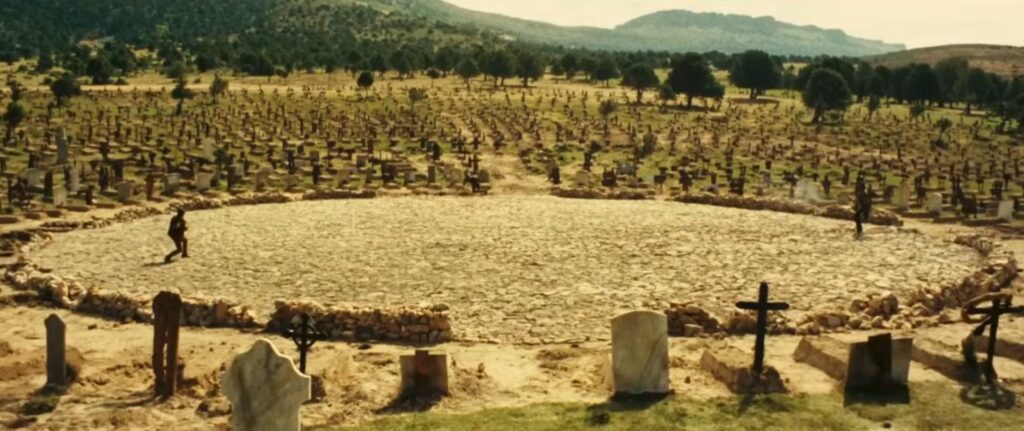
Cinematography in the service of hate

Reality finds expression in and is depicted by words, pictures and symbols. These in turn have a life of their own in that they are potent enough to impose the perception of the world through the meanings that they convey. An animal or a particular species may be perceived as a part of higher matter or a being endowed with a soul. Correspondingly, it can be disposed of without compunction or venerated. Think about cows in India; think about the treatment of dogs and cats in Europe as opposed to that in China; think about the attitude towards pigs in the Semitic and non-Semitic world, about clean and unclean animals, about edible and inedible species in different parts of the world.

Much the same is valid for humans. Depending on time and place they – or rather different categories of humans or – to be precise – different classes or groups of them are viewed as a legitimate booty or an object of veneration. Vera Mukhina’s Worker and Kolkhoznitza Monument of 1937 was a homage paid to the underclass people elevated to the highest status of veneration in the first socialist country. The perspective was changed and so the category of people once looked down on was transmuted to the category of people regarded as the pillars and pinnacle of society. Reversely, monuments to the heroes and members of the once ruling classes were pulled down, their memory tarnished or obliterated. Before that epic change could happen, hundreds of books, poems, pictures needed to be produced, hundreds of literary works or works of art that assailed the perception of reality and transformed it stepwise, thus paving the way for that change. The process is slow but very effective. It begins with casting doubt on the sacred and the acceptable, it continues with critique of the hitherto untouchable and sacrosanct, it ends up with the overturn of the scale of values, with elevating yesterday’s slaves and servants and debasing today’s lords and patricians. 

The Worker and Kolkhoznitza, a monument in its own right and a logo of a Soviet film studio: the once downtrodden elevated to the pinnacle of society.

In this manner the ancient gods of Egypt, Greece and Rome, the deities of the Celtic, Germanic and Slavic peoples were dethroned; in this manner the value of honour and dignity has been supplanted by the value of productivity and effectiveness; in this manner women are given preferment over men and adolescents are given advancement over adults. Animals are treated with reverence – at least in the white man’s world – so eating meat, wearing natural furs and using cosmetics tested on living creatures is frowned upon. These and many other changes take some time before they come to fruition. The champions of new ideas are assiduous and canny, their opponents – stupefied and won over or at least rendered ineffective.

The way for profound, revolutionary, enormous changes have always been paved by thought, thought put across to ever larger masses of people by literature, visual arts and – especially nowadays – the combination of the two: the movie industry. This is one of the most effective and compelling tools with which those who run the industry can shape the perception of the world in the minds of tens and hundreds of millions. The majority of people learn their history, moral and political lessons from (predominantly) feature and (less frequently) documentary films.  Continue reading

Burning man – a nascent cult

Humankind has since time immemorial had two categories of people: those who accept and even embrace reality and those who rebel against it and attempt to flee it or remedy it. Perhaps it is a psychological thing: there are individuals who can cope with the world as it is, whatever may happen, and individuals who cannot and need to take the sabbatical every now and again.

Every year in ever increasing numbers young, professional, mainly white Americans and Canadian zero in on Black Rock City, Nevada, somewhere in the Black Rock Desert, north of Reno, in vehicles turned into juggernauts to spend their time – eight days – pleasing themselves, doing yoga, listening to music, sharing and gifting, as they say, and bowing down to all the present-day forms of superstition. The seemingly ad-hoc created community has its ten commandments called principles of burning man and these are:

 1 radical inclusion (everyone is welcome);

 2 gifting (without expecting reciprocity);

 3 decommodification (no commercial sponsorship);

 4 radical self-reliance (reliance on the inner resources of one’s self);

 5 radical-self expression (meaning determinable by every individual);

 6 communal effort (cooperation, collaboration and – to quote the third synonym used on the Burning Man website: interaction);

 7 civic responsibility (compliance with the law);

 8 leaving no trace (cleanliness of the environment);

 9 participation (being through doing); and

10 immediacy (immediate experience). 

Continue reading

“I am dying, but I won’t surrender. Farewell, Motherland!”

It was eighty years ago, at about four after midnight, on a Sunday. A heavy shelling of Brest Fortress began. The place was attacked by German artillery and air force, soon surrounded by German troops, whose task it was to capture the stronghold within eight hours. Had not Belgian Fort Eben-Emael been taken within hours a year earlier? The Russians can’t be better than the Belgians, thought Hitler’s generals. Yet, Brest Fortress withheld the first, the second and many other assaults. It resisted the attacks even though the other German units had moved further east and were approaching Smolensk. It took Germans eight days to quell the obstinate resistance. Still, individual defenders remained in the recesses of the ruined fortress much longer and continued to pose a threat to the occupying forces. So it was. After the war a graffiti was found on one of the walls, reading: “I am dying, but I won’t surrender. Farewell, Motherland!”

Alexander Lukashenko delivering a speech at Brest Fortress. Russian audio here.

Precisely these words were quoted in the televised speech delivered by Belorussian President Alexander Lukashenko and occasioned by the 80th anniversary of Germany’s attack on the Soviet Union, which opened the Great Patriotic War of the years 1941-1945, a war that is still vividly remembered and commemorated in Belarus and Russia. The president’s speech, impassioned as it was, was at the same time a strong political statement and an address not only to Belorussians but the Western world. During the approximately 20 minutes, Alexander Lukashenko recalled the blitzkrieg of 1941 and compared it directly with the “colour” blitzkrieg of 2021: just as in 1941 the whole of Europe pounced on the nations of the Soviet Union, so did the whole of the European Union charge against Belarus, with the difference being that this time it was the hybrid war rather than its hot equivalent. To add insult to injury, said Belorussian President, one German Minister Maas – as President Lukashenko condescendingly put it – imposed economic sanctions on Belarus precisely at night on 22 June. Was this symbolism intended? asked the President. 

He gave his speech against the backdrop of a huge Russian soldier – or, to be precise, a huge stone head mounted on powerful stone shoulders of a 1941 defender of Brest Fortress – whose stern countenance of a formidable warrior lent gravity to the President’s words. Can it be – continued the President – that history taught them no lesson? Is the German minister – asked Alexander Lukashenko – acting in his capacity as an heir to the Nazis or as an apologizing German? Have the Germans forgotten what harm they did to the many nations of Europe? Have they forgotten how often they have apologized, shed tears, went down on their knees ever since?  Continue reading

Gefira 55: The Transmutation of the World

Mankind has known coercion since its inception. A group of people, not to mention large tribes and eventually nations, obviously needs a hierarchy, someone to lead and the masses to follow the leader. The leader figure may be embodied by an individual or an elite. There must be a set of rules for society to function. Hence coercion. People are forced to abide by the commandments set proverbially from on high or merely agreed upon by a number of the more powerful leaders. The coercion meant that some worked, others divided the fruits of the work; that some spilt their blood in wars, while others declared those wars and concluded peace treaties; that some served while the others were attended to. Our age is no different and yet very much different: those who rule demand that all men and women tolerate, approve of, like – nay! – love each other. Hate – what do I say! – mere dislike, not to say disgust, disapproval, criticism are forbidden. We are entering the age of the dictatorship, the tyranny, the despotism of all-embracing, all-levelling love.

Think of all the hate-speech laws and the resultant penalties for raising an eyebrow at the sight of a tattooed individual, for looking twice at ostentatious behaviour only yesterday regarded as obscene. All such acts are microagressions to say the least and need to be nipped in the bud. The tyranny of love does not extend to its opponents who need to be reeducated, reshaped, remoulded; failing which, the opponents of the all-embracing love are fair game. Like those poor chaps tied to medieval pillories, with their faces and buttocks exposed to the projectiles of all kinds hurled at them by a passer-by who pleased to entertain himself in this way.

The ideology of the all-embracing love has not been born within the latest twenty-four hours, nor within the latest decades. It has been developing for three or so centuries, beginning at least in the Age of the Enlightenment. This ideology has worked its way from the theocentric to the anthropocentric view of the world, where now the working class, now women, now non-whites, now homosexuals are venerated. The same ideology is now intent on dethroning man and put nature – the planet, the Pachamama, the mother earth, the environment – in his stead.

It is the feature of ideology that it has nothing to do with logic, with thinking. Ideology invades and affects minds making use of evaluating terms and creating ideals. If reality belies them, so much the worse for reality. This man-cum-earth venerating ideology is the world religion of the 21st century, attempting to incorporate the other creeds. The 2019 Abu Dhabi Declaration signed by the leaders of the three Abrahamic religions and stating that it pleases God to have diversity in the form of the many creeds speaks for itself.

Gefira 55 traces back the birth of the modern ideology and doctrines that seem to be encompassing or be forcefully imposed on the world. It also conducts a comprehensive, if short, survey of the current critical points in world politics in an attempt to zero in on where the future Gavrilo Princip will fire the ominous shots in the Sarajevo of the future.


Gefira Financial Bulletin 55 is available now

  • The New World in, the Old World Out
  • The Transmutation of the Modern World
  • The Pedigree of Ideas
  • Basel III or the Great Upheaval in the Financial Markets

Sow the wind and reap the whirlwind

There used to be a time when European countries would conquer other continents to spread Christianity, i.e. to save the savages – as it was said – from eternal damnation. Since Christianity has been dead for many decades now, Western nations have rolled out a new religion: that of human rights. The advantage of the new creed is that it is supposed to be universal – as such was adopted by the United Nations – and does not require the different peoples of the world to renounce their religious beliefs. Rather, the religious leaders of all the other faiths fall all over themselves to show that their religious precepts have always been in line with the universal human rights or, indeed, that the human rights derive from their creed.

Be it as it may, the human rights religion is a political tool in the hands of the powerful for subduing others to their will. Under the pretext of defending human rights – wars are launched, missiles are fired, revolutions are staged and governments are toppled. Yugoslavia, Libya, Syria, Afghanistan – you name it – have all been subjected to penal measures in the name of preventing humanitarian disaster from occurring or spreading. The countries were bombed in the name of saving the lives of – yes, yes – women and children and oppressed minorities of all types. Even when the Americans did not know what to do with the incorporation of Crimea into Russia, Victoria Nuland, while listing the alleged Russian violations of the international law and – how otherwise! – human rights, pointed to the alleged prosecution of the homosexual “community” as they say.

The human rights religion is only used when it becomes useful. The fate of Uyghurs in China was not a problem for the “international” opinion for decades until it fit Washington’s plans to use it as a pressure to be exerted against Beijing. Since China has been regarded as America’s rival vying for world dominance, the human rights card is being played more frequently. When you lend your ear the the Western media, then all the message that you get is that the Middle Kingdom is a den of perpetrators of the worst atrocities aimed against particular groups of people: Uyghurs, the Tibetans, Christians, political dissenters and so on, and so forth.

Continue reading

The Signs of the Times

“When it is evening, you say, It will be fair weather, for the sky is red. And in the morning: To day there will be a storm, for the sky is red and lowering. You know then how to discern the face of the sky: and can you not know the signs of the times?” (Matthew 16:2-3).

Three Kenyan runners acquire Romanian citizenship. The chances are they may represent the country during the Tokyo Olympic Games. The three women have been granted citizenship because “Romanians just as Germans or Swedes or the French make up an open nation.” What is an open nation? An open nation is a civic union of people unrelated by blood, culture, language, religion, anything. You may become French or Romanian, American or Swedish by a legal deed, just as you may become a member of a club, a party, an organization. Even easier. After all you need to somehow fit the profile of the club or identify with the principles of a Party whose member you want to become. With nations – assuming that the word nation is the right term here – it is far easier.


Yes, these Africans are from now on Europeans.

Jodie Turner-Smith, a black actress of Jamaican descent, is the latest impersonation of Anne Boleyn. Never mind that up till very recently there were no black people on the British Isles; never mind that Anne Boleyn is a recognizable figure from the English past evoking no doubts about her race, her skin colour, her ethnicity. Admittedly, there was a time when white actors impersonated black protagonists. The difference is that their appearance would have been changed to resemble negroid features as close as possible. The very obvious thing that was done was to change the actor’s skin colour. The producers of “Anne Boleyn” could not be bothered to do anything like it. The king’s consort is as black as they make them.


In case you don’t know: she is one of the English queens.

Lori Lightfoot, the black mayor of Chicago, has recently made herself notorious by refusing to give interviews to white journalists. Not that it raised hue and cry, at least not the kind of hue and cry that a similar statement on the part of a white person would have raised. Lori Lightfoot, who is black, is “married” to Amy Eshleman, who is white, and they have adopted a daughter of colour. Just as we can have an idea of an open nation, why not have an idea of an open sex, open family, open aything?

Note that the three Kenyan – now Romanian – sportswomen or Jodie Turner-Smith as a white queen are by no means the only instances of what is happening. Africans representing European nations at sports events and black actors impersonating historic or legendary white characters are increasingly the new normal.


If you want a picture of the future model of connubial bliss, here it is.
Continue reading

Gefira 54: We are in need of critical reasoning

Gefira 49 made its readers more familiar with the idea of the Great Reset espoused by Klaus Schwab, the idea of refurbishing the whole world so as to make it – yes! – even better. We all know how badly we fare and how much we are afflicted with inequalities and how many problems beset us and how much poverty surrounds us. Hence, the project of restructuring capitalism, the best of the economic systems; hence, the proposition of transforming it into a kind of family business, with the word family denoting particular communities and ultimately all humanity, without regard for ethnicity, sex (nay, gender), skin… no need to enumerate the usual string of qualifiers. This new capitalism is technically referred to as stakeholder (not to be confused with shareholder) capitalism, really a kind of communism imposed from above. After all communism was state capitalism while this type of communism is going to be managed by global corporations rather than states. Now Gefira 54 picks up where Gefira 43 left off and goes on to have a closer look at the other branch of this breath-taking initiative developed and announced by the world’s elites: the branch’s name is inclusive capitalism and its apostle – or to be precise – female apostle is Lynn Forester de Rothschild. Inclusive capitalism appears to be another name for stakeholder capitalism, with all the same litany of wishful thinking: the top rich have joined forces to make the life of the hundreds of millions better in every significant respect. We know nothing about the actual goals of the elites, but the avowed targets are – as usual – equality and equity and fairness and the planet without regard for… well, we all know for what.

Gefira 54 then scrutinizes a significant part of mankind i.e. Africa or the Dark Continent, to see whether the lofty ideals disseminated and pursued by the billionaires are feasible in the place where they are most needed. We survey Africans, their patterns of behaviour and their capabilities not only on the continent where they are indigenous but also in the African diaspora and we ask a few questions, wondering, whether the world’s elites see the problems that we see. It is, by the way, an interesting phenomenon that the rich should care so very much about the poor. It is also an interesting phenomenon – which by now has become a rule – that individuals who have made very big money, oftentimes within one generation, within a decade or two, automatically become philanthropists with their own agendas of “making the world a better place” as is often said or sung. Likewise, it would be interesting to know whether they want to share the wealth that they have amassed with the rest of us or elevate us all to their status. If the former is the case, obviously, super rich though they are, their wealth spread among a few billion people would be reduced to so tiny individual amounts as to render them ridiculous. If the latter is the case, then we need to overcome our disbelief that the super rich mean it seriously to endow the hundreds of millions of people with manor houses, private jets and yachts. I can hear some of you say that neither of these sounds plausible. True enough. Then the elites must have conceived something other than what they reveal to us. What is it?

The equal or equitable (they make this distinction and few people care to find out what it means) society of tomorrow seems to be all the more problematic if we only take a closer look at the world’s finances, with the money being created by a click of a computer mouse and the production and services being largely hampered by the state of emergency that has been imposed almost everywhere around the globe because of the nucleic molecule in a protein coat that occasionally expedites someone’s arrival at the Pearly Gates.


Gefira 54: We are in need of critical reasoning

  • Capitalism with a human face
  • Africa
  • Ukraine
  • Inflation ante portas