800 000 troops at Russia’s underbelly

The American peace proposals have been countered by the proposals drafted by the European Union. The European Union has frantically elaborated its own vision of the peace process because the American points are not much to the commissioners’ liking, and because – and that is utterly important – the European Union desperately seeks to become politically relevant. As it is, the war is going to be brought to an end through negotiations conducted by the Russian Federation and the United States – the only protagonists on the world’s political stage. Neither Ukraine nor the EU matters. Ukraine has been objectified, while the European Union – sidelined.

The EU’s attempt to regain political traction reminds one of France’s attempts towards the end of the Second World War to play the war game on a par with the United Kingdom, the United States, and the Soviet Union. And, indeed, France managed to restore at least a semblance of its political relevance. The allies allowed Paris to be present at the ceremony of accepting the German surrender and to have its own occupational zone in Germany. It was – as said above – only due to the political generosity of the victorious powers that France was recognized as one of the winning parties because in reality France had been routed and occupied for a couple of years and – what follows – without the intervention of the Americans (and the British) France would not have liberated itself, on its own. No wonder then that when Marshal Keitel saw the French delegation attending the act of capitulation he could not restrain himself from remarking, ‘They, too, have defeated us?’

Today, it is not France alone but the entirety of the European Union plus Great Britain. In particular Germany, France, and the United Kingdom want to take a seat at the negotiating table and put forward their own proposals. They want to leave their mark on the peace process. And again, it depends on the United States of America and maybe also on the Russian Federation whether the EU will be admitted to the inner circle of world politics.

The counterpoints drafted by Brussels at times converge with those authored by Washington, and at times they diverge. Of the 28 points, Point 6 is quite peculiar. It states: ‘Size of Ukraine military to be capped at 800,000 in peacetime.’

800 000 troops at peacetime! That’s more than the standing armies of France (200 000), Germany (180 000), and the United Kingdom (140 000) combined! That’s more than twice as many troops as Turkey has (350 000). Consider that the Turkish armed forces are the second most numerous in NATO. And consider that Turkey’s standing army of 350 000 is sustained by Turkey’s population of 85 million, while Ukraine’s ‘capped’ military of 800 000 would have to be supported by 30 million, maybe even fewer people! If you add to it the devastation of Ukraine and the million or so of Ukrainian young men who have been killed or maimed, you begin to wonder how such an army could ever be raised in the first place.

The enormity of the size of Ukraine’s armed forces is one thing. The other is: why should Ukraine have such a huge standing army even if its maintenance were feasible? This question will surely be answered by Brussels along the lines of ‘making Ukraine capable of defending itself against the Russian aggressor,’ but is this explanation plausible? After all, at present, the Ukrainian army numbers maybe more than the said 800 000, and – as can be seen – it cannot withstand the Russian steady offensive. Why should it be capable of withstanding a similar offensive in the future?

Or maybe what the European Union covertly seeks is to keep using Ukraine as a permanent battering ram against Russia. in such a scenario the negotiated peace is going to be a mere ceasefire.

The proposal allowing Ukraine to have such a large army also runs counter to one of the two aims of the Special Military Operation, which is (apart from denazification) – demilitarization. How can Brussels expect Moscow to even consider Point 6? How could President Vladimir Putin or anybody in his place agree to having such an army at Russia’s underbelly after four years of war, after all the sacrifice and effort? Do Brussels politicians believe in the acceptability of this proposal? If they do, then their sanity is questionable. If we assume that their sanity remains all right, then we must come to the conclusion that this point alone serves the purpose of torpedoing the whole peace process, for a 800 000-men-strong army on Russia’s doorstep is a non-starter for Moscow.

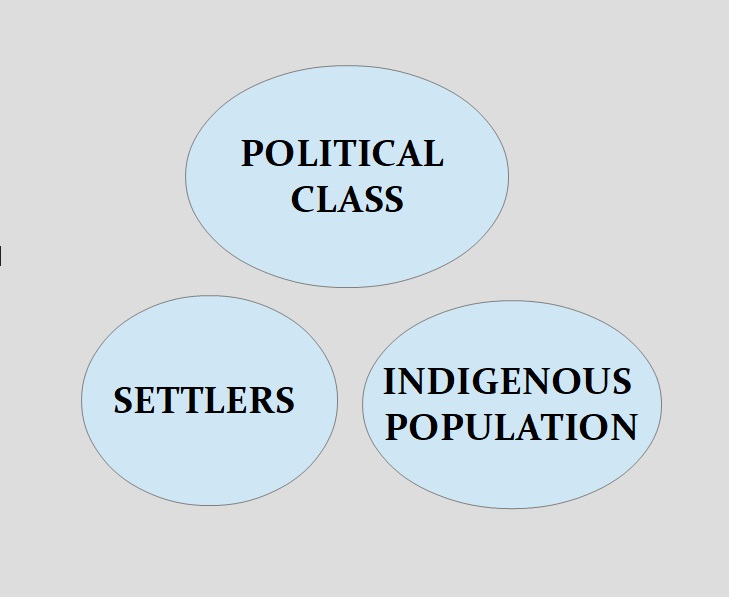
The rapacious elites destroy their own countries

It is sad but it is true: the elites or the ruling classes are hellbent on destroying their nations and their states. They are doing it in a variety of ways but they are doing it without a shadow of a doubt. They feel themselves deracinated from their respective nations and as a result they are spinning ideas of being citizens of the world where there are no nations, no races, no religions, and no cultures. Since the members of these elites are rich and influential, they can afford to live in nice and pleasant palaces or hotels, they can afford to travel the world and always have a lodging in a luxurious hotel, be it Nairobi or Karachi, where they are taken very good care of by the servicemen and servicewomen of all skin colours who necessarily speak English and smile all the time in the presence of the affluent travellers.

If a healthy elite could be compared to the head while the elite’s nation – to the rest of the body, then the depraved elites could be compared to the head that is cut off from the rest of the body. And that’s the problem. The head connected to its body feels the body’s pains and ailments acutely and acts on them appropriately. The head that is disconnected from its body feels absolutely nothing. The body may be suffering and ailing, and still the head does not respond to it. It’s even worse: a disconnected elite will tend to experiment with the body submitting it to any and all tests irrespective of whether those tests or experiments are painful, damaging or simply unpleasant.

The Western elites – the Western heads – came upon the ideas of applying to their bodies (nations) ethnic replacement, green economy, and rainbow sexuality. They are really intent on imposing those ‘values’ and they seem to be looking from afar how the experiment is developing. The lower classes are complaining? Let them. They can do nothing about what is being done to them. They are viewed as laboratory mice or laboratory rats. Does an experimenter care what the mice or the rats are feeling while being examined or tested? The British, French, German, Swedish and other guinea-pigs do not like the reality created by their elites, but then they are no more than guinea-pigs. No amount of resistance seems to matter to the experimenters.

That Eastern elites – while following everything that is propagated by their Western counterparts and their Western gurus – provide a kind of added value to this mix: they exploit their nations – their mice and rats – and export most of the money to the banks run by their Western colleagues or they invest that money in property and other goods in the countries run by their Western colleagues. They purchase palaces and yachts, they purchase expensive automobiles or invest in the shares issued by Western entrepreneurs or the bonds of the Western governments. We all remember Russian oligarchs who have invested in… the British football clubs. Why couldn’t they invest in the Russian football teams?

Why? They had amassed fortunes in their countries, exploiting (stealing from) their own nations – their co-citizens – so why couldn’t they give some of that money back to that same country, their own co-citizens?

Both kinds of of rapacious and disconnected elites are in for a rude awakening. The head cannot live disconnected from the body for a long time. It will, therefore, sooner or later, be replaced.

War is a blessing while people are like grass

The war in Ukraine is dragging on. The end is nowhere in sight. It is dragging on and soon it will be entering its fourth year. Reason suggests that Russia with its demographic and industrial potential could put the hostilities to a rapid end. Nothing of the sort is happening. Reason suggests that Ukraine should lay down its arms since there is no way it can regain lost territories, not to speak of winning over its much stronger neighbour. Nothing of the sort is happening. Reason also suggests that the West should work towards ending the hostilities because if Ukraine’s defeat eventually comes, the EU will be politically worse off. Nothing of the sort is happening. Why?

Russia. Russia has been benefiting from the war effort just like the United States benefited from the First World War and the Second World War: at that time American economy was boosted, and so is Russia’s economy today. Russia is benefiting from the war also in terms of its society rallying around the head of the state. Precisely as it was the case with the United States in both world wars, so it is now in the case of Russia: it is not directly affected by the hostilities it. Yes, Russian soldiers are dying or are wounded, but Russian soil and Russian civilians remain for all practical purposes unscathed.

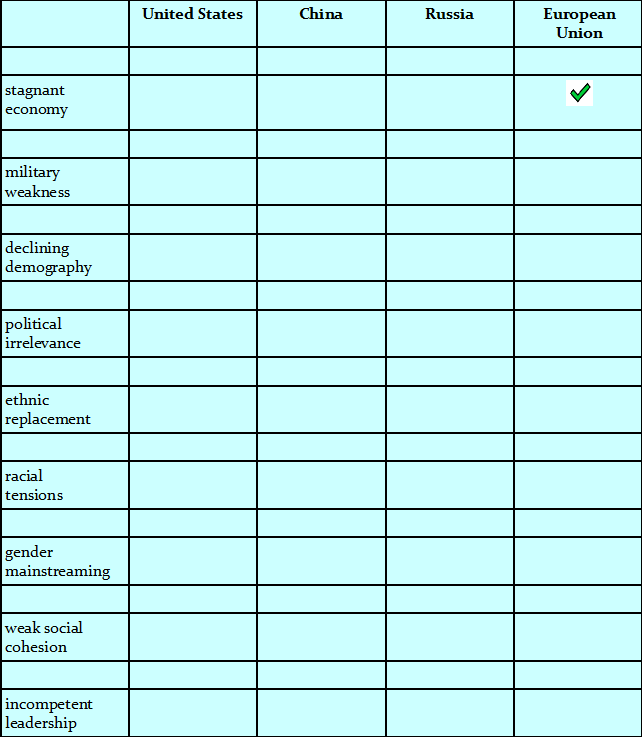
The European Union. The European Union is in decline. A decline caused by its deviant green ideology, by the indiscriminate acceptance of the influx of foreigners, and lastly by its economic problems brought about by the renunciation of cheap Russian gas. The welfare state is becoming overburdened, the governments and heads of state are increasingly unpopular while national and right-wing parties are on the political rise. Not infrequently people take to the streets and show their disdain for their leaders. The European dream is shattered. What then are the EU managers trying to do the save the day? Yes, they are trying to find a scapegoat for all the negative phenomena. This scapegoat is Russia. A very convenient scapegoat. All economic problems can now be blamed on the aggressor from the east, all shortages and shortcomings – on the ‘Mongols’ looming large on the eastern horizon. Europeans ought only to understand what is at stake, and rally round the EU commissioners in a joint attempt to defend the Garden against the Jungle.

The United States. The United States has used the war in Ukraine not only to weaken Russia, but also to subjugate Europe. Yes, Washington knows that Russia will eventually win, but in the process it will lose some of the people, and it will be kept busy, letting Washington more leeway elsewhere in the world. Europe has been conveniently rendered economically impotent, which is another gain for Americans. A competitor has been removed. The competitor’s reliance on Russian energy sources has been significantly lowered. Washington is cherishing high hopes that some of Europe’s industries and businesses will relocate to the United States, which will further deindustrialize the Old Continent and re-industrialize America.

What is the attitude of the three mentioned players to Ukrainians?

Russia. Russia recognizes in Ukrainians brothers by ethnicity. That is one of the reasons why Russian troops steer clear of destroying civilian objects and objects of cultural heritage. Concurrently, Russian troops are fighting hard culling the Banderite-type troops. This alone will render Ukraine less hostile to Russia. Also, the Russian army is destroying Ukraine’s military, thus making it no match to the Russian Federation in the nearest future. The destruction of the civilian infrastructure will make it barely possible for Ukraine to be accepted as a member of the European Union.

The European Union. The European Union couldn’t care less about Ukrainian life though, sure enough, the EU managers say they do. Ukrainian lives are pawns on the geopolitical chessboard and are willingly sacrificed on the altar of combating Russia. And what a paradox! The EU commissioners are gladly embracing ‘refugees’ from Africa and Asia who allegedly escape from war while they would gladly see all Ukrainian able-bodied men drafted into the Ukrainian army and sent to the front! The European Union accepts males from the Third World: why would it rather not accept all Ukrainian men who want to be drafted? True, Europeans are not as yet rounding Ukrainian men up in their cities and sending them back home, but such ideas have emerged now and again, here and there.

The United States. The United States views Ukraine precisely as Europe does: after all it was Zbigniew Brzezinski, the American politician and political thinker, who famously framed the globe as a chessboard. That’s precisely how the big players think about nations and countries: nations are chessmen while their territories are black and white squares of the chessboard. Accordingly, you sacrifice a chessman or you let go of a square as the case may be. The United States is one player, Russia or China is the other. Anything between them is – as we have already said – chessmen and chessboard squares. That’s all there is to it.

That’s also precisely how the managers of the world view the common people and their countries. The European elites may be whipping up war hysteria, but they themselves will not handle rifles or lie in trenches. Far be it from them! Whatever they want to impose on the common man and woman, they themselves prefer not to be affected by. Immigrants by the million for the common European to live with on a daily basis, but the commissioners live in places where they do not need to bother about strangers. Is it any different with war? No. Consider Ukraine’s President Zelensky. How has he experienced the three years of hostilities? He’s been travelling the world over, has been warmly received everywhere, and has given hundreds of interviews and made hundreds speeches, issuing hundreds of statements. How about the members of the Ukrainian government, of Ukraine’s parliament, how about higher officers? Pretty much the same story.

It has always been so throughout human history. Napoleon Bonaparte had half a million soldiers killed, frozen, or maimed in Russian steppes, but he himself made sure to be able to escape from the enemy and the frost in a comfortable coach, wrapped in warm furs. Adolf Hitler and his entourage? After the Red Army had crossed the Oder and was approaching Berlin, he and his ministers and generals must have realized that the end was inevitable and that the end was just round the corner. Some of them must have already taken the decision to commit suicide, and yet in order to prolong their lives by mere three-four months they did not stop the war. Rather, they sent new waves of troops – teenagers and the elderly – and added hundreds of thousands if not millions deaths to the huge overall toll.

For the managers of the world affairs, war is a game, a game that thrills them because it is a game played in reality. It is not a computer game. Augustus II the Strong (1670-1733), Elector of Saxony and King of Poland conspired with Tsar Peter I of Russia to attack Sweden in the latter’s possession on the Baltic. The war, which began in 1700 and lasted till 1721, soon after its outbreak turned to be a catastrophe for Saxony and partly for Russia. Augustus was forced to draft new and new men to either defend his country or help his Russian ally. When someone pointed to him that so many men had died and so many more were about to die, he shrugged his shoulders and merely replied: people are like grass. The more you trample it, the more abundantly it will regrow.

You’ll have to kill me to make Slovakia go to war against Russia!

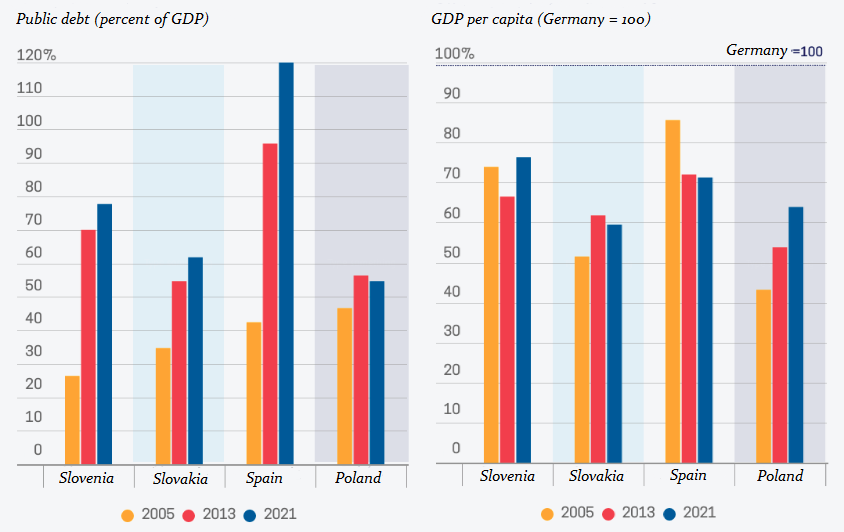
Slovakia is one of the smallest member-states of the European Union. It used to be part of Czechoslovakia. In 1993, Slovakia separated from Czechia and became an independent republic, which was a political dream that had been pursued for the whole of the 20th century by the majority of Slovak political activists and intellectuals. The separation of Slovakia and Czechia went peacefully and smoothly, quite unlike the dissolution of the former republics of the former Yugoslavia. (By the way, Slovakia – the former constituent part of Czechoslovakia – is not to be confused with Slovenia, also an EU member-state – the former constituent part of Yugoslavia. Both countries are Slavic nations, whose names derive from the Slavic word meaning word, hence the similarity in their denominations.)

Slovakia is one of the smallest countries of the European Union, but despite its small size both in terms of area (slightly smaller than Croatia but slightly larger than Denmark or the Netherlands) and population (roughly as populous as Norway or Ireland), it stands out as an entity that is courageously pursuing its own interests rather than being submissive to the dicates from Brussels. In this respect Slovakia resembles Hungary. Quite recently, Slovakia’s Prime Minister Robert Fico (pronounced: FEE-tsaw, not FEE-kaw) dared to visit Moscow and Beijing, which was a gauntlet thrown down for Brussels to take up. Slovakia’s prime minister’s policy making which is free from external influence and pressure – quite like the policy making on the part of Hungary’s Viktor Orbán – is proof that even a relatively insignificant country can follow its own path rather than that imposed on it by external forces. In other words, it takes a leader, a statesman, a brave individual, a man of strong convictions and principles to run a country in accordance with the country’s best interests. What are those interests?

One of them is not to be involved in military hostilities. That’s precisely one of the prerogatives of Robert Fico’s political platform. Slovakia’s prime minister laid down his principles of good governance while giving a speech occasioned by the anniversary of the Slovak National Uprising, August 29–October 29, 1944, that broke out against the Germans who had been controlling and occupying the country for a few years. Robert Fico spoke to a large audience where a couple of elderly combatants – participants of the uprising – were present. He spoke against the backdrop of an impressive monument commemorating the historic events. In his speech, the prime minister intertwined the past with the presence. He vividly depicted the atrocities of war and contrasted them with the present-day reckless talks among the present-day European politicians who are discussing the possibility of war (with Russia) as if it were a computer game that you can start and end at will, sitting in a comfortable place. In an attempt to get across the horrors of war and the unspoken suffering, Robert Fico mentioned the assassination on his own person. Not to appear as a hero or a victim of the event. No. Slovakia’s prime minister said something along the following lines: I was hit by the bullets and was speedily helicoptered to a hospital where I was taken good care of and could survive. Imagine now, Robert Fico continued, that you get hit here, in this field, in this low temperature. There is no chopper going to pick you up. You are lucky enough if a stretcher-bearer or a medical orderly is close by and tends to your wound superficially. That’s it. Your chances of survival are small. That’s what war is all about. Robert Fico mentioned American President Roosevelt, who famously remarked that some of the more bellicose senators or representatives should have a shell exploding in their backyard to make them realize what war really is all about.

Slovakia’s prime minister mentioned the morally reprehensible demolition of the monuments to the Red Army soldiers who liberated Slovakia at the end of the Second World War. There ought to be no dehumanization of other nations, other peoples, he said. His attempts at bringing about reconciliation or at least mutual understanding between Russia and Europe were met with hostility in the West. Sweden’s prime minister revealed to Robert Fico that Slovak Social Democrats might be excluded from the cooperation of European social democratic parties because of Fico’s visit to Moscow and Beijing. When Slovakia became a member-state of the European Union in 2004, said the Slovak prime minister, the Union seemed to be a peaceful organization. Sadly, it is no longer so. War is the order of the day in Brussels. But if anybody wants to draw Slovakia into war, he will have to replace Slovakia’s prime minister because – Robert Fico said – so long as he remains Slovakia’s prime minister, Slovakia will not let itself be drawn into a military conflict.

Did Robert Fico invite yet another assassination attempt on his life?

Ribbentrop-Molotov (1939) occurred in the wake of Chamberlain-Hitler (1938)

Russian President Vladimir Putin gave a speech during one of the sessions of the Valdai International Discussion Club (September 29 – October 2). That’s already a traditon: Vladimir Putin is habitually invited to to sessions of the Club, and this year was no exception. The speech was was followed by about two hours of questions from the journalists and the president’s answers. In both parts of his presence at Valdai, the Russian President laid down Russia’s point of view, Russia’s expectations, and Russia’s intentions.

[1] The world should be rid of military blocs. They have no purpose. Or – if there needs to be a military bloc – let it be one big military bloc – like NATO – but inclusive of all countries. Russia twice attempted to become a member of the Atlantic alliance: in 1954 (the being a part of the Soviet Union), and then in 2000. In either case Russia’s proposals have been turned down. Why? President Putin recounted his 2000 meeting with President Clinton and his suggestion concerning Russia’s NATO membership. The American president was willing to accept the proposal in the morning, only to turn it down later in the day, saying that the time was not right yet. Why? When would the time be right? asked Russia’s president.

[2] In anti-Russian narrative the West is glaringly biased in its actions and unfair in its propaganda. Take the historical policy, said the president. Much fuss is about the so-called Ribbentrop-Molotov Pact of 1939. As a result of this pact signed by foreign ministers of respectively the Third Reich and the Soviet Union Poland was dismembered in the following weeks. Yet, the West glosses over the preceding Munich Agreement of 1938 between the British and French prime ministers Chamberlain and Daladier on the one hand and the rulers of Italy and Germany – Mussolini and Hitler – on the other within the framework of which Czechoslovakia was dismembered within the following weeks. Why do Western propagandists lay emphasis on the former and ignore the latter?

[3] Similarly, if Russia is a paper tiger, as President Donald Trump famously said, and this paper tiger – that is Russia – is successfully fighting in Ukraine against NATO, then what NATO is? asked Vladimir Putin to the amusement of the audience.

[4] Though the war in Ukraine is waged and the collective West appears to be bellicose towards Russia, nonetheless the United States keeps importing Russian uranium for American nuclear power plants, and Russia appears to be America’s second largest provider of this resource. This Russo-American deal should continue, said the Russian president, because it serves the interests of both partners, but why then can’t Western Europe purchase Russian gas? Why does the United States demand that China and India stop purchasing Russian gas and oil? Obviously, the old rule of quod licet Iovi, not licet bovi applies here.

[5] The West is deteriorating, losing its identity, having problems with immigrants and others. So, rather than being focused on Russia, the West ought to deal with its internal problems. The loss of cultural identity has brought about a new phenomenon: an ever larger stream of people from the West is arriving in Russia to settle. One of the most striking examples is the case of Michael Gloss, son of a deputy director of the CIA, who arrived in Russia and voluntarily joined the Russian armed forces to fight against Ukraine. He was accepted, trained and sent to the front where he was killed. He was killed by a Ukrainian drone, while being wounded and trying to help his Russian mate. The Russian authorities granted him an order for bravery and requested Steve Witkoff – President Trump’s special enboy to Moscow – to hand it over to his family. Michael Gloss fought for Russia as he viewed Russia as a guard of traditional values that are shrinking in the West. They are shrinking so rapidly and have shrunk so much that even those Russian intellectuals – said Vladimir Putin – who have always dreamt about the West as paradise, as a model for Russia, as the Garden of Eden, began to say that the Europe that they have loved so much is no more.

[6] The Russian President revealed Ukrainian losses: in September 2025 alone Ukraine had 44.700 casualties of which 50% were irretrievable. During the same time Kiev could send to the front 18.000 of those drafted and 14.000 from hospitals as replacements, which means that the Ukrainian Army was short of 11.000 troops. The Russian President also said that between January and August of the current year as many as 150.000 Ukrainian soldiers deserted the ranks. Some surrendered willingly to the Russian troops, although that was a hard task on their part because they were often killed by drones operated by mercenaries who do not care about Ukrainian lives.

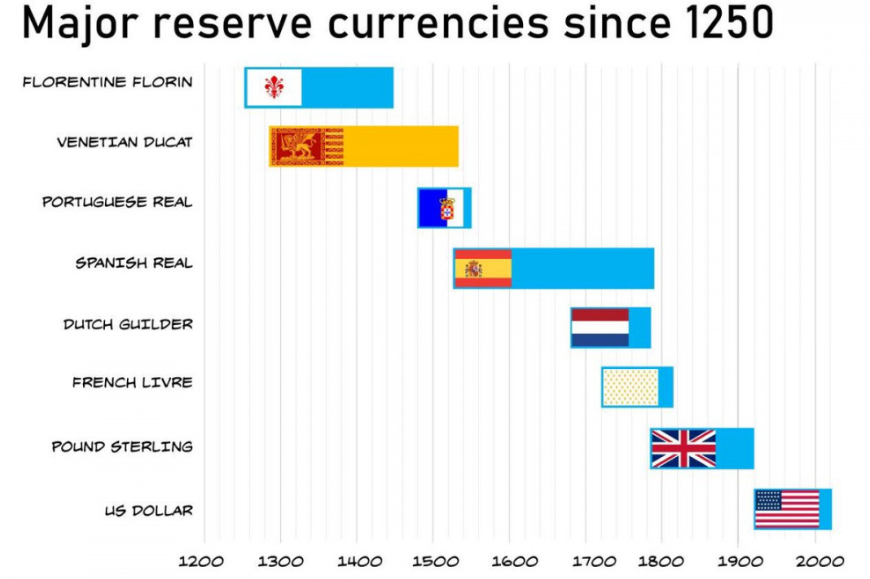
[7] Vladimir Putin said that Russia along with China and India and others do not want to dethrone the dollar: the fact that Russia, China and India and other countries are beginning to use other currencies in their trade is a simple result of the West’s financial policy that leaves Russia, and China, and others no other way as to bypass the dollar.

[8] President Vladimir Putin praised President Donald Trump and said, indeed, that he believed that the war would not have broken out had Donald Trump been the American president; and, yes – said the president – Donald Trump is a man who has the ability to listen to his interlocutor, to hear him out, and grasp his point of view.

[9] Unfortunately, just as once it was the Soviet Union that would impose its ideology on other countries, now this attitude has been adopted by the United States in Washington’s attempt to homogenize the world and create it in America’s image.

[10] At a point during the questions-and-answers part, Vladimir Putin confessed to being an ardent reader of poetry, especially Alexander Pushkin. From a volume of his poetry the Russian president read out loud a larger fragment of the poem that Pushkin entitled The Anniversary of (the Battle of) Borodino (Бородинская годовщина). The text refers to the age-long dream of the West to subjugate Russia. The poem was composed in 1831 and occasioned by the 1830-31 Polish anti-Russian uprising, which had the political and moral backing of the West. The message that the Russian president wanted to put across was that the strife between the West and Russia is of very long standing.

Donald Trump’s Machiavellian plan to finish the war?

Ukraine’s president, European managers and all anti-Russian forces are beside themselves with joy because of the recent statement that the American President Donald Trump made on Truth Social. The American leader did an about-turn over the war, writing that Ukraine could successfully oppose its enemy and – and that is what sent positive shock waves across the Western world – Ukraine can regain all its lost territories. The EU leaders must have heaved a huge sigh of relief. Eventually the United States has been brought over to the point of view of the coalition of the willing!

Donald Trump’s words are kind of weird, and they are kind of not. They are weird because they represent a complete opposite to what the president used to say for the last few months: Ukraine was losing to Russia and had to be ready to cede some territory. Yet, the same words are not weird because President Donald Trump has accustomed us to this nice trait of his character that he loves saying two opposite things, sometimes within the same day or even in the same breath. Anyone who’s been paying attention to the American presidents statements should have grown accustomed to this particular style of his communication with the public.

Let us assume, however, that Donald Trump is going to stick to this statement. That means that the United States is from now on supporting Ukrainian war effort, at least psychologically; that also means that the European Union does not need to bother about Americans trying to hold Brussels back from aiding Ukraine in one way or another; and finally, the president’s words encourage those political groupings in Ukraine which might be framed as a pro-war party. An easy interpretation, is it not?

Does Donald Trump believe in what he said? It might be that President Donald Trump has been misinformed and misled by his advisors, and that he really thinks that Ukraine is doing militarily well while Russia is on the verge of an economic, and – what follows – social collapse caused by its war effort. In his statement the president used words and phrases such as paper tiger in reference to the Russian Federation or long queues for gas in reference to Russian economy. Donald Trump may believe in any and all of these things: after all, he does not make an impression of being very well educated and knowledgeable about the world, its geography and history. Some of the president’s earlier statements confirm this observation, like when he said that Russia lost over sixty million casualties during the Second World War (a number three times as large as in reality). The same observation concerning the level of general education and expertise on Russia can easily be extended to the American elites. So much so that they very often let themselves be guided by visceral hatred rather than critical reflection towards their geopolitical opponents.

But there might be something more than meets the eye. It might also be that President Donald Trump is an incarnation of Machiavelli, at least in the understanding and image of the latter that most people share: someone sly and canny. What do we mean? Well, it might be that President Donald Trump is perfectly aware of the vast disproportion of the forces between Ukraine and Russia in favour of the latter, and since he has been unable to bring about peace, and since he’s been thwarted in his peaceful attempts by both the EU and some of his advisors, he devised a Machiavellian plan to accelerate the end of the hostilities by… pushing Ukraine into the conflict with an even greater vigor and gusto: this will make it easier for the Russians to crush Ukrainians and thus bring the war to an end. Stiff resistance and a couple of more failed offensives might prove to be the last nail in Ukraine’s coffin, since the country is running low on manpower, military equipment, and resources. The American president may safely prompt the European Union to continue the aid to Kiev, knowing full well that Brussels is also running low on its resources, financial or otherwise. Ok, if you want to prolong the war, Donald Trump might be thinking, then go on, be at each other’s throat. The more fiercely you will fight, the sooner the end will come. When the lightweight doggedly wishes to hurl himself against the heavyweight and precipitate his own destruction, why should the referee (United States) who has grown tired of the boxing match (the war) intervene?

For the wages of sin is death

Eighty six years ago today the Second World War broke out. It broke out on September 1, 1939, with Germany assailing Poland, and with Great Britain and France declaring war on the Third Reich three days later. Within the next more than five years Europe would be engulfed in flames, suffer enormous devastation and a huge loss of life. What was the cause of the war? No, we are not going to repeat the hackneyed arguments that our readers are most likely to be familiar with, to be familiar with all of them. We are going to point to one thing only: intemperance.

Yes, intemperance. Intemperance in the political appetite of the main player, of Germany. Had Adolf Hitler stopped his aggressive policy after gobbling up Czechia, Germany would most probably have become the most powerful country in Europe, the German language would be what the English language is today. Taking into account the advancements of German technology during the late thirties and early forties – the television being launched during the Berlin Olympic Games in 1936, the jet engine (Me-262) and the V-2 missiles – Germany most probably would have launched the first man into orbit and land him on the moon. The entirety of Europe – maybe only except for the United Kingdom and partly France – was under German influence and… spell. Think of Hungary, Romania, Slovakia, think of the national-socialist parties in Norway, and even Great Britain, think of the expansion of German cinema and what not.

Between the swallowing of Czechia and the offensive against Poland, Germany occupied a huge chunk of territory in central Europe, numbered eighty million people (the United Kingdom had 48, France 41 million inhabitants) and was closely allied during the period of 1939-1944 in one form or another with Italy, Spain, Hungary, Romania, Finland, and Slovakia. There were strong pro-German political movements in Yugoslavia (especially Croats) and Bulgaria as well as in Turkey. No one on the continent pose any threat to Germany, either militarily or economically. There were numerous German minorities in Poland and Romania, which could be leveraged against the Polish or Romanian authorities. Germany regained its position as a power and appeared to be mightier than it had been before the First World War. The only thing that Germany seemed to have lost for good were the few African colonies that it had had prior to the outbreak of the First World War. Anyway, had Berlin stopped at this point – 1938/1939 – its expansionary politics, had Adolf Hitler died or been toppled… Had Germany shown restraint…

As we know, pride – or better put: self-pride – comes before a fall. Intemperance in its political appetites brought Germany to rack and ruin within a couple of years. The country lost a third of its territory, was split into two political entities, has been and remains in a way occupied till this day, while the German language, culture, literature and cinema have lost to the English language and American culture, literature or cinema.

Isn’t it the same with the European Union nowadays? It began modestly as an economic union of six states coming together only for the purpose of jointly managing the extraction and production of coal and steel. Then the union began expanding, gobbling up ever more states, creating ever more administrative structures and imposing its moral rules upon almost the rest of the world. Much the same can be said about NATO. Initially, a reasonable defensive organization, has evolved into a truncheon, a bludgeon with which the West decided to discipline or police small, powerless countries, be it Yugoslavia or Libya. Both organizations began swelling, swelling rapidly and could not recognize any limits to their growth. They did not even – which would be rational – allow themselves time to digest what had recently been swallowed. Hence, the unstoppable expansion to the east. Isn’t this expansion comparable the that of Germany’s before 1939? Both Berlin then and Brussels now are just incapable of recognizing limits to their growth (though otherwise they claim that there are such limits in economy, see the notorious tenet worked out by the Club of Rome). As a result, the European Union and NATO, just as the Third Reich, have been keeping expanding, come hell or high water, reeling in more and more territory and people. Is it so because it is Germany that is at the core of the European Union?

Eventually, just as the Third Reich found its nemesis and its undoing in Russia, so, too, does the European Union and NATO. It was in Russian and Ukrainian (Ukrainian!) steppes that the German (and Italian, an Hungarian, and Romanian) armies dug their graves. It is again in Russia and Ukraine that the European Union and NATO are digging their own graves. Eighty years later. Had Brussels and Washington stopped on the River Bug (the river separating Poland from Belarus), the European Union would by now have become a political and economic colossus that China and Russia would have reckoned with. As it is, it appears that the Union is at the end its economic and political tether, while China is on the rise.

It is not without reason that intemperance is one of the seven deadly sins: it brings a downfall. Restraint is a virtue: its reward is prosperity and stability.

Notice that just as Berlin could not recognize its failure in the east and continued war to the bitter end, so does the European Union. Are the bureaucrats in Brussels hoping for a miracle as Adolf Hitler did? The Miracle of the House of Brandenburg? Well, such miracles do happen, but miracles are miracles precisely because they happen extremely rarely. Yes, it happened so during the Seven Years’ War (1756-1763), when Berlin was captured by the Russian troops and Prussia was on its deathbed, that an unexpected change on the Russian throne caused Russia to suddenly withdraw its troops from Prussia, thus weakening the anti-Prussian alliance (made up among others of Austria and France), thus saving Frederick II, who then famously coined the quoted phrase of the Miracle of the House of Brandenburg. Yes, it was kind of a miracle. And, since it was a miracle, it happened but once. Else it wouldn’t be known in history as a miracle. Now, Hitler hoped for the same or similar event, sitting in his Berlin bunker and staring at the image of his beloved historical hero: Frederick the Great. Franklin Delano Roosevelt’s death close to the end of the Second World War began to be construed by Hitler’s entourage as a miraculous sign. They had hoped for a political change, the end of the coalition between the United States, the United Kingdom and the Soviet Union, the resultant salvation of the Third Reich – a repeat of the Miracle of the House of Brandenburg. But no, the miracle did not repeat itself because miracles are rare, extremely rare.

Also today we can observe the coalition of the willing, top European leaders who intransigently refuse to look reality in the face. They are hoping for a collapse of Vladimir Putin, for societal unrest inside Russia and for a successful offensive on the part of the Ukrainians. The leaders who are making up the coalition of the willing are not as yet hidden in a bunker and they are not staring at the portrait of Frederick the Great, but they behave precisely like they are hidden in a bunker and staring at the Prussian king’s image. Teenagers and elderly people are drafted into the Ukrainian army just as teenagers and the elderly were drafted into the Volkssturm, and despite the obvious and glaring similarity the leaders making up the coalition of the willing seem to be totally oblivious to it. What are they counting on? On the miracle of the House of Brussels?

The EU leaders and creators have had an opportunity to create something valuable in history and they have botched everything up. That’s because they were and continue to be puffed up with self-pride and intemperance. It was not enough to unite Europe and somehow mix European nations: they needed to let in the Third Worlders by the million; it was not enough to just respect the cultural differences and especially to respect the moral mainstay of the Old Continent: they needed to flood it with the rainbow propaganda; it was not enough to enjoy a modest, rational economic development: they needed to jump into the “green” “sustainable” and “renewable” never-never world. Lastly, it was not enough to keep within the European fold almost all European countries and to slowly solidify the union and NATO: they needed to expand without rhyme or reason and they desperately needed to tease and irk big Russia.

Fools. Fools like insatiable Napoleon Bonaparte, fools like intemperate Adolf Hitler. They wanted more and more, deeper and deeper, farther and farther, faster and faster till they hit with their heads against a brick wall and now are forced to retreat with their tails between their legs. Fools. They thought they were all-powerful, like gods. They thought the world was out there for them to shape and form to suit their whims and their narcissistic grandiosity. They sacrificed the lives of the millions and still have absolutely no pangs of conscience. Yet, just as their political predecessors, they are eventually being punished. The union is coming apart at the seams. It is in a downward spiral – economically, demographically and politically. Think of the seven dwarfs – top European politicians – taking orders from President Donald Trump in the White House. Think of them being asked to leave the room because the real leader wanted to phone another real leader, that is the hated Putin. It was not very much earlier when the seven dwarfs framed themselves as the seven giants, giants that can confidently dictate to Russia, China and India. Look at them now with their silly, ridiculous seventeenth-eighteenth-nineteenth package of sanctions. Look at them conspiring among themselves while Trump and Putin – the real leaders – confer above their heads. The seven dwarfs could have been leading their union to a “bright” future, but they preferred to listen to the serpent hanging from a tree. The serpent told them that they could do whatever they pleased. They listened and believed. And they became intemperate. Intemperance is a sin, and – as we know (though they don’t) – the wages of sin is death.