



They were just the two of them: Czech and Lech. They wandered the terrain along the Carpathian Mountain chain and eventually made a stop on a plain on both sides of the Moldau/Vltava River. There they settled and grew in numbers: two extended families, that of Czech, and that of Lech. With the passage of time, as they populated the new land, it turned out that there was little room for two families whose numbers were constantly rising. One of the brothers – Lech – decided to part with Czech and look for a new land to settle. His family moved north, crossing the Giant Mountains (Sudeten) and wended its way through primordial forests, till they spotted a big white eagle spreading its magnificent wings over an impressive nest. That’s the place we want to settle, said the forefather Lech, and so his extended family struck root in the country that later came to be known as Greater Poland. Centuries later it was here that a strong dynasty was established whose successive leaders managed to gradually join the neighbouring tribes – offshoots of the original Lech family – into one political entity, giving rise to what later was to be known as Poland. The white eagle became the country’s national emblem and has remained so till this day.
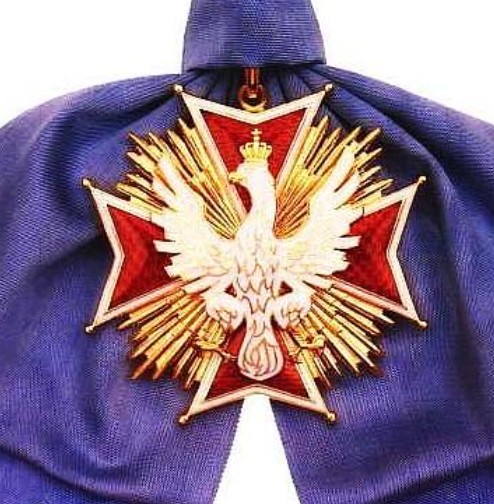
No wonder then that Order of the White Eagle is the name of the highest decoration that a Polish monarch or president can bestow. It traces its origin back to the year 1705, and its motto reads pro fide, lege et rege, or for faith, law and king.
Throughout its history the order has been given to a number of individuals, Polish and foreign. After Poland had been partitioned by Austria, Prussia and Russia, the Russian Empire adopted the order as its own and its monarch continued bestowing it. Russian emperors were simultaneously Polish kings during that time.
After World War Two, though the order was not officially abolished, it was not conferred by the so-called communist authorities. The Polish government in exile (representing the anti-communist political forces) continued to bestow it.
With the fall of communism in Eastern Europe (1989), the Polish authorities resumed the bestowal of the order, decorating both Polish citizens and foreign individuals. The order is conferred by Poland’s president who is aided in this task by a special Chapter of the Order of the White Eagle. Each Polish president is a recipient of this order ex officio.
Among the foreign recipients of the order is Ukraine’s President Volodymyr Zelenskyy. He received it in April 2023 when Andrzej Duda was Poland’s president. Why did he receive the order? Officially because Volodymyr Zelenskyy is a champion for freedom and democracy and the human rights and all that blah, blah, blah. In fact, he was given this decoration because he is the commander-in-chief of the Ukrainian army which fights against Russia, and there is nothing more pleasing to the majority of the Polish people than to reward anti-Russian political conduct.
But there is a big snag. Though Poland supports Ukraine in its fights against Russia with all its might, there are historical events that divide the two nations. During the Second World War the Ukrainian Insurgent Army UPA (Українська повстанська армія, УПА) and its ideological background – The Organisation of Ukrainian Nationalists OUN (Організація українських націоналістів, ОУН) – decided to ethnically cleanse the territories with mixed Polish-Ukrainian population. The year 1943 was an especially terrible year, which came down in history as the Volhynia Massacre, during which an estimated 100.000 Polish people were murdered and tortured. It was the time when the whole of pre-war Poland was under German occupation, the time when Ukrainian political leaders flirted with the Third Reich and provided Germany with Ukrainian auxiliary military units, the time when Ukrainian elites hoped for creating a Ukrainian state, free of national minorities. The Volhynia Massacre has become an iconic symbol of the events, but the ethnic cleansing continued for three years in between 1943 and 1945, spreading to East Galicia (today’s area around the city of Lvov) and today’s easternmost Poland.
Now the past is the past. The Volhynia Massacre is not the only one such event in human history. What makes it politically explosive is the fact that the Ukrainian political elites have not even attempted to condemn the event, nor have they decided to denounce the then political leaders and ideologues. To the contrary, Ukrainian nationalism is based on the veneration of the instigators and perpetrators of the massacres. Ukrainian cities and towns have monuments and commemorative plaques devoted to as well as streets or squares named after the same instigators and perpetrators. Though Kiev receives as much support from Poland as it is physically possible, Ukraine’s authorities show no willingness to apologise for the evil done to the Poles by Ukrainian past generations. When – to top it all – recently President Volodymyr Zelenskyy decided to name a military unit after the “Heroes of the UPA” (Ukrainian Insurgent Army), Polish President Karol Nawrocki said that enough is enough, and made a suggestion to strip the Ukrainian leader of the decoration of the White Eagle.
But why was Volodymyr Zelenskyy conferred this order in the first place? Did the Polish elites not know that their Ukrainian counterparts kept venerating the OUN/UPA leaders and ideologues? Did they not know that Ukrainian cities and towns are peppered with OUN/UPA memorabilia? Did the Polish elites not sense that Ukrainian politicians were reluctant to take any steps towards historical reconciliation? Was President Andrzej Duda, President Karol Nawrocki’s predecessor, not aware of all this when in April 2023 he was decorating President Volodymyr Zelenskyy with the Order of the White Eagle? Of course, he knew everything and was aware of everything, and for all that he continued supporting Ukrainian chauvinists, thus marring the memory of the tens of thousands of his compatriots who had been maimed, tortured, dismembered, crucified, burnt alive, murdered, expelled from their homes, from their villages, and, and, and. President Andrzej Duda represented the same political faction as President Incumbent Karol Nawrocki. Now President Karol Nawrocki wants to strip Volodymyr Zelenskyy of the order. Well, it’s like having the right hand giving a gift and the left hand taking it back. In their total helplessness the Polish authorities are exposing themselves to ridicule.
Besides, why all this fuss over the bestowal of the said order? Ukraine’s President Volodymyr Zelenskyy is by no means the only one recipient of the White Eagle unworthy of the honour. Let us survey the list of the recipients of this decoration. Who do we find there?
We have mentioned the partitions of Poland, the time when the Polish state as a political entity was annulled by the three neighbouring powers of Prussia, Austria and Russia. Poland – or to be accurate: the Polish-Lithuanian Commonwealth – collapsed also due to the high treason of some members of its nobility. Many of these traitors received the Order of the White Eagle prior to or after the act of treason. Did they deserve the order? During the time of Congress Poland – a semi-independent Polish state created on the lands of the Russian partition in 1815 – it was the Russian tsars who received the said decoration ex officio, as Polish heads of state. Among other recipients was General Ivan Paskevich, who suppressed the 1930-31 Polish national uprising, or Adam Wirtemberski, who while commanding Russian troops shelled the Puławy Palace, where Polish insurgents found refuge. Adam Wirtemberski had the palace bombed knowing full-well that among its residents was his own mother, Maria, a Polish patriot… Did he deserve the decoration?
Pre-war Poland awarded the Order of the White Eagle to August Hlond, Primate of Poland, who later (1939), when Germany attacked his country, fled abroad in a cowardly way, leaving the Polish Catholics alone face to face with the German occupiers.
Also today’s Poland has conferred this order to very many individuals, also foreigners, whose merits are – to put it mildly – doubtful. Who do we see among the recipients? We can see Valdas Adamkus or François Hollande or Helmut Kohl, whose only merit was that they were presidents or Prime Minister of, respectively, Lithuania, France, and Germany. (How does that relate to Poland and Poland’s interests?) Also, quite a few monarchs were recipients of the Order of the White Eagle: Queen Mathilde of Belgium, Queen Paola of Belgium, Queen Máxima of the Netherlands, Queen Beatrix of the Netherlands, Queen Margrethe II of Denmark, Queen Sonja of Norway, Queen Sofía of Spain (what a propensity for queens!), or Emperor of Japan Akihito.
President Volodymyr Zelenskyy is by no means the only Ukrainian president who received this said order. The other recipients are President Leonid Kuchma (1997), President Viktor Yushchenko (2005), and President Petro Poroshenko (2014). Why did they get this decoration? It looks like they were awarded the order ex officio, just like their Polish counterparts (four Ukrainian presidents were decorated out of just six in total!).
Virtuti Militari (for Military Virtue) is Poland’s highest decoration for heroism and courage. Between the Second World War and the fall of communism (1945-1989) in Poland it was considered to be the highest order, since the Order of the White Eagle, though not abolished, was not granted any more. Now in the year 1974 the communist authorities conferred Virtuti Militari on Leonid Brezhnev, Secretary General of the Communist Party of the Soviet Union, the leader of the USSR. That gesture on the part of the Polish authorities met with a widespread and strong disapproval among the Polish people. Why should a foreign leader, a leader of a country that was regarded as Poland’s overlord be decorated with Virtuti Militari? When communism collapsed, the bestowal of the cross was annulled in 1990. Leonid Brezhnev, the recipient, had been dead for eight years… The decision of stripping Leonid Brezhnev of Virtuti Militari was signed by the then President of Poland Wojciech Jaruzelski, a communist by conviction, Leonid Brezhnev’s erstwhile political friend… What a comedy!
They call stripping of such an order an act of historical justice, but such decisions are rather acts of childishness: it is giving a thing and taking a thing to wear the devil’s golden ring. One cannot erase the fact that unworthy recipients were considered worthy at the time of bestowal; you cannot undo history. Damnatio memoriae or condemnation of memory – because that’s what it is all about – has been practised in the past many times across cultures and continents. In some cases damnatio memoriae is somehow understandable, when representatives of a new political system want to undo, unsay, or offset what their predecessors have done. In the case of the revocation of the bestowal of the said Order of the White Eagle on Ukraine’s President Volodymyr Zelenskyy we are facing ridicule pure: while Poland’s political system has not undergone a change, Poland’s current president wishes to undo what his predecessor did, a predecessor who belonged to the same political persuasion! What does that say about political leaders and political ruling elites?
Whether President Karol Nawrocki will be successful in stripping President Volodymyr Zelenskyy of his Order of the White Eagle remains to be seen. The decision to become effective needs to be countersigned by Poland’s prime minister, and he is a strong political opponent of the current head of state. He may choose not to oblige the president. The Prime Minister has already said that such the proposal on the part of the Polish president to strip Volodymyr Zelenskyy of his order plays into the hands of the Kremlin: a dispute between Warsaw and Kiev is precisely what Moscow is looking forward to. If (in a few days’ time) Poland’s Prime Minister blocks the president’s initiative, then Karol Nawrocki will suffer a dent on his political prestige. Why put forward a proposal that is not going to be pushed through?


