
The American peace proposals have been countered by the proposals drafted by the European Union. The European Union has frantically elaborated its own vision of the peace process because the American points are not much to the commissioners’ liking, and because – and that is utterly important – the European Union desperately seeks to become politically relevant. As it is, the war is going to be brought to an end through negotiations conducted by the Russian Federation and the United States – the only protagonists on the world’s political stage. Neither Ukraine nor the EU matters. Ukraine has been objectified, while the European Union – sidelined.
The EU’s attempt to regain political traction reminds one of France’s attempts towards the end of the Second World War to play the war game on a par with the United Kingdom, the United States, and the Soviet Union. And, indeed, France managed to restore at least a semblance of its political relevance. The allies allowed Paris to be present at the ceremony of accepting the German surrender and to have its own occupational zone in Germany. It was – as said above – only due to the political generosity of the victorious powers that France was recognized as one of the winning parties because in reality France had been routed and occupied for a couple of years and – what follows – without the intervention of the Americans (and the British) France would not have liberated itself, on its own. No wonder then that when Marshal Keitel saw the French delegation attending the act of capitulation he could not restrain himself from remarking, ‘They, too, have defeated us?’
Today, it is not France alone but the entirety of the European Union plus Great Britain. In particular Germany, France, and the United Kingdom want to take a seat at the negotiating table and put forward their own proposals. They want to leave their mark on the peace process. And again, it depends on the United States of America and maybe also on the Russian Federation whether the EU will be admitted to the inner circle of world politics.
The counterpoints drafted by Brussels at times converge with those authored by Washington, and at times they diverge. Of the 28 points, Point 6 is quite peculiar. It states: ‘Size of Ukraine military to be capped at 800,000 in peacetime.’
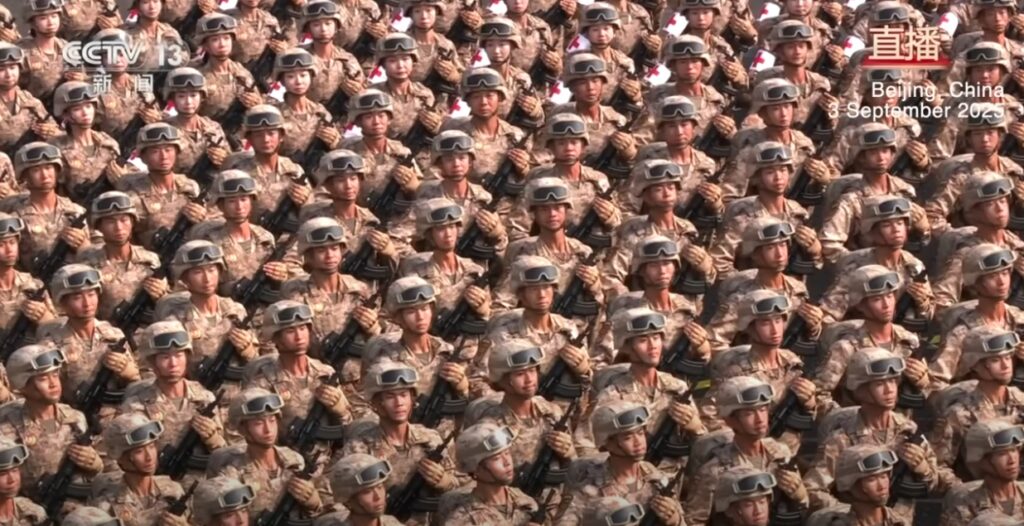
800 000 troops at peacetime! That’s more than the standing armies of France (200 000), Germany (180 000), and the United Kingdom (140 000) combined! That’s more than twice as many troops as Turkey has (350 000). Consider that the Turkish armed forces are the second most numerous in NATO. And consider that Turkey’s standing army of 350 000 is sustained by Turkey’s population of 85 million, while Ukraine’s ‘capped’ military of 800 000 would have to be supported by 30 million, maybe even fewer people! If you add to it the devastation of Ukraine and the million or so of Ukrainian young men who have been killed or maimed, you begin to wonder how such an army could ever be raised in the first place.
The enormity of the size of Ukraine’s armed forces is one thing. The other is: why should Ukraine have such a huge standing army even if its maintenance were feasible? This question will surely be answered by Brussels along the lines of ‘making Ukraine capable of defending itself against the Russian aggressor,’ but is this explanation plausible? After all, at present, the Ukrainian army numbers maybe more than the said 800 000, and – as can be seen – it cannot withstand the Russian steady offensive. Why should it be capable of withstanding a similar offensive in the future?
Or maybe what the European Union covertly seeks is to keep using Ukraine as a permanent battering ram against Russia. in such a scenario the negotiated peace is going to be a mere ceasefire.
The proposal allowing Ukraine to have such a large army also runs counter to one of the two aims of the Special Military Operation, which is (apart from denazification) – demilitarization. How can Brussels expect Moscow to even consider Point 6? How could President Vladimir Putin or anybody in his place agree to having such an army at Russia’s underbelly after four years of war, after all the sacrifice and effort? Do Brussels politicians believe in the acceptability of this proposal? If they do, then their sanity is questionable. If we assume that their sanity remains all right, then we must come to the conclusion that this point alone serves the purpose of torpedoing the whole peace process, for a 800 000-men-strong army on Russia’s doorstep is a non-starter for Moscow.