Silver flying high 

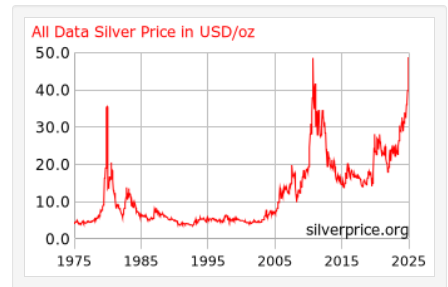
The price of silver has performed very well since the beginning of the year, due to both investment and industrial demand (mainly due to the production of solar panels by China), but it was only recently that information emerged about a real decline in supply in this market. As a result, the silver price hit new all-time records.  

The supply crisis was to begin with India and the Diwali festival there. At this time, Indians bought millions of rupees worth of jewelry to worship their goddess of wealth, Lakshmi. In previous years, this demand was for gold and the supply came from Asian refineries. This year, however, was different. For months, there has been speculation on social media in India that after such a big rally in gold, it is now time for silver. The breakthrough was to be the statement by banker and investor Sartak Ahuja, who in one of the videos targeting his 3 million follower community, stated that the silver to gold price ratio, currently 100:1 makes silver the obvious choice this year. After the video with the statements was released, Indians started buying silver massively, leading to the first silver shortage at the largest precious metals refinery in India. As per various Indian sources, the demand for silver was huge, never seen before, leading to a situation where Indians had to pay 8 dollars more for an ounce of silver than in the world markets. 

Due to the fact that the Chinese refineries were not working at the time because of a week’s break (public holidays), demand from Indian refineries shifted to the West and in particular to the LBMA (Bullion Stock Exchange in London) in London. There it quickly became apparent that 83% of the accumulated silver in LBMA warehouses is in the hands of ETFs and cannot be lent out (the refinery borrows the silver, processes it and sells it, earns a margin on it and then buys it back and returns it to their lender). Considering that there are 790 million ounces of silver in the LBMA, only 150 million ounces can be made available to refineries and other institutions. Thus, the low availability of metal led to an increase in silver rental costs to 39% per year if the rental period of the metal is 1 month.

As Metal Focus reports, the cost of borrowing silver for one day (overnight) rose to 200%, and the difference between the buy and sell price (spread) rose so high that trading became impossible. Although there are currently already forecasts for higher silver prices in 2026 (Bank of America is betting on $65 per ounce in 2026, which seems very likely), the current crisis is expected to subside within a few days when the LBMA finally delivers silver from New York and China.  

The rapacious elites destroy their own countries

It is sad but it is true: the elites or the ruling classes are hellbent on destroying their nations and their states. They are doing it in a variety of ways but they are doing it without a shadow of a doubt. They feel themselves deracinated from their respective nations and as a result they are spinning ideas of being citizens of the world where there are no nations, no races, no religions, and no cultures. Since the members of these elites are rich and influential, they can afford to live in nice and pleasant palaces or hotels, they can afford to travel the world and always have a lodging in a luxurious hotel, be it Nairobi or Karachi, where they are taken very good care of by the servicemen and servicewomen of all skin colours who necessarily speak English and smile all the time in the presence of the affluent travellers.

If a healthy elite could be compared to the head while the elite’s nation – to the rest of the body, then the depraved elites could be compared to the head that is cut off from the rest of the body. And that’s the problem. The head connected to its body feels the body’s pains and ailments acutely and acts on them appropriately. The head that is disconnected from its body feels absolutely nothing. The body may be suffering and ailing, and still the head does not respond to it. It’s even worse: a disconnected elite will tend to experiment with the body submitting it to any and all tests irrespective of whether those tests or experiments are painful, damaging or simply unpleasant.

The Western elites – the Western heads – came upon the ideas of applying to their bodies (nations) ethnic replacement, green economy, and rainbow sexuality. They are really intent on imposing those ‘values’ and they seem to be looking from afar how the experiment is developing. The lower classes are complaining? Let them. They can do nothing about what is being done to them. They are viewed as laboratory mice or laboratory rats. Does an experimenter care what the mice or the rats are feeling while being examined or tested? The British, French, German, Swedish and other guinea-pigs do not like the reality created by their elites, but then they are no more than guinea-pigs. No amount of resistance seems to matter to the experimenters.

That Eastern elites – while following everything that is propagated by their Western counterparts and their Western gurus – provide a kind of added value to this mix: they exploit their nations – their mice and rats – and export most of the money to the banks run by their Western colleagues or they invest that money in property and other goods in the countries run by their Western colleagues. They purchase palaces and yachts, they purchase expensive automobiles or invest in the shares issued by Western entrepreneurs or the bonds of the Western governments. We all remember Russian oligarchs who have invested in… the British football clubs. Why couldn’t they invest in the Russian football teams?

Why? They had amassed fortunes in their countries, exploiting (stealing from) their own nations – their co-citizens – so why couldn’t they give some of that money back to that same country, their own co-citizens?

Both kinds of of rapacious and disconnected elites are in for a rude awakening. The head cannot live disconnected from the body for a long time. It will, therefore, sooner or later, be replaced.

Would Frederick Chopin approve it?

The Frederic Chopin International Piano Competition has been held every five years (with breaks for such events as war or the notorious pandemic) since 1927. Artists from all over the world come to Warsaw to take part in the hope of winning the first prize, which will make them famous and enable them to perform in the best concert halls around the globe. This piano competition kind of corresponds to various championships in sports events. In either case the future participants need to prepare themselves many years prior to the competition and prove themselves worthy of the invitation. Quite an effort for an artist, quite a challenge.

We have long been accustomed to the fact that sports events have been tied with politics: sport has emerged as yet another battlefield in the hybrid war between the collective West and Russia. We are all familiar with the fact that Russian athletes are not allowed to compete under the Russian national flag, the Russian national anthem is not played in case a Russian athlete wins, and many a time Russian participants are compelled to renounce Russia’s war effort.

Much the same has been happening in the artistic world: concurrently with the beginning of the hostilities in Ukraine, Russian performers were banned or restricted in the United States or Europe, while in many places Russian artistic creators – composers and dramatists – were removed from theatres and concert halls from one day to the other. If that reminds the reader of banning or burning books and other works of art by various authorities throughout history it is because what we are seeing now is precisely the same phenomenon.

The 2025 Frederic Chopin International Piano Competition is no exception in this respect. It is not only that the event takes place in Europe: it is held in Poland of all the countries, and Poland as is well known is rabidly anti-Russian. The two Russian pianists who were ultimately admitted to the contest were coerced to meet the same demands that are set for athletes: they could only perform under a neutral flag and they were to sign a categorical condemnation of the violation of international law.

Frederick Chopin, in whose commemoration the Competition is held, was born in 1810, in Poland, at this part of Poland which belonged to the Duchy of Warsaw, a puppet or rump state under French rule. This part of Poland was torn off by Napoleon Bonaparte from the Kingdom of Prussia (a German state), which had grabbed hold of most of present-day Poland in 1795. Two years after Chopin’s birth, the French god of war committed his European troops to the Russian campaign, where he suffered a resounding defeat. As Russians pushed the European units back into Europe, they took over the Duchy of Warsaw, turning it into the Kingdom of Poland. This Kingdom of Poland had its own army, its own currency, its own parliament, its own government; Polish was the official language (not Russian!). This Polish state had the Russian tsar as its king: a typical personal union. The tsar’s brother headed the Polish army. All the Polish generals and colonels along with lower-rank officers who had previously fought against Russia under Napoleon were generously pardoned and allowed to hold their high military position within the Kingdom of Poland. One may feel tempted to argue that the Polish state was at that time more independent of St Petersburg than it is nowadays independent of Brussels or Washington.

Thus, young Frederick Chopin grew up in a Poland that was in a political union with Russia, while the other parts of his homeland were semi-autonomous regions of Prussia and Austria, where the Poles did not have their own army. Somehow there is little resentment in present-day Poland towards the Prussian and Austrian rule.

Now young Frederick Chopin played the piano even to the grand prince – the tsar’s brother and received praise from him. The tsar’s brother being commander-in-chief of the Polish army was credited to be a ruthless person, which supposedly provoked a national uprising triggered among the Polish young officers insulted by the grand prince’s behaviour (with enormous resistance to the uprising on the part of the Polish colonels and generals!). A full-scale war erupted in which the Polish forces, being very much outnumbered by the Russians, were eventually defeated after ten months of hostilities (1831). Amazingly enough, the tsar’s brother, the same ruthless prince, emotionally took the side of his Polish troops… Well, he had a Polish wife to boot…

Frederick Chopin had left Poland before the outbreak of the uprising. He had left Poland allegedly because it was impossible for him to live under Russian rule and develop his artistic skills – in point of fact he had left Poland for France because such was the habit of the Polish (and not only Polish) upper classes. In his later biographies this is interpreted as an escape from the occupant… He spent the rest of his life abroad, mainly in France, the same France, which under Napoleon I had created the Duchy of Warsaw, that rump, puppet state that we have mentioned above. Napoleon I or Napoleon Bonaparte, whose name features in the lyrics of the Polish national anthem, was so much afraid of Prussia, Austria, and Russia, or wanted so much to please the three powers – his alleged mortal enemies – that he did not name the Polish state – the Polish state nor did he turn it into a kingdom but a duchy. Still, as already said, it is his name that has found its way into the Polish national anthem, which is sung till this very day. Never mind that in a few years he lost that Duchy of Warsaw to Russians because of his reckless mindless irresponsible adventurous invasion of Russia; never mind that there he had also lost hundreds of thousands of Europeans, among them tens of thousands of the Polish troops.

Talking about Poland’s utmost enemies. After Germany had occupied Poland in 1939, in 1940 the German governor of the Polish lands ordered a complete destruction of the world-known monument to Frederick Chopin along with all its copies and replicas wherever they could be found in museums or elsewhere. The Warsaw monument was blown up and cut into pieces.

When the war had come to its end – that is to say – when the Russians had ousted the Germans out of Poland, the monument was recreated and put in its former place. The Russian occupiers – as they are nowadays often called in Poland – never dared to touch a finger to the monument. The Frederic Chopin International Piano Competition, interrupted by the war, was, of course, resumed. Not even once were German pianists taking part in this competition required to perform under a neutral flag or to sign a political declaration.

BRICS against the dollar

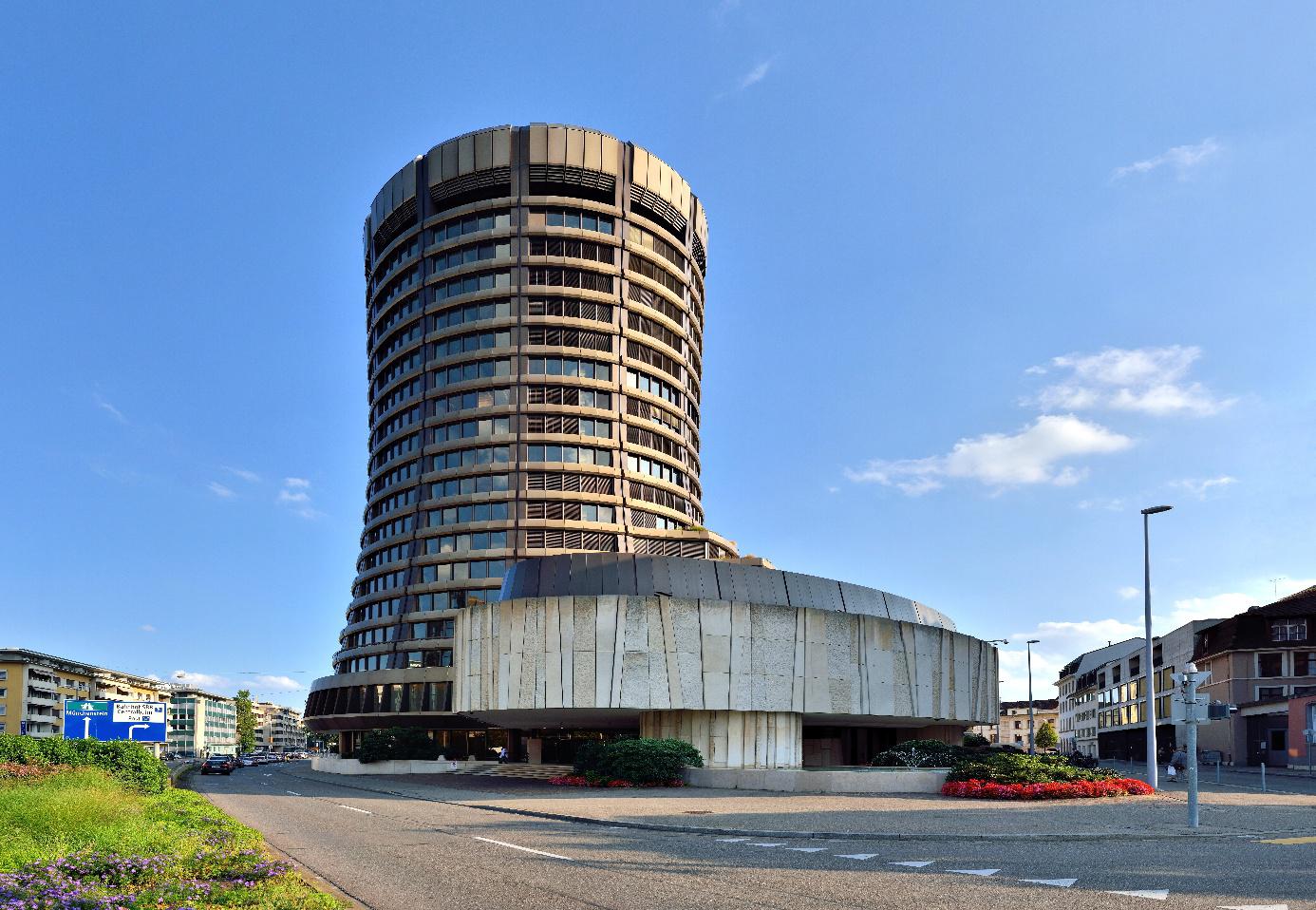
Do you believe that every central bank acts independently of other countries? That the currency you pay with every day means anything in the world? Well, francs or crowns do, but others… Anyway, central bankers from all over the world gather from time to time at their headquarters in Basel to set the course for all currencies, their appreciation or depreciation, at secret meetings. Yes, at secret meetings, which is not in keeping with the transparent, democratic world and Switzerland in particular. There in the tower of their bank (the headquarters of the BIS – the Bank for International Settlements) they pay their bills, plan the next crises, the next helicopter monies, the next bailouts. Yes, there are such circles and their history goes back to the times before the Second World War.
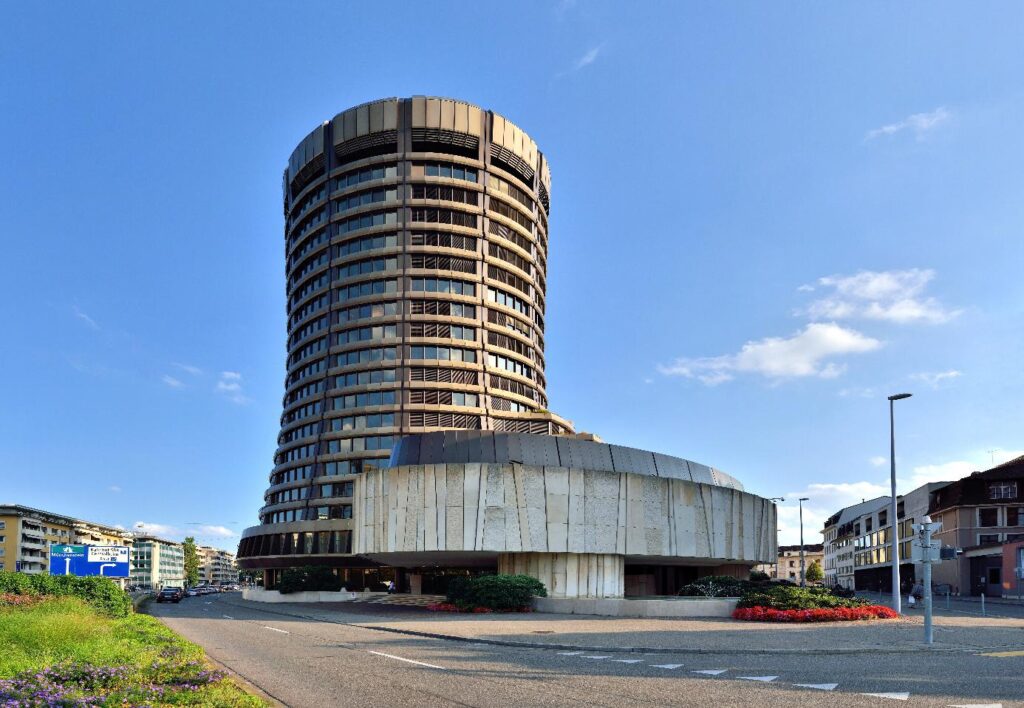
The headquarters of BIS, the infamous bank about which numerous authors such as Le Bro and Ronald Bernard wrote volumes. Source: Wikipedia.

Now some are stepping out of line: the BRICS countries are throwing down the gauntlet to the dollar, the king of all currencies, to which they have all had to submit up to now.

The absolute dominance of the dollar is beyond doubt because:

First

When the Second World War ended, the US economy undoubtedly became the most powerful in the world. In 1970, the United States accounted for about 40% of the world’s GDP. It was the only one left untouched after a major armed conflict and was able to use its position to introduce convenient rules for itself. For example, funds under the Marshall Plan (post-war reconstruction of Europe) were nominated in dollars.

Second

The US has created a financial system based on its currency. Until its link to gold was severed, every other currency was firmly tied to the dollar. This meant the need to hold dollar reserves. For example, the UK had up to 70% of its reserves in US currency at the time.

Third

The International Monetary Fund and the World Bank are institutions dependent on the USA (30% of the dollar reserves gave the USA a decisive vote). Therefore, loans in dollars were granted to countries in a difficult financial situation. In addition, they often had to open their markets to American exports, which only strengthened their dependence on the dollar.

Fourth

Until recently, all commodities were traded on the stock exchanges and always denominated in dollars, be it gold or oil, it doesn’t matter. All of them.

However, the era of globalization set in motion in the USA has begun to have negative effects. One of these was the unprecedented economic growth of many countries, especially China. They all increased their production and trade, and so their currencies became more and more relevant. In the 1980s, the dollar was the currency of 80% of trade accounts. Later, this share declined: from the 1990s to today, it has fallen from 70% to 54%. JP Morgan predicts that it will be around 50% by 2030.

A similar trend can be observed by analyzing the share of individual currencies in global reserves. The dollar’s dominance peaked at the beginning of the 21st century, when it accounted for around 72% of all reserves. As you can see in the chart below, this share has gradually declined over the last two decades.
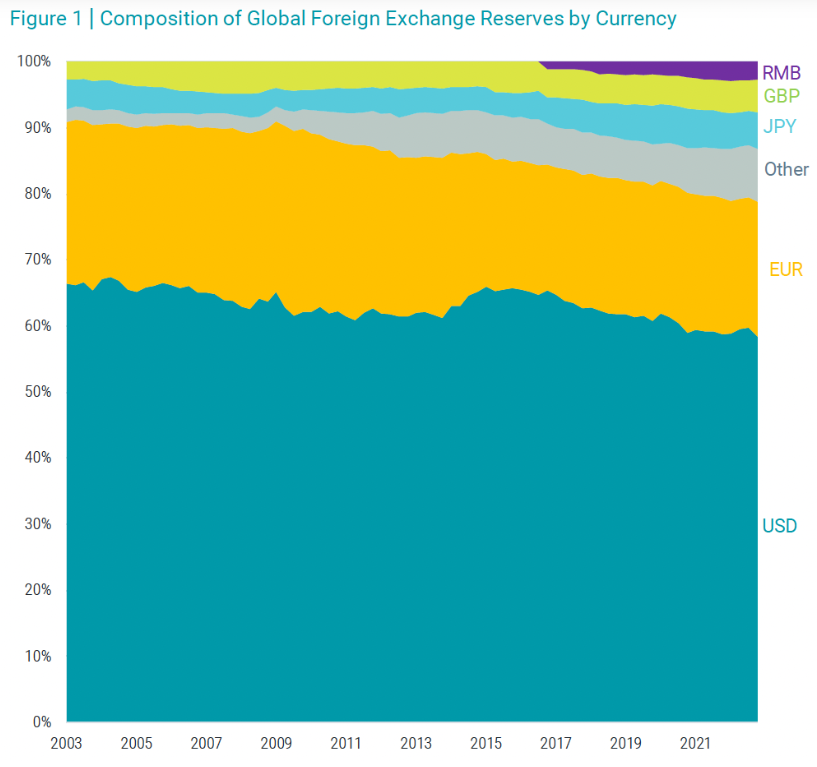
Source: Arcadiawm.com

As you can see, the majority of the new shares of currencies other than the dollar are due to the development of the economy in almost the entire world (“Other” in the chart). This is the effect of globalization and the growth of wealth in many countries. Interestingly, the Chinese yuan only started to play any significance in 2017.

The growing popularity of the yuan can also be seen even more clearly by analyzing SWIFT data, i.e. the American payment system used worldwide: In 2023, the value of transactions made in this currency increased dramatically. This made the yuan the 4th most popular currency in this system. This is indirectly due to the sanctions imposed on Russia for its invasion of Ukraine. This forced the Russians to bypass the dollar, which is why the yuan and ruble currently account for around 90% of the country’s trade with China. To this should also be added bilateral agreements with Brazil and Argentina, which were signed at the time and have included the yuan in trade between these countries.

However, one of the main reasons for the popularization of the Chinese currency is the activity of the BRICS. This bloc accounts for 31.5% of global GDP, 40% of the population, 40% of the oil market and 72% of the rare earths market. The participating countries cooperate with each other through investment in infrastructure and trade. One of the group’s most important assumptions is the pursuit of a multipolar world order and thus a world in which the dollar is no longer the most important currency. Within the framework of the BRICS, institutions were created that represent alternatives to the World Bank and the International Monetary Fund. These are the New Development Bank and the Contingent Reserve Arrangement. Their business is very similar to their Western counterparts, but there is one fundamental difference. Loans are granted in local currency, which reduces dependence on the dollar. As a result, 69% of trade between the BRICS countries will bypass the US currency in 2025.

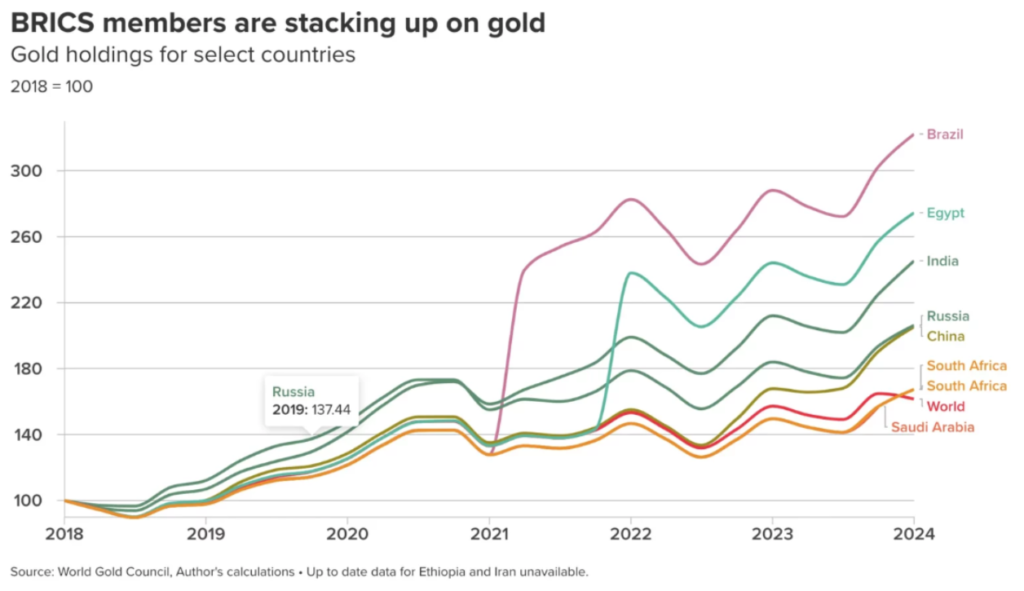
In addition, BRICS countries are buying gold instead of dollars. Recently, it has been the very countries (with China in the lead) that have been most responsible for global gold purchases, mostly directly from local miners, further reducing dependence on the dollar. It is worth noting that the BRICS countries account for 20% of global gold bullion supplies. Therefore, it is obvious that many countries (including the BRICS) are trying to have as many gold reserves as possible, which should further boost demand for this metal.
What’s more: In October 2025, the Moscow Precious Metals Exchange was launched on the initiative of the BRICS. It enables calculations in gold, platinum, diamonds and rare earth metals. It bypasses the SWIFT system and the London Metal Exchange system. This decision makes countries such as Russia and China independent of possible sanctions and supports trade in commodities and currencies of the BRICS countries.

In addition to the newly opened Moscow Exchange, there is also a Shanghai Exchange specializing in gold and silver, which supports 30% of gold trading in the yuan. A merger with a newly opened organization could create a common market for metals within the BRICS, making the bloc further independent of Western influence. These events only emphasize that the role of gold will only increase in the coming future.

A thorn in the side of the Americans and Western bankers is the fact that the BRICS are using their control over 72% of rare earth element (REE) reserves as leverage against the West. The recent information about Chinese restrictions on the export of these commodities and Trump’s threats that followed only confirm this.

China, a tycoon in this market and the most important member of the BRICS, is also trying to establish alternative supply chains in order to circumvent Western influence as broadly as possible. One example is the Middle Kingdom’s investments in Africa. The Dark Continent is a kind of gateway to the implementation of the de-dollarization strategy, as there are huge, unknown REE deposits (up to 10% of global supply in the next 5 years). In Angola, for example, a new mine is being built. From 2026, it is planned to produce 20,000 tons of mixed rare earth carbonate (MREC) per year, which will cover 5% of the global demand for magnetic metals. Lobito Corridor (the Banguela railroad) will be used for export. It is an infrastructure financed by China as part of the New Silk Road (BRI). The key here is the fact that it completely bypasses the routes controlled by the West, facilitating trade with China and Russia. Therefore, China is building a new network of dependencies and cutting off its competitors from access to attractive markets in order to obtain economically critical minerals. We would not be surprised to see Angola join the BRICS in a few years, as well as Nigeria, where Africa’s largest REE processing plant is located.

To summarize: The emergence of a multipolar world order is very likely, even if the dominance of SWIFT, the BIS, the IMF and similar US-dependent institutions will continue for some time to come.

Hamas and the Russian Social-Democrats: So far Apart in History and Geography, so Close in Essence of Their Existence

Popular culture is familiar with the story of Doctor Frankenstein, who created a monster in human form. He did not want to create a monster. He wanted to create a super human, his helpmate, a genius, someone who might serve his purposes. Yet, as it usually happens, humans cannot fully control reality. Even minute plans tend to go awry. There are too many factors to control. Still, man is always tempted to create reality after his own fashion. Man is always tempted to be able control nature and to be able to control the development of social and political events. And Man oftentimes ends up with the results achieved by Doctor Frankenstein.

Consider the Bolshevik revolution in Russia. It was in large part occasioned by imperial Germany. The First World War was in full swing – the end to the hostilities was nowhere in sight. Germany fought on two fronts. To get rid of one of them would have meant a really big relief. So the German General Staff prompted by one Alexander Parvus decided to create a political factor that might disrupt Russia’s war effort. This factor had long been in existence. It was the Russian social-democrats – with Lenin and company, biding their time in Switzerland. At the beginning of 1917 Russia saw its first revolution – the so called bourgeois revolution as a result of which the tsar was toppled. Yet, the new government did not think about withdrawing Russia from war. Russia remained France’s and England’s firm ally against Germany. Germany still needed to fight on the eastern (Russian) and Western (French) fronts. The Russian social-democrats, however, had been shooting their mouth off about how important peace was for the proletariat and that war was only waged in the interests of the ruling classes, and that once in power, the social-democrats would bring the war to an immediate end. The German General Staff, having been notified of the Russian exiles in Switzerland and their plans to end the war, were beside themselves with joy. A scheme was forged to let Lenin and company through Germany and Scandinavia straight to Saint-Petersburg. This plan was duly executed. The Russian revolutionaries arrived in Russia’s northern capital and got down to the revolutionary work of toppling the bourgeois government. With success. Soon after, just as they had promised, the social-democrats also known as the Bolsheviks, signed a peace treaty with Germany in Brest-Litovsk, thus withdrawing the Russian troops from the participation in the war that at first would be known as the Great War, later – as the First World War. Germany’s plan was successful: Russia stopped being the United Kingdom’s and France’s ally. (That this success did not eventually help Germany to win the war is another story.)

The operation of landing Russian social-democrats inside Russia was successful… or was it? Yes, Russia was taken out of war and significantly weakened in the following years due to the civil war and the war with the interventionist forces. Yet, in less than thirty years the same Russian revolutionaries managed to defeat the German armies and conquer Germany, planting the red flag of communism on the Reichstag. Worse, the Russian social-democrats, known as Bolsheviks and ultimately Communists, extended their influence to central Europe and managed to build a formidable superpower that the West stood in awe of for decades. In other words, in the long run the German general staff created a monster, just like Doctor Frankenstein had once done. The monster helped Germany wage war for the time being (1917-1918), but then threatened its creator and almost took the creator’s life (1945). the monster certainly infected the creator with its own ideology: directly, while part of Germany was turned into a vassal state in the Soviet Union’s sphere of interests, and indirectly in that leftist ideology would spread in Western Germany as well (let alone the rest of the Western world).

Why are we reminding the reader of this story? We are recollecting this story simply because the same scheme has been occurring again and again. Precisely the same scheme has been recently replayed in the case of Hamas. It is no secret that Hamas was created by Israel, by Israeli politicians, by Israeli secret services. Jewish politicians and political scientists make no secret about it. Why was it created by Israel? Because Hamas was to play in Palestine a similar role to that played by the Russian social-democrats (Bolsheviks, Communists) in Russia. Its task was to take over the control exercised by the Palestinian Liberation Organization (PLO) over Palestinians. Why Hamas was preferred by the Israeli politicians over the PLO? Because the PLO being a moderate organization has had every chance of winning international support and bringing about the establishment of the Palestinian sovereign state, which did not fit Israeli political plans. Now Hamas was very radical in its views and methods, so radical that Hamas was even unpalatable to the Arab Muslim world. It was so unpalatable that it could easily be labelled a terrorist organization and as such it could not be viewed as a political partner either for Israel or on the international political stage. With the PLO being pushed on the margin of the Palestinian cause, it was Hamas that became to be strongly associated with Palestine and the Palestinian nation. The state of Israel, unwilling to recognize the sovereign state of Palestine, could play for time, claiming that one cannot sit down at the negotiating table with terrorists.

For the time being the Israeli plan seemed to work perfectly well. Hamas became a bogeyman for the world, which let Israel maintain its military control over the West Bank and Gaza Strip and refuse talks on a peaceful settlement and the creation and recognition of a sovereign Palestinian state.

Then came October 7, 2023: Hamas struck inside Israel, killed a number of people and took hostages. That entailed Israeli reaction in the form of a prolonged military intervention in the Gaza Strip, an intervention that has been lasting for over two years. Again, Doctor Frankenstein (Israel) has created a monster (Hamas). The creature that was to serve the interests of the state of Israel turned against its creator. Two years of hostilities between Israel and Palestine or rather the small Gaza Strip have painted a portrait of Israel as a ruthless state that does not respect basic human rights. The Western public opinion has turned for the most part against Tel Aviv. The Palestinian cause is again on the rise internationally. The result?

The result is that the political talks aimed at bringing the conflict to a peaceful settlement are rather humiliating for Tel Aviv. The organizers of the 2025 Gaza Peace Summit that took place on 13 October 2025 in Cairo extended invitations to approximately thirty countries. Apart from the Middle East countries, which is understandable, the list of invitees includes such far-away nations as Armenia, Hungary, Norway, or even Japan, but not Israel! The absence of the State of Israel at the negotiating table in Cairo speaks volumes. Is this alone not Hamas’s big victory over Tel Aviv? Is that not a repeat of the same old story of a creature (Hamas) turning against its creator (Israel)?

America has no chance in the Arctic

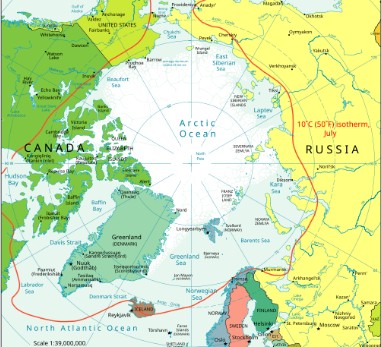
The conflict between Israel and Hamas is good for Russia. When the Israeli army began its operation in the Gaza Strip and the Houthis began attacking container ships in the Persian Gulf in retaliation, shipments through the Russian Northeast Passage increased rapidly. No wonder: the route is 30% shorter than the one through the Suez Canal, free of terrorists and Somali pirates (who have something to say in the case of the other alternative route – around Africa).

The ice is melting and Russia, having the largest fleet of icebreakers, is modernizing the ports in Murmansk and Sabetta and is expanding old military bases built during times of the Soviet Union in the north. Experts believe that the Arctic Ocean will probably be ice-free by the 2040 summer season due to climate change. Moscow estimates that 44% of the Arctic shelf is under its control, and the oil and gas reserves there are estimated to be worth around 20 trillion dollars. The Arctic has huge energy reserves of global importance. According to the US Geological Survey, around 30% of the world’s natural gas reserves and 13% oil fields (90 billion barrels) lie beyond the Arctic Circle. However, there are technical and financial problems with their production. The extraction of deposits in difficult polar conditions requires modern technologies and enormous investments, which Russia is still often unable to afford.

And this is where the Chinese friends come to the rescue, for whom the Northeast Passage (NSR) is a plan B for the New Silk Road: the Chinese are financing LNG projects, developing cooperation in the construction of satellites to monitor ice density, participating in the modernization of ports and the construction of transhipment terminals. Examples include the participation of CNPC, the largest Chinese oil and gas trading company, and the Chinese Silk Road Fund in the Yamal LNG project, as well as the announced investment in Arctic LNG 2. In the fall of 2024, the Chinese Coast Guard announced its first patrol in the waters of the Arctic Ocean, and the operation was carried out in cooperation with the Russian Coast Guard. Chinese shipping companies and logistics firms are increasingly operating transits via the NSR; specific liner projects (container shipping) and joint ventures with Russian players (e.g. Rosatom cooperation) emerged in 2023-2024.

Meanwhile, America is letting go of its opportunities in the north, is barely expanding its fleet of icebreakers, no new bases are being built and Donald Trump is on a collision course with Canada, the most important partner when it comes to the alternative northern passage through Canadian waters. Period.

Afghanistan

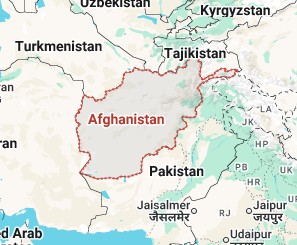
When Joe Biden initiated the chaotic withdrawal of the US army, he may not have been in his right mind. Kabul witnessed Dantesque scenes at its airport while 70,000 Afghan US army personnel who could not be evacuated, and 7 billion dollars worth of military equipment was handed over to the Taliban. That alone merits the name of treason, or at least – disgrace. Still, Joe remained politically unscathed and continued to hold office.

Now Trump says the airfield in Bagram should be recaptured. Why? Because the Taliban should be combated again? Not at all. It’s about big geopolitical plans.

The simple answer is that the airfield is only an hour’s drive from the Chinese factories that manufacture nuclear weapons.

In a broader context, it is also about raw materials. The withdrawal of the USA has opened up space for China, which although not officially recognizing the Taliban government, is conducting intensive economic negotiations with it. Afghanistan has huge reserves of copper, lithium, cobalt, gold, uranium and rare earths – estimated to be worth up to 3 trillion dollars. It is precisely these raw materials that are crucial for the production of batteries, electronics and the development of green energy technology, which is exactly what China needs. One of the Middle Kingdom’s biggest projects in Afghanistan is Mes Aynak – a huge copper mine. But that’s not all. Afghanistan could be a land corridor connecting China with Iran, the Middle East and Europe. That’s why China is investing in roads, railroads and the energy sector there as part of the New Silk Road. 

The Taliban are not stupid either and invest in their own country. The most blatant example of this is a huge Taliban project – the Kosh Tepa Canal. Its aim is to transform desert land into fertile agricultural land by diverting water from the Amu Darya River. It is an investment of enormous economic, but also political importance – it shows that the Taliban want to build a state despite the lack of international recognition.

A possible US intervention in Afghanistan would be met with a reaction from China and escalate tensions between Washington and Beijing, which could end in new tariffs and trade wars. China is already limiting the export of rare earths from its own country, for example, which is perhaps why Trump is looking to other countries.