



Argentina will be joining the ranks of exporters of liquefied natural gas (LNG) next year when it stars exporting gas from its Vaca Muerta shale play. Source: Oil Price
Economics
Kosovo Prime Minister says taxes on imports from Serbia and Bosnia will rise from 10 to 100 per cent immediately – a day after Serbia hailed the failure of its bid to join Interpol. Source: Balkan Insight
India’s crude oil imports in October rose to their highest level in at least more than seven years, data from the Petroleum Planning and Analysis Cell (PPAC) of the oil ministry showed on Tuesday. Source: Reuters
Saudi Aramco will sign five crude oil supply agreements with Chinese customers, it said in a statement on Wednesday, taking the volume of its 2019 China crude oil supply agreements to 1.67 million barrels per day. Source: Reuters
Crude oil stockpiles in China rose by 29.09 million barrels last month from a month before and are likely to continue up, S&P Global Platts calculations have suggested. The inventory build was a result of rising imports combined with lower refinery activity, which led to the 416.7-percent surge in October from September. Source: Oil Price
Beijing and Manila have agreed to a joint oil and gas exploration deal – one of 29 deals that were signed on Tuesday as Chinese President Xi Jinping began a two-day state visit to the Philippines. Source: South China Morning Post
South Korean shipyards have boxed out their Japanese rivals from the market for building large ships carrying liquefied natural gas (LNG), winning all of the orders for the next three years worth more than $9 billion. Source: Reuters
In November, Donald Trump announced that he would approve the sale of F-35 Lightning II fighter jets, the most advanced V-generation aircraft equipped with AI sensors and other technological innovations. Even more important is who the buyer of these weapons is. It is, of course, Saudi Arabia, which will purchase more than 20 F-35s, 300 Abrams tanks, MQ-9 Reaper drones, air defence systems and a variety of missiles. Why do the Arabs need so many advanced weapon systems? Well, it’s obviously about superiority over Iran, but also (though this is not said out loud) over Qatar, which is not exactly a friend of the Saudis and is armed to the teeth.
This is a situation similar to that of the 1980s, when Ronald Reagan tried to emphasize the power of the alliance with the Arabs by providing them with the latest military technology. At that time, AWACS systems and F-15 aircraft were sold despite opposition from the United States’ most important ally in the region, Israel. At that time, it was a blow to the Soviet Union, and today Trump’s game is focused on China and Russia. The Americans had to somehow “consolidate” the Saudis in their camp, as they had recently been buying more and more weapons from China and Russia. The purchase of weapons such as the F-35 makes Arabia dependent on American technology and service.
On the other hand, the US had to use the “carrot and stick” approach to keep oil prices low, which is unlikely to please the Arabs and OPEC+ as a whole. This is an important issue for the United States, as cheap black gold keeps inflation low in the country, satisfies consumers, secures the voter base, and weakens the major exporters of this commodity, such as Russia and Iran. This shows that it is enough for the US to be present in this region through arms exports in order to remain a strategic player there.
The world has for ever been looking up to the West, to Western science, culture and what not. It has always been a dream of Third World people to travel to France or the United Kingdom, to Germany or the United States, just to be there for a moment or – still better – to work there or to study there. When towards the 19th century Japan began to modernizing, Japan’s authorities sent delegates to Germany to study German law and German administration. Why? Because Japanese reforms were to be grounded in German experience, in German solutions. When the Chinese adopted the communist ideology, they adopted it from the West, where it was born, although mainly via the Soviet Union. Vietnam uses the Latin script which was imposed on the nation by the French colonizers and remained in use because it was estimated to be good. India still recognizes the English language as one of the official languages of the country.
Much the same can be said about Africa. African governments, constitutions and social or administrative solutions are modelled on European solutions, while the country of Liberia (settled by liberated American blacks) is an African copy of the United States. Throughout Africa – European languages are spoken hand in hand with the local tongues.
All of this, the whole spiritual and moral capital that the West had throughout the world has been squandered and gambled away. The Western know-it-alls – graduates of the Ivy League, graduates of the Sorbonne, Oxford and Cambridge – in their unbounded self-pride and their bottomless feeling of superiority that whispered into their ears that the West would always be a dominant player began to dig their own grave or shoot themselves in the foot. In a word: the Western smart alecs have brought about the collapse of their own civilization. How did they do it? We’ll list some of the actions but not in any particular order.
First, in their passionate hatred they put a lot of effort into destroying the Soviet Union. They hated the Soviet communist ideology (which, as said above, originated in the West), and they were scared of the Soviet might. Not wishing, however, to take losses themselves, the West was looking around for a country that could be used as a battering ram against Moscow. They found it: China. Though the Middle Kingdom was as communist as the Soviet Union (if not even more communist), Beijing let itself be used by Americans to align itself against Moscow. This step was facilitated by the stupidity of the Russian leadership whose members rather than ingratiating themselves to China preferred to show the Chinese communists their inferior place in the global communist hierarchy. The Chinese comrades caught hold of the opportunity that presented itself to them and began to surf the American wave of support.
As if that was not enough, Washington, or rather the rich elites who are always in pursuit of enriching themselves, came up with an idea of dividing the world into three economic zones, with the West being the ruling head, Africa and Russia being assigned the role of suppliers of natural resources, and Asia being turned into a world’s factory. The men and women from the Ivy League and from the Sorbonne, Oxford and Cambridge dreamt about controlling and shaping the minds of the whole of humanity. Africa’s human resources were estimated as too unskilled and too uneducated to be tasked with manufacturing, but the African continent was known for its natural resources. The Asians on the one hand were known for their diligence and work stamina, so they were naturally selected as providers of labour. A nice global division, was it not? Something like the social division that we observe in ant or bee communities.
Acting on this idea the Western elites began to shift production from the West to Asia, especially to China. The word outsourcing was coined and made hugely popular. Why pay Americans or Western Europeans for their labour if the Chinese, the Vietnamese and others can do the same for a much smaller remuneration? The greed that took the better of the Western elites blinded them to a few simple facts. One is that outsourcing meant providing China with technology and teaching China’s labour valuable skills. Concurrently, outsourcing meant depriving the West of its manufacturing potential along with depriving the West’s people of income. The American products made in China could not easily be sold in the United States because Americans would not have much money. Outsourcing enriched the American or generally Western elites in the short term, and strengthened China economically in the long term. As soon as the economic development in China had translated into China’s rising military might, while the growing welfare had secured the firm position of the Communist Party of China among the billion of the Chinese people, an outcry could be heard on the Potomac! China is America’s arch enemy! Why?
It was the United States that created a powerful China, was it not? True, China is developing rapidly, but is it threatening the United States? It looks like Washington is threatened not by a country’s military strength but rather by a country’s economic growth. Well, if that is so, the proponents of the free market i.e. the whole West ought to put more and more effort into outperforming China on the economic level. Why is China perceived as a military threat? Does the Middle Kingdom have a record of conquest? China is bordered by tiny Vietnam and Korea: do these nations feel threatened by the Chinese dragon? Why should America feel threatened? If Washington assumes that China’s economic might will translate into China’s military might – a substantiated assumption – then why did the American elites contribute so much to turning the Middle Kingdom into an economic power? Was it that greed – profit, to use a more elegant word – switched off their reasoning? Was it a shot in their foot?
Second, Washington’s acts of alienating concurrently China and Russia (and Iran, and – recently – India) have necessarily pushed those countries into each other’s embrace. Moscow and Beijing as well as Beijing and Moscow on the one hand and Tehran and Delhi on the other are coming politically and economically closer not so much because they are in love with each other, but because they have been left with no other choice. Again, was such a development of events hard to predict? The United States had its hand in the 1989 Tienanmen Square riots and in the 1999-2009 Second Chechen War, in either case trying to weaken respectively China and Russia from within. Does that alone not make Beijing and Moscow want to cooperate and support each other? At first there was the idea on the part of Washington to use China against the Soviet Union; then there was the idea to use Russia against China. It seems that the United States have overplayed its hand in either case. If Washington wanted to pit Moscow against Beijing, it shouldn’t have schemed in Ukraine to tear this country away from Russia’s zone of interest. Another shot in the foot?
Third, the de-industrialization. We have mentioned outsourcing. We need to add to it the intentional process that has been going on in Western Europe within the framework of which Europeans have deprived themselves of much of their industry. Factories and power plants, internal-combustion engines and growth in general have come to be perceived as detrimental to the environment, hence to the planet. All these activities have been limited or stopped. With the war in Ukraine Europe has also cut itself off from cheap Russian gas. Now amid the war hysteria and the plans to militarize the Old Continent a simple question arises: does Europe have the industry and cheap resources with which to re-militarize itself? Was the green economy not yet another shot in the West’s foot?
Europe wants war, and Europe wants war badly. Yet, Europeans have unlearnt patriotism. Europeans have unlearnt patriotism because their authorities have wanted them to unlearn it. Germans and the French, the Italians and the Spaniards were supposed to drop their national identities and replace them with European if not cosmopolitan identities. Why should they now feel an willingness to fight? It is even worse: Europe has been intentionally flooded with total foreigners from Africa and Asia. Are these foreigners going to fight against Russia? Is that the reason why they left their own countries? Have they come to Europe to fight for it? Who can ever believe that?
The armed forces cannot be assigned all the money Europeans might want to spend on the military: there are millions and millions of immigrants, and rising, and the incomers need constant social support, social welfare. Go try withdrawing some of that support from them and you will have Paris and London, Brussels and Hamburg go up in flames!
Fourth, the dollar. It was an ingenious trick played by the United States of America at the end of the Second World War that Washington managed to impose the dollar on the rest of the world as a reserve currency or currency of international trade. The dollar began to be sought after, the dollar began to be accumulated by the treasuries of almost all countries around the globe. This alone meant that the United States could burden the other nations with its own debt and with its own inflation. Ingenious as this sleight of hand may have been, it carried its undesirable effects. If America provides the currency for the whole world, then America must print this currency for the whole world. Since the whole world stands in need of the dollar, the only ultimate way to acquire it is to sell goods and services to the United States. If the United States can have all the goods and services from around the world by simply issuing the dollar, America is naturally tempted not to manufacture much itself. The United States becomes a country whose main product on offer is its currency, is its dollar. To put it bluntly, America’s main export product are paper banknotes or electronic impulses in computers or servers! America ceases to really develop, America becomes like a rich individual who having millions at his disposal has absolutely no incentive to work, to create, to develop. Doesn’t it remind one of the once powerful Spanish Empire? The Spanish Empire fell under the weight of gold that had been brought from South America. Blessing at first, gold turned to be the final nail to the Spanish coffin. The case with the dollar is similar: blessing at first, but a final curse.
So much so that the West’s reckless steps precipitate the working of the curse: the freezing of the Russian financial deposits has become a wake-up call to the rest of the world. Assets in the dollar or, indeed, any Western currency can be lost at the drop of a hat. Hence the idea, then the urge that was born in the wide world toward de-dollarization. It is not that China or Russia, Iran or Saudi Arabia would necessarily like to get rid of the dollar. No. Rather, they see no other way out. Who in his right senses will continue to keep his money on an account in a bank that can freeze the money whenever it pleases? Thus, the dollar policy has proved to be yet another shot in the foot. If the West loses the war in Ukraine, which is highly likely, the West might as well start digging its own grave.
The conflict between Israel and Hamas is good for Russia. When the Israeli army began its operation in the Gaza Strip and the Houthis began attacking container ships in the Persian Gulf in retaliation, shipments through the Russian Northeast Passage increased rapidly. No wonder: the route is 30% shorter than the one through the Suez Canal, free of terrorists and Somali pirates (who have something to say in the case of the other alternative route – around Africa).
The ice is melting and Russia, having the largest fleet of icebreakers, is modernizing the ports in Murmansk and Sabetta and is expanding old military bases built during times of the Soviet Union in the north. Experts believe that the Arctic Ocean will probably be ice-free by the 2040 summer season due to climate change. Moscow estimates that 44% of the Arctic shelf is under its control, and the oil and gas reserves there are estimated to be worth around 20 trillion dollars. The Arctic has huge energy reserves of global importance. According to the US Geological Survey, around 30% of the world’s natural gas reserves and 13% oil fields (90 billion barrels) lie beyond the Arctic Circle. However, there are technical and financial problems with their production. The extraction of deposits in difficult polar conditions requires modern technologies and enormous investments, which Russia is still often unable to afford.
And this is where the Chinese friends come to the rescue, for whom the Northeast Passage (NSR) is a plan B for the New Silk Road: the Chinese are financing LNG projects, developing cooperation in the construction of satellites to monitor ice density, participating in the modernization of ports and the construction of transhipment terminals. Examples include the participation of CNPC, the largest Chinese oil and gas trading company, and the Chinese Silk Road Fund in the Yamal LNG project, as well as the announced investment in Arctic LNG 2. In the fall of 2024, the Chinese Coast Guard announced its first patrol in the waters of the Arctic Ocean, and the operation was carried out in cooperation with the Russian Coast Guard. Chinese shipping companies and logistics firms are increasingly operating transits via the NSR; specific liner projects (container shipping) and joint ventures with Russian players (e.g. Rosatom cooperation) emerged in 2023-2024.
Meanwhile, America is letting go of its opportunities in the north, is barely expanding its fleet of icebreakers, no new bases are being built and Donald Trump is on a collision course with Canada, the most important partner when it comes to the alternative northern passage through Canadian waters. Period.
When Joe Biden initiated the chaotic withdrawal of the US army, he may not have been in his right mind. Kabul witnessed Dantesque scenes at its airport while 70,000 Afghan US army personnel who could not be evacuated, and 7 billion dollars worth of military equipment was handed over to the Taliban. That alone merits the name of treason, or at least – disgrace. Still, Joe remained politically unscathed and continued to hold office.
Now Trump says the airfield in Bagram should be recaptured. Why? Because the Taliban should be combated again? Not at all. It’s about big geopolitical plans.
The simple answer is that the airfield is only an hour’s drive from the Chinese factories that manufacture nuclear weapons.
In a broader context, it is also about raw materials. The withdrawal of the USA has opened up space for China, which although not officially recognizing the Taliban government, is conducting intensive economic negotiations with it. Afghanistan has huge reserves of copper, lithium, cobalt, gold, uranium and rare earths – estimated to be worth up to 3 trillion dollars. It is precisely these raw materials that are crucial for the production of batteries, electronics and the development of green energy technology, which is exactly what China needs. One of the Middle Kingdom’s biggest projects in Afghanistan is Mes Aynak – a huge copper mine. But that’s not all. Afghanistan could be a land corridor connecting China with Iran, the Middle East and Europe. That’s why China is investing in roads, railroads and the energy sector there as part of the New Silk Road.
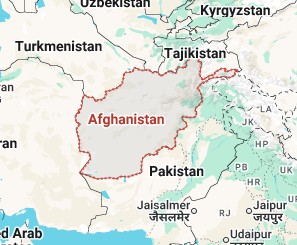
The Taliban are not stupid either and invest in their own country. The most blatant example of this is a huge Taliban project – the Kosh Tepa Canal. Its aim is to transform desert land into fertile agricultural land by diverting water from the Amu Darya River. It is an investment of enormous economic, but also political importance – it shows that the Taliban want to build a state despite the lack of international recognition.
A possible US intervention in Afghanistan would be met with a reaction from China and escalate tensions between Washington and Beijing, which could end in new tariffs and trade wars. China is already limiting the export of rare earths from its own country, for example, which is perhaps why Trump is looking to other countries.
The war in Ukraine is dragging on. The end is nowhere in sight. It is dragging on and soon it will be entering its fourth year. Reason suggests that Russia with its demographic and industrial potential could put the hostilities to a rapid end. Nothing of the sort is happening. Reason suggests that Ukraine should lay down its arms since there is no way it can regain lost territories, not to speak of winning over its much stronger neighbour. Nothing of the sort is happening. Reason also suggests that the West should work towards ending the hostilities because if Ukraine’s defeat eventually comes, the EU will be politically worse off. Nothing of the sort is happening. Why?
Russia. Russia has been benefiting from the war effort just like the United States benefited from the First World War and the Second World War: at that time American economy was boosted, and so is Russia’s economy today. Russia is benefiting from the war also in terms of its society rallying around the head of the state. Precisely as it was the case with the United States in both world wars, so it is now in the case of Russia: it is not directly affected by the hostilities it. Yes, Russian soldiers are dying or are wounded, but Russian soil and Russian civilians remain for all practical purposes unscathed.
The European Union. The European Union is in decline. A decline caused by its deviant green ideology, by the indiscriminate acceptance of the influx of foreigners, and lastly by its economic problems brought about by the renunciation of cheap Russian gas. The welfare state is becoming overburdened, the governments and heads of state are increasingly unpopular while national and right-wing parties are on the political rise. Not infrequently people take to the streets and show their disdain for their leaders. The European dream is shattered. What then are the EU managers trying to do the save the day? Yes, they are trying to find a scapegoat for all the negative phenomena. This scapegoat is Russia. A very convenient scapegoat. All economic problems can now be blamed on the aggressor from the east, all shortages and shortcomings – on the ‘Mongols’ looming large on the eastern horizon. Europeans ought only to understand what is at stake, and rally round the EU commissioners in a joint attempt to defend the Garden against the Jungle.
The United States. The United States has used the war in Ukraine not only to weaken Russia, but also to subjugate Europe. Yes, Washington knows that Russia will eventually win, but in the process it will lose some of the people, and it will be kept busy, letting Washington more leeway elsewhere in the world. Europe has been conveniently rendered economically impotent, which is another gain for Americans. A competitor has been removed. The competitor’s reliance on Russian energy sources has been significantly lowered. Washington is cherishing high hopes that some of Europe’s industries and businesses will relocate to the United States, which will further deindustrialize the Old Continent and re-industrialize America.
What is the attitude of the three mentioned players to Ukrainians?
Russia. Russia recognizes in Ukrainians brothers by ethnicity. That is one of the reasons why Russian troops steer clear of destroying civilian objects and objects of cultural heritage. Concurrently, Russian troops are fighting hard culling the Banderite-type troops. This alone will render Ukraine less hostile to Russia. Also, the Russian army is destroying Ukraine’s military, thus making it no match to the Russian Federation in the nearest future. The destruction of the civilian infrastructure will make it barely possible for Ukraine to be accepted as a member of the European Union.
The European Union. The European Union couldn’t care less about Ukrainian life though, sure enough, the EU managers say they do. Ukrainian lives are pawns on the geopolitical chessboard and are willingly sacrificed on the altar of combating Russia. And what a paradox! The EU commissioners are gladly embracing ‘refugees’ from Africa and Asia who allegedly escape from war while they would gladly see all Ukrainian able-bodied men drafted into the Ukrainian army and sent to the front! The European Union accepts males from the Third World: why would it rather not accept all Ukrainian men who want to be drafted? True, Europeans are not as yet rounding Ukrainian men up in their cities and sending them back home, but such ideas have emerged now and again, here and there.
The United States. The United States views Ukraine precisely as Europe does: after all it was Zbigniew Brzezinski, the American politician and political thinker, who famously framed the globe as a chessboard. That’s precisely how the big players think about nations and countries: nations are chessmen while their territories are black and white squares of the chessboard. Accordingly, you sacrifice a chessman or you let go of a square as the case may be. The United States is one player, Russia or China is the other. Anything between them is – as we have already said – chessmen and chessboard squares. That’s all there is to it.
That’s also precisely how the managers of the world view the common people and their countries. The European elites may be whipping up war hysteria, but they themselves will not handle rifles or lie in trenches. Far be it from them! Whatever they want to impose on the common man and woman, they themselves prefer not to be affected by. Immigrants by the million for the common European to live with on a daily basis, but the commissioners live in places where they do not need to bother about strangers. Is it any different with war? No. Consider Ukraine’s President Zelensky. How has he experienced the three years of hostilities? He’s been travelling the world over, has been warmly received everywhere, and has given hundreds of interviews and made hundreds speeches, issuing hundreds of statements. How about the members of the Ukrainian government, of Ukraine’s parliament, how about higher officers? Pretty much the same story.
It has always been so throughout human history. Napoleon Bonaparte had half a million soldiers killed, frozen, or maimed in Russian steppes, but he himself made sure to be able to escape from the enemy and the frost in a comfortable coach, wrapped in warm furs. Adolf Hitler and his entourage? After the Red Army had crossed the Oder and was approaching Berlin, he and his ministers and generals must have realized that the end was inevitable and that the end was just round the corner. Some of them must have already taken the decision to commit suicide, and yet in order to prolong their lives by mere three-four months they did not stop the war. Rather, they sent new waves of troops – teenagers and the elderly – and added hundreds of thousands if not millions deaths to the huge overall toll.
For the managers of the world affairs, war is a game, a game that thrills them because it is a game played in reality. It is not a computer game. Augustus II the Strong (1670-1733), Elector of Saxony and King of Poland conspired with Tsar Peter I of Russia to attack Sweden in the latter’s possession on the Baltic. The war, which began in 1700 and lasted till 1721, soon after its outbreak turned to be a catastrophe for Saxony and partly for Russia. Augustus was forced to draft new and new men to either defend his country or help his Russian ally. When someone pointed to him that so many men had died and so many more were about to die, he shrugged his shoulders and merely replied: people are like grass. The more you trample it, the more abundantly it will regrow.
Russian President Vladimir Putin gave a speech during one of the sessions of the Valdai International Discussion Club (September 29 – October 2). That’s already a traditon: Vladimir Putin is habitually invited to to sessions of the Club, and this year was no exception. The speech was was followed by about two hours of questions from the journalists and the president’s answers. In both parts of his presence at Valdai, the Russian President laid down Russia’s point of view, Russia’s expectations, and Russia’s intentions.
[1] The world should be rid of military blocs. They have no purpose. Or – if there needs to be a military bloc – let it be one big military bloc – like NATO – but inclusive of all countries. Russia twice attempted to become a member of the Atlantic alliance: in 1954 (the being a part of the Soviet Union), and then in 2000. In either case Russia’s proposals have been turned down. Why? President Putin recounted his 2000 meeting with President Clinton and his suggestion concerning Russia’s NATO membership. The American president was willing to accept the proposal in the morning, only to turn it down later in the day, saying that the time was not right yet. Why? When would the time be right? asked Russia’s president.
[2] In anti-Russian narrative the West is glaringly biased in its actions and unfair in its propaganda. Take the historical policy, said the president. Much fuss is about the so-called Ribbentrop-Molotov Pact of 1939. As a result of this pact signed by foreign ministers of respectively the Third Reich and the Soviet Union Poland was dismembered in the following weeks. Yet, the West glosses over the preceding Munich Agreement of 1938 between the British and French prime ministers Chamberlain and Daladier on the one hand and the rulers of Italy and Germany – Mussolini and Hitler – on the other within the framework of which Czechoslovakia was dismembered within the following weeks. Why do Western propagandists lay emphasis on the former and ignore the latter?
[3] Similarly, if Russia is a paper tiger, as President Donald Trump famously said, and this paper tiger – that is Russia – is successfully fighting in Ukraine against NATO, then what NATO is? asked Vladimir Putin to the amusement of the audience.
[4] Though the war in Ukraine is waged and the collective West appears to be bellicose towards Russia, nonetheless the United States keeps importing Russian uranium for American nuclear power plants, and Russia appears to be America’s second largest provider of this resource. This Russo-American deal should continue, said the Russian president, because it serves the interests of both partners, but why then can’t Western Europe purchase Russian gas? Why does the United States demand that China and India stop purchasing Russian gas and oil? Obviously, the old rule of quod licet Iovi, not licet bovi applies here.
[5] The West is deteriorating, losing its identity, having problems with immigrants and others. So, rather than being focused on Russia, the West ought to deal with its internal problems. The loss of cultural identity has brought about a new phenomenon: an ever larger stream of people from the West is arriving in Russia to settle. One of the most striking examples is the case of Michael Gloss, son of a deputy director of the CIA, who arrived in Russia and voluntarily joined the Russian armed forces to fight against Ukraine. He was accepted, trained and sent to the front where he was killed. He was killed by a Ukrainian drone, while being wounded and trying to help his Russian mate. The Russian authorities granted him an order for bravery and requested Steve Witkoff – President Trump’s special enboy to Moscow – to hand it over to his family. Michael Gloss fought for Russia as he viewed Russia as a guard of traditional values that are shrinking in the West. They are shrinking so rapidly and have shrunk so much that even those Russian intellectuals – said Vladimir Putin – who have always dreamt about the West as paradise, as a model for Russia, as the Garden of Eden, began to say that the Europe that they have loved so much is no more.
[6] The Russian President revealed Ukrainian losses: in September 2025 alone Ukraine had 44.700 casualties of which 50% were irretrievable. During the same time Kiev could send to the front 18.000 of those drafted and 14.000 from hospitals as replacements, which means that the Ukrainian Army was short of 11.000 troops. The Russian President also said that between January and August of the current year as many as 150.000 Ukrainian soldiers deserted the ranks. Some surrendered willingly to the Russian troops, although that was a hard task on their part because they were often killed by drones operated by mercenaries who do not care about Ukrainian lives.
[7] Vladimir Putin said that Russia along with China and India and others do not want to dethrone the dollar: the fact that Russia, China and India and other countries are beginning to use other currencies in their trade is a simple result of the West’s financial policy that leaves Russia, and China, and others no other way as to bypass the dollar.
[8] President Vladimir Putin praised President Donald Trump and said, indeed, that he believed that the war would not have broken out had Donald Trump been the American president; and, yes – said the president – Donald Trump is a man who has the ability to listen to his interlocutor, to hear him out, and grasp his point of view.
[9] Unfortunately, just as once it was the Soviet Union that would impose its ideology on other countries, now this attitude has been adopted by the United States in Washington’s attempt to homogenize the world and create it in America’s image.
[10] At a point during the questions-and-answers part, Vladimir Putin confessed to being an ardent reader of poetry, especially Alexander Pushkin. From a volume of his poetry the Russian president read out loud a larger fragment of the poem that Pushkin entitled The Anniversary of (the Battle of) Borodino (Бородинская годовщина). The text refers to the age-long dream of the West to subjugate Russia. The poem was composed in 1831 and occasioned by the 1830-31 Polish anti-Russian uprising, which had the political and moral backing of the West. The message that the Russian president wanted to put across was that the strife between the West and Russia is of very long standing.
On 27 September 2025, Foreign Minister Sergei Lavrov made a speech during the session of the United Nations. It is not the first time that a Russian diplomat has had a speech there. Older generations will have remembered the speech given by Nikita Khrushchev and especially those delivered by Foreign Minister Andrei Gromyko, who held his post for almost three decades. Yes, officially they were Soviet functionaries, but the former was Ukrainian, the latter – Russian by ethnicity. Yet, speeches by Sergei Lavrov have a new quality to them. Those of the readers whose memory reaches sufficiently far back would never have expected at that time a Soviet diplomat to say a word in defence of a religious faith, least of all of the Christian faith. Now Minister Sergei Lavrov did precisely that: in his speech he stood up for the rights of the Ukrainian Orthodox Church (Moscow Patriarchate) and for the Serbian Orthodox Church. Can the older readers imagine anything like that many decades ago?
This mention of the two orthodox churches was a detail in the long speech and it took up no more than two sentences. Nor was it particularly important among the issues that Minister Sergei Lavrov listed. We draw the reader’s attention to this detail to one more time show the magnitude of changes that have taken place in Russia and the stubborn refusal of some parts of the world to recognize those changes. Yes, present-day Russia is almost every bit as traditional and religious as tsarist or imperial Russia. It was the tsars who felt obliged to defend Orthodox Christianity against suppression, be it in the Balkans or in the Middle East. The Russian Federation is a continuation of that political course.
You might say that Russia – like the lost sheep – is back in the fold of the Christian nations of Europe. You might say that only that you can’t – on second thoughts. Now Europe, especially Western Europe, ceased being Christian, so Russia is again in the out-group.
It was not without grounds that Foreign Minister Sergei Lavrov said in the same speech that there are forces in the world who insist on dividing nations and countries into two opposing groups, into us against them, into the garden (the European Union) and the jungle (the rest of the world), into democracies and autocracies, into those who have the right to feel secure and those who do not, into those – the golden billion – who can enjoy life to the full and those who are expected to serve the golden billion, into those who sit at the table and those who are on the menu. Citing Josep Borrell (though not mentioning his name) about the division into the garden and the rest of the world, Minister Sergei Lavrov called out the conceitedness of the Western world, which does not want to recognize the rights of other countries to determine their national interests and to pursue them. Rather, the Western world uses its economic and military might to either provoke internal strife in a target country or to intervene there militarily. The list of the afflicted countries is long – Yugoslavia, Iraq, Libya, Palestine, Iran, Qatar, Yemen, Syria, Lebanon – and growing. All this is being done in violation of the UN Charter, in the light of which all countries should be allowed to have their just place in the concert of nations irrespective of their military might, the number of inhabitants or the extent of their territory.
The United Nations Charter enshrines also the principle of non-interference in the internal affairs of sovereign states along with the principle of the integrity of sovereign territories. Sadly, the opposite is true. A string of colour revolutions and arbitrary sanctions have become the main instrument of Western diplomacy, said Sergei Lavrov. The recognition of Kosovo as an independent state is a strike against Serbia’s territorial integrity. At present the West is directing its efforts at Bosnia and Herzegovina with the aim of infringing upon the rights of the Serbian part of the population, a step which is in violation of the the Dayton Peace Agreement (Dayton Accords).
Hold on, for a moment! you might say at this point. How does Sergei Lavrov dare to mention the non-infringement of territorial integrity if the Russian Federation has annexed Crimea and then the four eastern provinces of Ukraine. As if in anticipation of this question Sergei Lavrov quoted the 1776 (American) Declaration of Independence, where it is stated that governments are only legitimate if they have the consent to govern from the governed. Now the populations of Donbass and Crimea refused to recognize the regime that came to power in 2014 because it gained power by means of a coup d’état rather than the will of the governed, and also because it banned the Russian language – the language of at least half of the inhabitants of Ukraine and all of Donbass and Crimea – from schools, the mass media and culture. The Kiev regime could thus be equated with the colonial authorities that used to rule over Africa and parts of Asia: just like those colonial powers, the Kiev government acted against the governed, and was not elected by the governed. The same rule, Minister Lavrov stressed (the one contained in the Declaration of Independence), has also been enshrined in the UN Charter.
A remark as an end note. The Ukrainian representatives had demonstrably earphones to let the whole world know that they needed an interpretor for the Russian language, in which Minister Lavrov spoke. The chances that they do not speak Russian or even that Russian is not their mother tongue are very slim. The earphones might have also been used to get the message across how desperate for independence Ukraine is, fighting against the Russian oppressor. But bear in mind that during the time of the Soviet Union, Ukraine – although a constituent republic of the Soviet Union – was a member of and consequently had its own seat in the United Nations (along with Belarus). At that time Russia as such was not represented in the United Nations: it was the Soviet Union that was. Though some equate the Soviet Union with Russia or Russia with the Soviet Union, these two entities overlap only to a certain extent. This overlap is comparable to something like that of the United Kingdom (corresponding to the Soviet Union in that it made up of England, Wales, Scotland and North Ireland) and England (an equivalent of Russia). None of the constituents of the United Kingdom has its representatives in the United Nations.
Ukraine’s president, European managers and all anti-Russian forces are beside themselves with joy because of the recent statement that the American President Donald Trump made on Truth Social. The American leader did an about-turn over the war, writing that Ukraine could successfully oppose its enemy and – and that is what sent positive shock waves across the Western world – Ukraine can regain all its lost territories. The EU leaders must have heaved a huge sigh of relief. Eventually the United States has been brought over to the point of view of the coalition of the willing!
Donald Trump’s words are kind of weird, and they are kind of not. They are weird because they represent a complete opposite to what the president used to say for the last few months: Ukraine was losing to Russia and had to be ready to cede some territory. Yet, the same words are not weird because President Donald Trump has accustomed us to this nice trait of his character that he loves saying two opposite things, sometimes within the same day or even in the same breath. Anyone who’s been paying attention to the American presidents statements should have grown accustomed to this particular style of his communication with the public.
Let us assume, however, that Donald Trump is going to stick to this statement. That means that the United States is from now on supporting Ukrainian war effort, at least psychologically; that also means that the European Union does not need to bother about Americans trying to hold Brussels back from aiding Ukraine in one way or another; and finally, the president’s words encourage those political groupings in Ukraine which might be framed as a pro-war party. An easy interpretation, is it not?
Does Donald Trump believe in what he said? It might be that President Donald Trump has been misinformed and misled by his advisors, and that he really thinks that Ukraine is doing militarily well while Russia is on the verge of an economic, and – what follows – social collapse caused by its war effort. In his statement the president used words and phrases such as paper tiger in reference to the Russian Federation or long queues for gas in reference to Russian economy. Donald Trump may believe in any and all of these things: after all, he does not make an impression of being very well educated and knowledgeable about the world, its geography and history. Some of the president’s earlier statements confirm this observation, like when he said that Russia lost over sixty million casualties during the Second World War (a number three times as large as in reality). The same observation concerning the level of general education and expertise on Russia can easily be extended to the American elites. So much so that they very often let themselves be guided by visceral hatred rather than critical reflection towards their geopolitical opponents.
But there might be something more than meets the eye. It might also be that President Donald Trump is an incarnation of Machiavelli, at least in the understanding and image of the latter that most people share: someone sly and canny. What do we mean? Well, it might be that President Donald Trump is perfectly aware of the vast disproportion of the forces between Ukraine and Russia in favour of the latter, and since he has been unable to bring about peace, and since he’s been thwarted in his peaceful attempts by both the EU and some of his advisors, he devised a Machiavellian plan to accelerate the end of the hostilities by… pushing Ukraine into the conflict with an even greater vigor and gusto: this will make it easier for the Russians to crush Ukrainians and thus bring the war to an end. Stiff resistance and a couple of more failed offensives might prove to be the last nail in Ukraine’s coffin, since the country is running low on manpower, military equipment, and resources. The American president may safely prompt the European Union to continue the aid to Kiev, knowing full well that Brussels is also running low on its resources, financial or otherwise. Ok, if you want to prolong the war, Donald Trump might be thinking, then go on, be at each other’s throat. The more fiercely you will fight, the sooner the end will come. When the lightweight doggedly wishes to hurl himself against the heavyweight and precipitate his own destruction, why should the referee (United States) who has grown tired of the boxing match (the war) intervene?
Several generations back, India was under British dominion and the British monarch – Queen Victoria – was even crowned Empress of India. We need to understand that India up to the end of the Second World War comprised today’s India along with today’s Pakistan and Bangladesh. The monarch of a lilliputian country – UK – became a ruler of a subcontinent. Then came World War One and World War Two, which resulted at first in the weakening, and then in the disintegration of the British Empire. The world came to be dominated by the United States of America, which was on the one hand a change, but on the other it was not a very great change as the United States is historically the offspring of the United Kingdom or Great Britain. Though the pound sterling has been supplanted by the dollar as the currency of international exchange, the language of the world’s hegemon has remained the same: English.
As the Suez Crisis of 1956 eventually broke the backbone of both France and Great Britain along with their fast shrinking empires and disappearing colonies, the United States emerged as a hegemon which had only the Soviet Union to reckon with. In 1991, the Soviet rival ceased to exist and so – by God’s grace as President Bush senior framed it – America reported a global victory. It seemed the Land of the Free was destined to lord it over for a good couple of decades. If older standards were to be restored, American presidents could be crowned emperors of China and India or viceroys of Russia and Europe. It turned however out, soon enough, that the Middle Kingdom with huge American infusions into its economy gradually emerged as a potentate, and so did India. The mental or psychological inertia lingered, though. Both the Chinese and the Indians are rather prone to looking up to the former powers as something better than they are: English still plays such a role around the globe that Latin did in medieval Europe, while British and American culture is still craved by many Chinese and Indians. One might say that though the economic and political influence has somewhat flagged, the spell still holds. Or does it?
Today Beijing and Delhi are in control of their own countries and pursue an international policy that serves their respective interests. The time when the both capitals would occasionally turn to Washington for advice, aid or approval is gone. The mental or psychological inertia persists… but more on the part of the Western world. In his proxy war against Russia the American president has made an attempt to isolate Russia economically in that he threatened those that continued to purchase Russian gas and oil with exorbitant tariffs. President Donald Trump’s favourite tactics may have had some effect in the case of some governments, but when it came to India, the American president met with a decisive resistance. As soon as India was threatened with retaliatory steps for exports from Russia, India’s Prime Minister Narendra Modi immediately turned to Moscow and Beijing for help, and had the commercial deal with the American Boeing annulled. In an effort to put things to rights, President Donald Trump decided to quickly call India’s Prime Minister Narendra Modi… to no avail. Political rumour has it that Trump made as many as four calls and none was answered. The rumour is spread by the respected Frankfurter Allgemeiner Zeitung and confirmed by other unnamed sources.
Be that as it may, the very idea that a leader of a country that used to be another country’s colony and used to rely on international aid for nourishing its citizens, plus the fact that one can spread news – rumour or no rumour – about any one leader refusing to respond to an American president’s phone four times is a telling mark of the change that is sweeping the whole globe. Narendra Modi’s sudden and decisive political swing towards China is a fact, a disturbing fact. The Moscow-Delhi-Beijing trio is to the United States an unpalatable event. Historically speaking, it was not so long ago when both China and India were under the West’s political and economic control. Today they have both thrown down the gauntlet to their former colonizers. Their ostentatious cooperation makes the Frankfurter Allgemeine Zeitung’s rumour look like fact. Trump’s remark on TruthSocial that we’ve lost India and Russia to deepest, darkest China substantiates this rumour even further. While Queen Victoria was India’s Empress, Donald Trump is not even India’s respected partner.
One of the very important outcomes of the SCO (Shanghai Cooperation Organization) conference held on 31 August – 1 September was the deal made between Moscow and Beijing about constructing and completing by 2030 the Power of Siberia 2 pipeline (the Power of Siberia 1 is already in operation), which will run through Mongolia. The pipeline will be built by Gazprom and it will provide the Middle Kingdom with natural gas extracted – among others – from the same fields which up to quite recently supplied Europe with this resource.
The consequences of this move are neither to be overlooked nor underestimated. Waging a crusade against Russia, Europe deliberately and purposefully cut itself off from Russian gas. Long before the conflict in Ukraine broke out, the leaders of the Old Continent for years kept complaining about the continent’s dependence on Russian gas. For years they they would make the cooperation for Gazprom ever more difficult. Then came the war in Ukraine and an eruption of Russophobia. Europe turned its back on Russian gas while the United States made sure that no one would think about reversing course: as we know the supply pipelines – NordStream and NordStream 2 – were sabotaged.
Europe is still purchasing some Russian gas through middlemen, but generally the Old Continent has switched to American LNG, which is more expensive as it requires shipment, liquefaction, and vaporization. The Russia-China deal will make it impossible for Europe to return to purchasing Russian gas: the Chinese market will swallow up any quantities of it. We are witnessing an epic change: the two NordStream pipelines are about to be replaced by the two Power of Siberia pipelines, redirecting immense amounts of gas from Europe to Asia. Simultaneously, since the Power of Siberia 2 will run through Mongolia, it is Mongolia that will greatly benefit from the Moscow-Beijing deal rather than Poland or Ukraine, through which the pipelines Yamal and Druzhba/Brotherhood run. Russian gas was supplied to Germany and Italy. It was cheap, cheaper than its American alternative, and so both these countries benefited from it a lot economically. All of this is in a complete reversal. What was done during the SCO session is like switching the railway points: the tank cars full of gas that used to be headed for Europe will all soon be headed for China.
Just as over time European and Russian economies will diverge one from the other, those of Russia and China will become closer and closer. The pipelines supplying Europe were in operation for decades, long before the collapse of the Soviet Union. With them gone, a new economic alliance between Moscow and Beijing will be forged. We can only wonder what European leaders think about this change. Sure, on the face of it they are still belligerent, but are they in their heart of hearts? If they are clever enough, they must be smelling a rat. The war that they had hoped to win is going sour, the sanctions that they had thought would coerce Russia into submission backfired, while the economic situation of the Old Continent is deteriorating with every month. Still, once they all invested so much hatred and scorn into Russia, they simply cannot put into reverse. Such is human psyche. They must wage their crusade to the bitter end.
The world is undergoing an epic change. The European Union is about to be dimmed by the Shanghai Cooperation Organization (SCO), so much so that the American tariff policy has just pushed India into Russia’s – which is not all that surprising – and China’s embraces. The last mentioned is a big event. India and China have been at loggerheads for decades, and now they are reconciling themselves against the pressure from the United States and their West in general. India and China means putting together almost three billion people. India, China and Russia have more nuclear warheads and missiles than the collective West. Why, even small North Korea has some and the nukes. The cooperation between the three main states – Russia, China and India – occupying the bulk of what is referred to as Asia along with the many smaller states that are members of the SCO is a huge political, economic and military challenge to the collective West. Washington, Paris, London and Berlin must have miscalculated heavily and overlooked what has been looming large on the political horizon for a long time. While they thought Russia would be an easy prey to be destroyed in the proxy war, they ended up facing a three-headed dragon emerging from Asia.
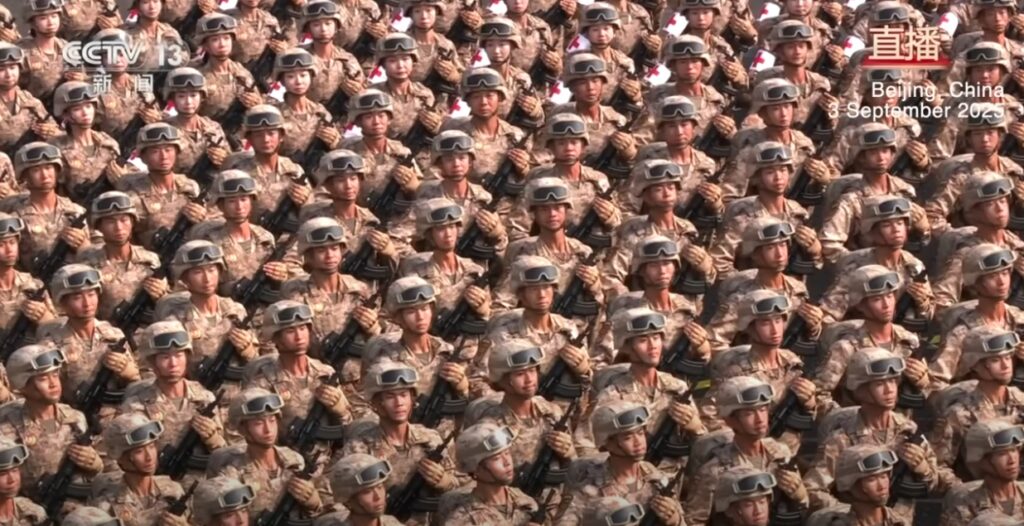
To think of it: China’s might has been created by the United States of America! What of the outsourcing, what of all the support that Washington would provide Beijing with just to spite the Soviet Union, the Middle Kingdom has become a superpower to be reckoned with. During the military parade occasioned by the 80th anniversary of the end of the Second World War in the Far East and the liberation of the Middle Kingdom from the Japanese occupation, China rolled out various kinds of armament, including drones and long-range missiles. China’s President Xi Jinping emerged in a limousine from the Tiananmen – the entrance to Beijing’s Forbidden City in a uniform habitually worn by Mao Zedong, a uniform resembling the one Joseph Stalin used to wear. Thus the Chinese leader stressed the connection with the recent past, although Chairman Mao was not the one who rendered positive services to the Chinese people. Russia does not preserve the continuity with its Soviet period of the past to that extent: true, the military parades in Moscow feature soldiers in uniforms and with military standards from the Second World War, but the tomb where mummified Lenin is till kept is shielded from public view; nor does Putin or the other members of the authorities climb the tomb as was the custom in the Soviet Union from where Soviet leaders would deliver their speeches and watch the marching soldiers.
Military parades in Moscow are compelling, yet the one in Beijing trumped Moscow’s parades. The parade held in Washington to mark the U.S. Army’s 250th birthday just cannot compare to either of the aforementioned: look for yourself. (Notice the rock music accompanying the American show; also, compare the Chinese vigorous march with the American languid walk.) China showed its military might also in equipment.
Within the framework of SCO the three leaders – Putin, Modi and Xi Jinping – conferred about political and economic topics. SCO conferences were also attended by Turkey’s President Erdoğan, while the military march was watched by Slovakia’s leader Robert Fico and Hungary’s minister for foreign affairs. So, Europe was ultimately somehow present, though not Western Europe, apart from a minor representative from Belgium. Were the representatives from the EU absent because of Putin’s presence there?
Well, Europe is crusading against Russia, and has grandiose plans of conquering China. Kaja Kallas, one-time Estonia’s prime minister, now the face of European diplomacy made no bones about it: “If you are saying that you are not able to beat, that we collectively are not able to really pressure Russia so much that it would have an effect because… then how do you say that you’re able to take on China risk. (…) My point is that if we don’t get Russia right, we don’t get China right, either.” (The interviewer tries to tone her statement down, to little effect.)
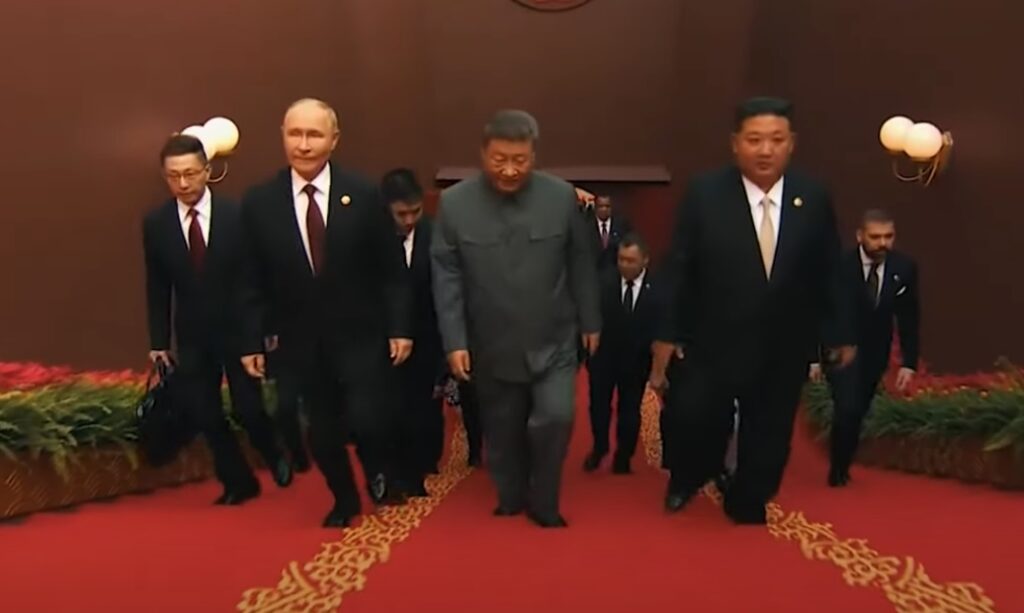
Vladimir Putin, Xi Jinping, Kim Jong Un
Strange that President Donald Trump failed to seize the opportunity to attend the anniversary of China’s liberation from Japan’s yoke. Just as Washington once pushed China and Russia into each other’s embraces, such a gesture on the part of the American president might have more favourably disposed the Middle Kingdom to the United States. Either Donald Trump didn’t want to go to Beijing of his own accord or he has bad advisors. The same is true of the European Union. Sadly, they could not be bothered to take part in China’s celebration. How can they then hope to develop friendly relations with the Middle Kingdom? How can then they hope to drive a wedge between China and Russia?
SCO’s membership includes India, Iran, Pakistan, Kazakhstan, China, Kyrgyzstan, Tajikistan, Uzbekistan, Belarus and Russia. It was established in 2001. SCO’s member states cumulatively make up 24% of the world’s area and 42% of the world’s population. (The European Union makes up less than 2% of the world’s area, and 5.5% of the world’s population.) Russia, China, India, and Iran are concurrently members of BRICS.

Trump may have stopped the left-wing revolution, but his achievements as a top manager in the top position remain miserable: the US is running a record deficit and DOGE is ceasing to exist.
The first year of Donald Trump’s second term will soon be over. In January, the public watched with interest as the new president made statements about restoring national finances. Elon Musk and his DOGE were supposed to reduce waste, fraud and bureaucracy and optimize the government’s work. New IT systems were to be introduced, useless jobs abolished, and unnecessary expenses reduced. Musk ran across the stage with a chainsaw accompanied by Javier Milea (the Argentine president), and Trump said that DOGE was a revolution and that they would find hundreds of billions in savings and reduce bureaucracy, including the federal administration. In short: America will be great again!
However, reality proved cruel. October marks the start of a new financial year in the US and thus a new budget. The budget deficit reached a record high of $284.3 billion this month, which is $300 million more than during the Covid-19 crisis, a time when the entire economy was shut down and the world was turned upside down. Never before in US history has there been such a high budget deficit at the start of the financial year.
However, it is important to note that an increasing proportion of this is attributable to the rising cost of servicing the debt. At present, it already accounts for 19% of all revenue, and forecasts indicate that expenditure on servicing US debt will exceed all social programmes and transfers within 10 years. Therefore, it can be argued that DOGE attempted to clean one room without realizing that the entire house is dirty and the owner is constantly walking around in dirty shoes. The savings should have amounted to more than $200 billion, while audits showed that this could be four times as much. This means that not only did loud statements come to little, but in the end there was still a record budget deficit. Ultimately, DOGE ceased to exist after 11 months, even though it was supposed to function until mid-2026.
Hopefully Mr Trump manages world affairs better on the military front than he does on the economic front in his own backyard, otherwise…
In 2006, the Bush administration passed the Pension Protection Act, which automated the American retirement plan, 401(k). Whereas Americans had previously been able to decide voluntarily whether or not to join the pension plan, after the new law was introduced, they had to explicitly state if they did not wish to do so. And since most people hardly ever check their contributions, participation in the program rose from 20% to 70%—an enormous cash injection for the stock market. Since in most cases 401(k) is a passive investment concept, i.e., the image of an index is purchased rather than stocks carefully selected through fundamental or technical analysis, the US stock market rose and continues to rise exorbitantly.
The danger is that if, for demographic reasons (declining US population, aging society) or economic reasons (higher unemployment), less money is thrown into the market, the market will begin to decline at a rapid pace as exorbitant sales are made.
Yes, there are numerous sellers of financial products who are currently dazzling us with their positive attitude toward the US economy. However, the stock market is completely overheated, especially in the US. At the moment, it is reminiscent of the dot-com bubble of 2000, especially since passive investment concepts now account for over 50% of the entire US stock market.
In addition, such concepts lead to large corporations being weighted more heavily due to automatic purchases. The best example was and is The Magnificent Seven, a stock index of seven large technology companies—Alphabet (parent company of Google), Amazon, Apple, Meta (Facebook), Microsoft, Nvidia, and Tesla—that have, or rather had, a dominant position, as Nvidia currently dominated them all. The market became narrow. If Nvidia falls, they all fall with it. In Europe, it is no better: in Germany, SAP, Siemens, and Airbus alone account for 30% of the weighting among the 40 DAX companies – which, incidentally, also facilitates manipulation of the DAX by large speculators.
One thing is certain: automated investment processes are stupid; they also mean that when a bubble bursts, there will be hardly any time to react accordingly.
Do you believe that every central bank acts independently of other countries? That the currency you pay with every day means anything in the world? Well, francs or crowns do, but others… Anyway, central bankers from all over the world gather from time to time at their headquarters in Basel to set the course for all currencies, their appreciation or depreciation, at secret meetings. Yes, at secret meetings, which is not in keeping with the transparent, democratic world and Switzerland in particular. There in the tower of their bank (the headquarters of the BIS – the Bank for International Settlements) they pay their bills, plan the next crises, the next helicopter monies, the next bailouts. Yes, there are such circles and their history goes back to the times before the Second World War.
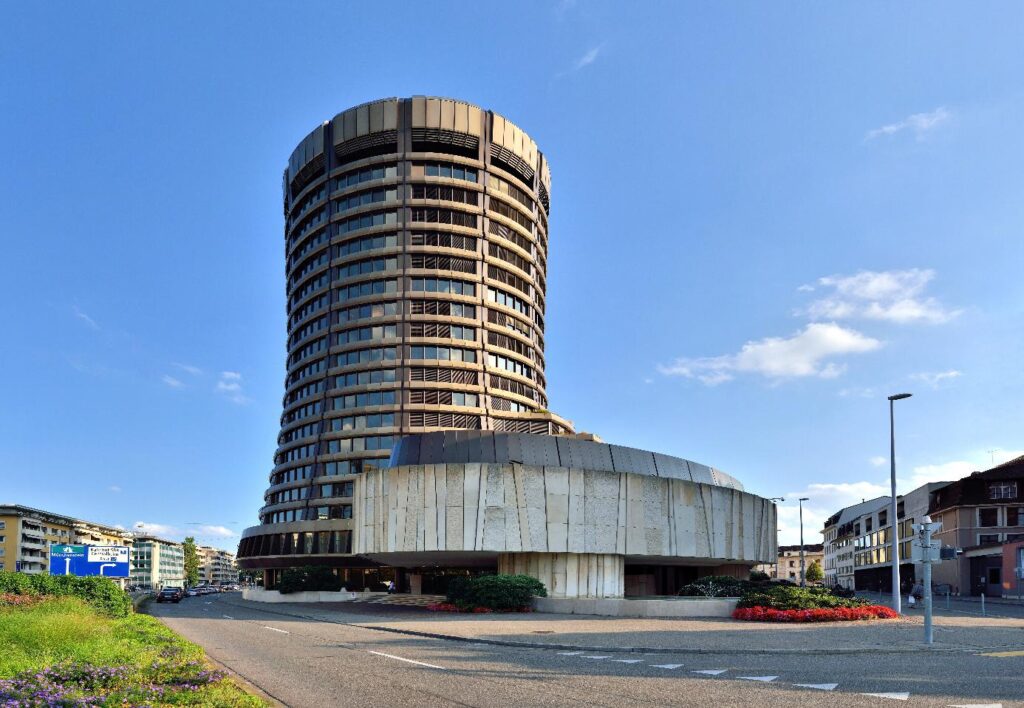
The headquarters of BIS, the infamous bank about which numerous authors such as Le Bro and Ronald Bernard wrote volumes. Source: Wikipedia.
Now some are stepping out of line: the BRICS countries are throwing down the gauntlet to the dollar, the king of all currencies, to which they have all had to submit up to now.
The absolute dominance of the dollar is beyond doubt because:
First
When the Second World War ended, the US economy undoubtedly became the most powerful in the world. In 1970, the United States accounted for about 40% of the world’s GDP. It was the only one left untouched after a major armed conflict and was able to use its position to introduce convenient rules for itself. For example, funds under the Marshall Plan (post-war reconstruction of Europe) were nominated in dollars.
Second
The US has created a financial system based on its currency. Until its link to gold was severed, every other currency was firmly tied to the dollar. This meant the need to hold dollar reserves. For example, the UK had up to 70% of its reserves in US currency at the time.
Third
The International Monetary Fund and the World Bank are institutions dependent on the USA (30% of the dollar reserves gave the USA a decisive vote). Therefore, loans in dollars were granted to countries in a difficult financial situation. In addition, they often had to open their markets to American exports, which only strengthened their dependence on the dollar.
Fourth
Until recently, all commodities were traded on the stock exchanges and always denominated in dollars, be it gold or oil, it doesn’t matter. All of them.
However, the era of globalization set in motion in the USA has begun to have negative effects. One of these was the unprecedented economic growth of many countries, especially China. They all increased their production and trade, and so their currencies became more and more relevant. In the 1980s, the dollar was the currency of 80% of trade accounts. Later, this share declined: from the 1990s to today, it has fallen from 70% to 54%. JP Morgan predicts that it will be around 50% by 2030.
A similar trend can be observed by analyzing the share of individual currencies in global reserves. The dollar’s dominance peaked at the beginning of the 21st century, when it accounted for around 72% of all reserves. As you can see in the chart below, this share has gradually declined over the last two decades.
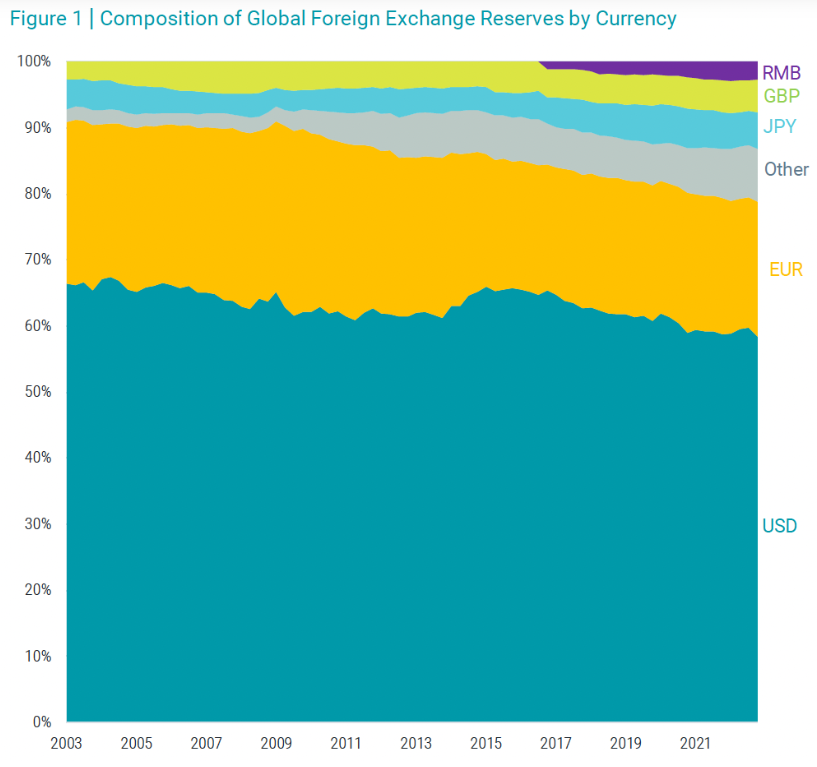
Source: Arcadiawm.com
As you can see, the majority of the new shares of currencies other than the dollar are due to the development of the economy in almost the entire world (“Other” in the chart). This is the effect of globalization and the growth of wealth in many countries. Interestingly, the Chinese yuan only started to play any significance in 2017.
The growing popularity of the yuan can also be seen even more clearly by analyzing SWIFT data, i.e. the American payment system used worldwide: In 2023, the value of transactions made in this currency increased dramatically. This made the yuan the 4th most popular currency in this system. This is indirectly due to the sanctions imposed on Russia for its invasion of Ukraine. This forced the Russians to bypass the dollar, which is why the yuan and ruble currently account for around 90% of the country’s trade with China. To this should also be added bilateral agreements with Brazil and Argentina, which were signed at the time and have included the yuan in trade between these countries.
However, one of the main reasons for the popularization of the Chinese currency is the activity of the BRICS. This bloc accounts for 31.5% of global GDP, 40% of the population, 40% of the oil market and 72% of the rare earths market. The participating countries cooperate with each other through investment in infrastructure and trade. One of the group’s most important assumptions is the pursuit of a multipolar world order and thus a world in which the dollar is no longer the most important currency. Within the framework of the BRICS, institutions were created that represent alternatives to the World Bank and the International Monetary Fund. These are the New Development Bank and the Contingent Reserve Arrangement. Their business is very similar to their Western counterparts, but there is one fundamental difference. Loans are granted in local currency, which reduces dependence on the dollar. As a result, 69% of trade between the BRICS countries will bypass the US currency in 2025.
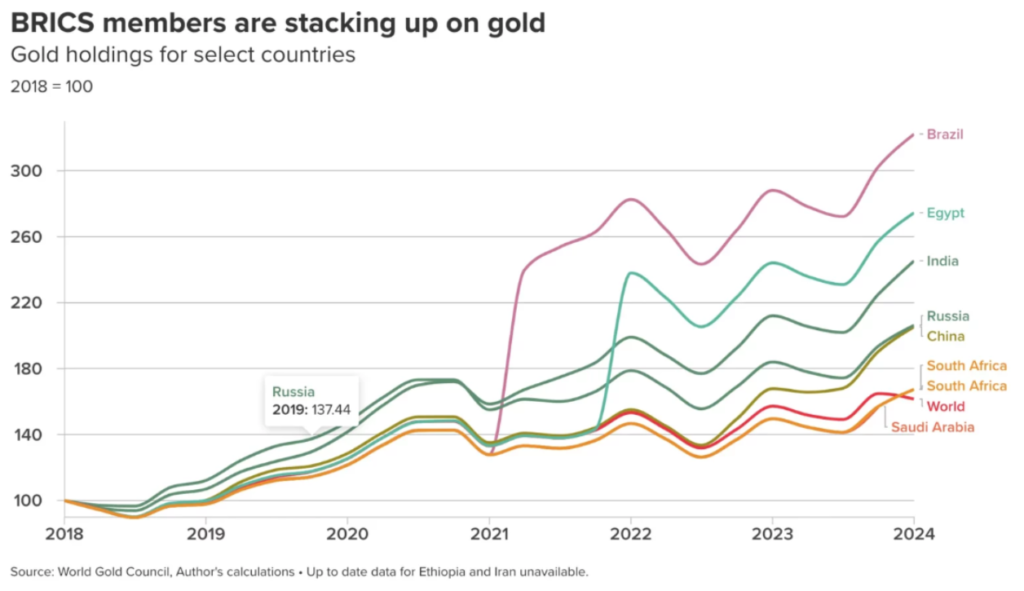
In addition, BRICS countries are buying gold instead of dollars. Recently, it has been the very countries (with China in the lead) that have been most responsible for global gold purchases, mostly directly from local miners, further reducing dependence on the dollar. It is worth noting that the BRICS countries account for 20% of global gold bullion supplies. Therefore, it is obvious that many countries (including the BRICS) are trying to have as many gold reserves as possible, which should further boost demand for this metal.
What’s more: In October 2025, the Moscow Precious Metals Exchange was launched on the initiative of the BRICS. It enables calculations in gold, platinum, diamonds and rare earth metals. It bypasses the SWIFT system and the London Metal Exchange system. This decision makes countries such as Russia and China independent of possible sanctions and supports trade in commodities and currencies of the BRICS countries.
In addition to the newly opened Moscow Exchange, there is also a Shanghai Exchange specializing in gold and silver, which supports 30% of gold trading in the yuan. A merger with a newly opened organization could create a common market for metals within the BRICS, making the bloc further independent of Western influence. These events only emphasize that the role of gold will only increase in the coming future.
A thorn in the side of the Americans and Western bankers is the fact that the BRICS are using their control over 72% of rare earth element (REE) reserves as leverage against the West. The recent information about Chinese restrictions on the export of these commodities and Trump’s threats that followed only confirm this.
China, a tycoon in this market and the most important member of the BRICS, is also trying to establish alternative supply chains in order to circumvent Western influence as broadly as possible. One example is the Middle Kingdom’s investments in Africa. The Dark Continent is a kind of gateway to the implementation of the de-dollarization strategy, as there are huge, unknown REE deposits (up to 10% of global supply in the next 5 years). In Angola, for example, a new mine is being built. From 2026, it is planned to produce 20,000 tons of mixed rare earth carbonate (MREC) per year, which will cover 5% of the global demand for magnetic metals. Lobito Corridor (the Banguela railroad) will be used for export. It is an infrastructure financed by China as part of the New Silk Road (BRI). The key here is the fact that it completely bypasses the routes controlled by the West, facilitating trade with China and Russia. Therefore, China is building a new network of dependencies and cutting off its competitors from access to attractive markets in order to obtain economically critical minerals. We would not be surprised to see Angola join the BRICS in a few years, as well as Nigeria, where Africa’s largest REE processing plant is located.
To summarize: The emergence of a multipolar world order is very likely, even if the dominance of SWIFT, the BIS, the IMF and similar US-dependent institutions will continue for some time to come.
One of the very important outcomes of the SCO (Shanghai Cooperation Organization) conference held on 31 August – 1 September was the deal made between Moscow and Beijing about constructing and completing by 2030 the Power of Siberia 2 pipeline (the Power of Siberia 1 is already in operation), which will run through Mongolia. The pipeline will be built by Gazprom and it will provide the Middle Kingdom with natural gas extracted – among others – from the same fields which up to quite recently supplied Europe with this resource.
The consequences of this move are neither to be overlooked nor underestimated. Waging a crusade against Russia, Europe deliberately and purposefully cut itself off from Russian gas. Long before the conflict in Ukraine broke out, the leaders of the Old Continent for years kept complaining about the continent’s dependence on Russian gas. For years they they would make the cooperation for Gazprom ever more difficult. Then came the war in Ukraine and an eruption of Russophobia. Europe turned its back on Russian gas while the United States made sure that no one would think about reversing course: as we know the supply pipelines – NordStream and NordStream 2 – were sabotaged.
Europe is still purchasing some Russian gas through middlemen, but generally the Old Continent has switched to American LNG, which is more expensive as it requires shipment, liquefaction, and vaporization. The Russia-China deal will make it impossible for Europe to return to purchasing Russian gas: the Chinese market will swallow up any quantities of it. We are witnessing an epic change: the two NordStream pipelines are about to be replaced by the two Power of Siberia pipelines, redirecting immense amounts of gas from Europe to Asia. Simultaneously, since the Power of Siberia 2 will run through Mongolia, it is Mongolia that will greatly benefit from the Moscow-Beijing deal rather than Poland or Ukraine, through which the pipelines Yamal and Druzhba/Brotherhood run. Russian gas was supplied to Germany and Italy. It was cheap, cheaper than its American alternative, and so both these countries benefited from it a lot economically. All of this is in a complete reversal. What was done during the SCO session is like switching the railway points: the tank cars full of gas that used to be headed for Europe will all soon be headed for China.
Just as over time European and Russian economies will diverge one from the other, those of Russia and China will become closer and closer. The pipelines supplying Europe were in operation for decades, long before the collapse of the Soviet Union. With them gone, a new economic alliance between Moscow and Beijing will be forged. We can only wonder what European leaders think about this change. Sure, on the face of it they are still belligerent, but are they in their heart of hearts? If they are clever enough, they must be smelling a rat. The war that they had hoped to win is going sour, the sanctions that they had thought would coerce Russia into submission backfired, while the economic situation of the Old Continent is deteriorating with every month. Still, once they all invested so much hatred and scorn into Russia, they simply cannot put into reverse. Such is human psyche. They must wage their crusade to the bitter end.
President Donald Trump wants the FED to lower the interest rates. The FED’s board is made up of governours who have the authority to either raise or lower the interest rates. The governours are nominated by presidents, and consequently, the parties that rally behind them. It so happens that democrats have more governours than the republicans. Since the FED does not want o lower the interest rates, President Donald Trump resorted to exerting pressure on one of the governours who are of democratic persuasion. Obviously on the advice of the members of his closest circle the president decided to dismiss one of the governours – Lisa Cook, who was appointed to this FED position by President Joe Biden. To be able to dismiss a governour, the president needs to have a valid reason – a cause as it is legally referred to. The president’s lawyers maintain there is cause enough, the lawyers from the opposition contradict. As usual, when it comes to legal matters, much depends on interpretation.
Now we do not want to delve into the case concerning Federal Reserve Governor Lisa Cook as such. What appears to be of greater importance is the mechanism of wielding power in the United States in particular and, generally, anywhere in the world.
A country’s leader – who may go by the name of president, prime minister, monarch, secretary general – has a job of managing and guiding the country. To do this job successfully, he needs to have a vision, a plan, and… wiggle room. We are not going to decide whether the interest rates ought to be higher or lower. What we are concerned with is whether you can be a successful leader of a country without having sufficient influence on the country’s finances. In the general election people choose their leader. Theoretically at least, they choose their leader on the basis of the promises that a candidate for office makes. Now the candidate running for office may of course be mendacious – having no intention of delivering on his promises – but let us assume that we are dealing with well-meaning candidates. Once elected to a high office, the successful politician needs to have real power or else he will not be able to deliver on what he promised, irrespectively of his good intentions.
On the flip side we have a mechanism enshrined in law – a constitution – statues that safeguards the proper balance of power, the famous checks and balances. We have such mechanisms because we fear to entrust full power to an individual or a group of individuals who might – as not infrequently happens – turn out to be socio- and psychopaths. But, the same checks and balances on the other hand hamper a well-meaning leader from discharging his duties in terms of fulfilling the promises that he made.
The refusal of the FED to lower the interest rates might be dictated by a couple of factors. One, the FED governours might be right from the economic or financial point of view. So far, so good. Two, those FED governours who are from the opposing party might simply want to act in spite of the president’s wishes, just out of malice. That’s bad enough. Three, the FED governours might want to please others than the president or the be ulk of the citizens of their country. That’s pretty bad. Who do the FED managers want to please? The FED’s shareholders. If for whatever reason the shareholders want the rates to be high or low, the FED will act accordingly. Sure enough, for public consumption the governours will frame their financial policy in terms of aiding the country’s economy rather than pleasing their shareholders. In any of the three cases the FED finds itself on a collision course with the President of the United States.
The question arises why the country’s leader cannot decide on financial matters? The answer is: because it is the law of the land to have a central bank that is independent or semi-independent of the country’s authorities. Indeed, the FED was established in 1913 and at that time it was agreed that the country’s financial policy would be placed in the hands of the financial entity which is for all intents and purposes not strictly a government agency but a private enterprise. One of the arguments was that if it were the presidents who could decide about the interest rates and the amount of money in circulation, they would soon trigger huge inflation and consequently bring the United States to rack and ruin.
Indeed, that might be so, the argument is somehow valid. Still, the same arrangement appears somewhat weird. It looks like a ship’s captain cannot give orders to the ship’s helmsman and decide about the course of the voyage. The passengers have entrusted their lives to the ship’s captain, not to the ship’s helmsman (by the way, governour derives from Latin gubernator, which means helmsman); consequently, if the ship runs aground or remains adrift, it is the captain who is held accountable. But the ship may run aground or be left adrift not because the captain was not competent enough, but because the ship’s helmsman refused to take the captain’s orders. Now the ship’s helmsman may be right in refusing to carry out the captain’s orders, but then in case of accident it ought to be the helmsman who should be held responsible rather than the captain. It may equally be so – as mentioned above – that the ship’s helmsman may act out of malice or may take orders from some of the influential passengers (shareholders). That’s a nice fix, isn’t it?
The problem of such or similar checks and balances is not limited to the United States. If leaders are restricted in their action, how can they be expected to deliver on their promises? If leaders cannot deliver on their promises because they are restricted, what sense then is there for having elections?
The USA recently officially classified silver as a “critical mineral” on the Department of the Interior’s list. What is this list and what does it mean? It contains minerals that the United States considers critical to its economy and national security. Many come from countries that are considered political adversaries, such as Russia or China. What does it mean for silver to be included on this list? First of all, any project related to the extraction, exploration or processing of such a mineral can claim state financial support. In addition, the process of obtaining mining permits is reduced from 10 years to 1-2 years, which can significantly support the development of national resources of this mineral.
Silver, together with gold, has been a real hit for stock market players in recent years and is steadily gaining in value. Readers of our Bulletin may recall our multiple recommendations for gold and silver. The US government’s decision and the possible imminent upheaval in the financial world – the switch to digital currencies by some central banks (CBDCs) with a return to gold backing – will ensure that the two precious metals will continue to shine for a long time to come.
The media in the EU tend to condemn and ridicule the US president. Yes, you could say that for them he has become the second biggest threat to the Western world (after Putin of course). Now thinking coolly and analyzing the latest facts, it can be concluded that Trump is doing everything good for America’s budget and economy.
Trump’s tariffs, for example, are portrayed as malicious and harmful to the global economy. In fact, they are an effective tool to successfully negotiate with all countries. The latest example: After negotiations with Japan, the US has lowered tariffs from 25% to 15%, but tariffs on steel and aluminum (50% and 25% respectively) remain unchanged. To reach this agreement, Japan agreed to open its market to American goods, including cars or agricultural products. Japan also offered a package of USD 550 billion in the form of loans and investments in US sectors such as semiconductors and energy, with the US retaining 90% of the profits.
If you want to take the propaganda of the leading Western media (CNN, BBC, ARD and all who serve the US Democrats) at face value, then consider the following:
① when someone/something hurts the US economy, stocks on Wall Street fall – since the stock market has realized that Trump is boosting the economy again, the indicators are rising and reaching their all-time highs.
② many companies listed on the Japanese stock exchange recorded growth following the announcement of the deal with Trump. The Nikkei index rose by almost 4%, while automotive companies rose from 9% (Nissan) to 17% (Mazda). The solid announcement of tariffs in April and tough negotiations by the United States have put pressure on trading partners to make concessions. Although the tariffs are lower than stated, the US has secured preferential terms such as opening markets for US exports (for example, Japan will buy 100 Boeing).
③ revenues in the US budget are rising hyperbolically and Trump will probably be able to realize his election promises.

Quelle: Daily Treasury Statement
Tariffs are, of course, a double-edged sword – they can increase prices and inflation in the US – but they have allowed them to obtain favorable terms that would be difficult to achieve under normal circumstances.
…then take a look at the world’s most famous investors and their strategies.
In our last bulletin, we devoted a lot of space to Warren Buffet. Another bigwig of the financial world – Peter Lynch – has been providing recipes for success on the stock market for decades. His long-standing approach is the opposite of what beginners in the financial market experience today: they buy access to a trading platform, sink into the swamp of information from the Internet, experience their first defeats, buy access to information from analysts, experts, specialists and … according to statistics, 80% of them do not make profits, but losses.
Today’s investors rely on so-called technical analysis (of share prices, for example), fund forecasts and the like, the opinion of an advisor. Lynch, on the other hand, has proven that an ordinary investor who is familiar with products and services can be successful if he invests with discipline and patience.
What assumptions guided our hero when analyzing companies? Lynch believed that the key to success on the stock market was to understand the business rather than blindly following the numbers. For example, going to a shopping center and observing which stores are successful (crowded). His method was based on several main pillars:
① excellent product – a company must provide a product or service of distinctive, inimitable quality;
② scalability – The company’s business model should allow for broad development;
③ overlooked – the company is overlooked by Wall Street for some reason;
④ long-termism – instead of speculating, Lynch invested in companies for years or even decades on the assumption that a good business will turn a profit given enough time.
⑤ empiricism – Lynch avoided complex mathematical models and relied on direct experience and intuition, supported by reliable research.
If this has aroused your interest, consider the following Lynch’s thoughts:
① “professional investors don’t understand the basics. A bunch of software does nothing unless they have done basic homework on companies. They feverishly buy access to services like Bridge, Shark, Bloomberg, First Call, Market Watch instead of spending more time at the mall”
② “When even analysts are fed up with any stock, it’s a sign that it’s time to buy it.”
③ “If I find 10 good stories of companies and they are all equally attractive, I buy all 10 and look forward to these companies growing. It’s like playing 10 games of poker. The third story is doing better, the sixth is weaker, the seventh is stable but has already earned 50%. Then you sell the seventh and buy the third again.”
④ “If the prototype works in Texas, postpone buying stock until the company shows it can make money in Illinois. Will this idea work elsewhere? That’s exactly the question I forgot to ask the founders.”
⑤ “You need to invest in multiple companies because of the five you choose, one will be wonderful, one will be very bad and three will be average.”
⑥ “You can lose money quickly, but you need a lot of time to recoup the losses.”
Warren Buffett said of Peter Lynch: “Well, I know Peter, I like him personally, and of course he has a great track record. Of course we have a lot in common, but there are also some differences. Peter of course loves to diversify a lot more than I do. I mean, he has more companies than company names that I can remember. But this is Peter and I… you know, I’ve said in the past that there’s more than one way to heaven in investing and that there’s no one true religion in this space, but there are some very useful religions. Peter has one, and I think … there’s a lot of overlap, but I wouldn’t do as well if I tried to do it the way Peter does, and he probably wouldn’t do as well if he tried to do it the same way I do.”
You have to find your own way. Both to invest correctly and to understand world events objectively. Gefira will help you with this.
The American president changed his approach to the stock market in his second term. To the extent that he paid homage to Wall Street during his first term, he recently said in an interview for Fox News that he needs to build a strong country without looking at the stock market. The average American cares because retirement funds are operating on risky assets and many small investors are putting their savings into the stock market instead of keeping their money in low-interest accounts like Germans or most Europeans.
Trump believes that we are now facing a transition that will eventually lead to the return of wealth to America. Incoming Secretary of the Treasury Scott Bessent later added fuel to the fire when he said during his interview that if anyone thinks Trump will change his policies to stop the stock market decline, they will be disappointed. Bessent is of the opinion that we are currently in a “detox period” – a transition from reliance on public spending to private spending – and any negative market behavior is the legacy of Joe Biden and his policies to stimulate the economy with debt and deficits.
The new managers on the Potomac point out that the indicators are falling and Wall Street appears to be heading for a deeper correction.
What is also falling are the indicators of economic activity: the ISM Manufacturing (PMI) (activity in the US manufacturing sector), while ISM Manufacturing Price (change in the prices manufacturers pay for raw materials and other materials for production) is rising significantly. In the case of the former, it was above 50 points, i.e. above the threshold above which the economy is assumed to be developing, but well below the previous value and also below forecasts. In the case of the latter, it may be a return of higher inflation. In addition, orders in the US manufacturing sector are falling. Unemployment is also rising – Trump’s (or Musk’s) redundancies in the public sector are important here.

As a result, Americans are less willing to spend their money, which means that domestic demand, one of the main drivers of the US economy, is falling. After all, consumer spending accounts for 68% of US GDP!

Can such a situation suit the Trump administration? Paradoxically: Yes!
It is well known that the Fed is maintaining high interest rates (4.5%) in response to persistent inflation of around 3% (target is 2%). High interest rates lead to higher bond yields. Considering that the US needs to refinance a large portion of its debt this year (a good 25% of the total), it would be best for it to do so at the lowest price – i.e. the lowest interest rate on bonds. It is well known that it will not be easy to get the Fed to lower interest rates in the face of increased inflation, so a recession is the best solution. With limited economic growth and demand (see above), inflation may ease considerably and the associated layoffs could prompt the Fed to cut rates to stimulate economic growth.
Hence the tariffs, hence the trade wars – the aim is to bring production back to America, to increase the attractiveness of US products for domestic consumers and… to initiate a new, better period for the American economy after the recession.
Argentina’s President Javier Milei, whom we praised in our article in February this year for his sober views and realpolitik, is showing his clout. Since he has been in office (exactly one year), applying radical measures, he has brought inflation in Argentina sharply down. At the beginning of his term of office, monthly inflation stood at 25.5 %, but it has now fallen to 3.5 %. This success is based on a comprehensive “shock program”, which included far-reaching cuts:
- Reduction in government spending: Milei halved the number of ministries and laid off numerous civil servants. Subsidies, for example for energy and transportation, as well as social benefits such as food subsidies and support for soup kitchens were also cut.
- Monetary and fiscal policy: Argentina’s national currency, the peso, was devalued and a strict austerity program was introduced to reduce the budget deficit. The aim was to achieve a balanced national budget.
- Market-oriented reforms: Milei was guided by ultra-liberal principles, aiming for a drastic reduction in the state apparatus and greater deregulation.
The FED or the ECB take years to get inflation under control, surrounded by crowds of employees, in their towers in Frankfurt (ECB) and Basel (BIS), in their bunkers in Fort Knox, cut off from reality, with the media serving them, convincing the public of the efficiency, caring and reasonableness of central bankers, leading us from one crisis to another. The ECB can do nothing about the deepening recession in Germany. An Argentinean who is going against the tide, a showman whom all the Western media despised a year ago and predicted his quick downfall, has succeeded. Against all odds. Though he is on the side of Ukraine and Israel in their conflicts, though he speaks out against the BRICS, Venezuela, Iran, Russia and China, nonetheless he argues against woke culture and all left-wing ideas for social transformation. Note that he was the first head of state Donald Trump met with (informally) after his election. While Trump is a protectionist who will try to control the US market with administrative measures, Milei is an opponent of liberalism and open markets. After 20 years of socialist government in Argentina, came a man who keeps his promises: he is putting an end to socialism and its failed ideas. First in the economy, then in all areas of life. One man, one word.
Donald Trump wants to increase tariffs on Chinese even by up to 60%, and Democrats will have no choice as to agree to at least some of protectionism planned by the Republicans, or else China will flood the market w its products to the detriment of American domestic industry. In recent years, Western companies and financiers have invested heavily in China only to withdraw from the country at present.
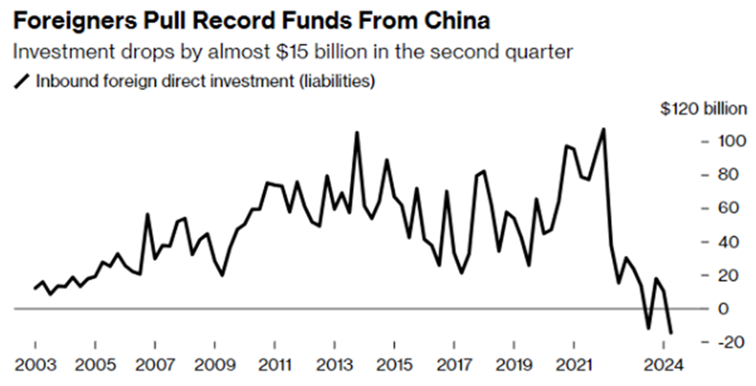
Source: bloomberg.com
In the second quarter of 2024, 15 billion dollars were withdrawn from China. At the same time, exports from the Middle Kingdom are on the rise as companies increase their inventories of Chinese parts, components, etc. so as not to be so affected by potential trade wars. Put simply, we buy what we can from China, but we no longer invest there. This strategy is being pursued by many countries. As a result, freight costs are also rising. Below you will find transport costs from main ports in China (Containerised Freight Index – green line). The situation is similar to that after the end of the pandemic, when inflation began to rage.
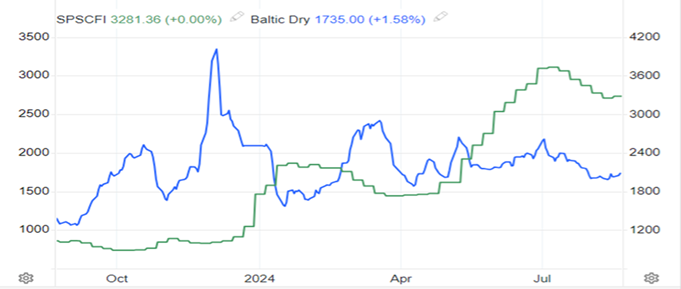
Source: tradingeconomics.com
Companies are filling their warehouses and politicians will have a tough nut to crack if inflation rises as a result of trade wars. Already, 59% of Americans believe their country is in recession, despite good economic data.
It is worth remembering that the development of the global economy has been due to free trade for several decades, with the focus on China. This process is now set to be halted and many Americans would even like to see it reversed. This will benefit many European or American companies, but unfortunately it will be at the expense of ordinary citizens, who will pay more for many products. This will fuel inflation and at the same time slow down the economy. Such a situation is known as stagflation. Stagflation is therefore a possible scenario as downside risks dominate the markets, including geopolitical tensions and trade fragmentation.


