
Rules for thee but not for me

On June 13 2025, Israel carried out air strikes against targets inside Iran. Tel Aviv has thus arbitrarily administered punishment to Tehran for allegedly developing Iran’s capabilities of constructing a nuclear bomb. A few remarks.

There are politicians and journalists, political analysts and other pundits who condemn the Russian intervention in Ukraine, which began in 2022, and in the same breath they justify the military action performed by Israel. Both Moscow and Tel Aviv claim they were compelled to carry out strikes against Ukraine and Iran respectively because the said countries posed an existential threat to Russia and Israel respectively. Ukraine wanted to join anti-Russian NATO and possibly acquire nukes, while Iran sought to manufacture nuclear weapons with the intention of wiping Israel out of the surface of the earth.

Why is Israel justified in its action while Russia is not? Notice that Ukraine borders on Russia, while Iran is divided from Israel by Iraq, Syria and Jordan.

Tel Aviv stands on guard not to let any of the Middle East countries to have nuclear weapons while Israel itself has an arsenal of such weapons.

Why should one country have nuclear weapons while any other be prohibited from possessing them? What is the moral or rational explanation? It might be that those who have weapons of mass destruction are likely to say that they are angelic warriors who are not likely to use them or to use them without justification while the other countries are the bad guys who certainly would use them without justification. Yes, such is the narrative, but then it does not require much stretch of imagination to realize that the so-called bad guys think along precisely the same lines with this difference, however, that they regard themselves as angelic warriors and others as villains.

What if South Korea wanted to acquire nuclear weapons? Reason? Because North Korea has them. Reason enough. We may rest assured the United States would have nothing against, so much so that South Korea might also be employed as an ally against China, allegedly America’s life-threatening rival. Why, the United States might not have anything against Japan acquiring nuclear weapons. Again, Japan might be used against China and – who knows – against Russia.

What if Tehran were rabidly anti-Russian? Would then Iran not be allowed to have nuclear weapons? If the idea of Ukraine possessing such weaponry was seriously considered at a time, then certainly an anti-Russian Iran would be given free rein in this respect.

Are American attempts at bringing international peace worth anything? President Donald Trump is helpless in brokering peace both in Ukraine and in the Middle East. The question arises whether the American leader is simply incompetent or… or whether these peace initiatives are only make believe. If the United States is a superpower, why cannot Washington project its political leverage on Ukraine and Israel? If a superpower cannot control much smaller states, then something must be the matter. What? It might be that Washington does not serve American interests. Is such a thought substantiated? Of course, it is. One only needs to look at the European leaders and their entirely anti-European policies whether it is the ethnic replacement or green economy or the anti-moral agenda.

What is the credibility of the American president? The Israelis have decapitated some of Iran’s military and civilian management precisely while talks were held between Washington and Tehran. It is obvious President Donald Trump must have known about the preparations for the attack. If by any chance he did not because he would have been against and the American powers that be desperately wanted to hit Iran, then his reliability as an American leader is even worse: why talk to a president who does not control his own country, his own agencies and his own underlings?

Iran lashed out, and lashed out successfully. Israel was hailed with missiles and the famed Iron Dome that was supposed to protect the country’s territory proved to be quite penetrable. Now Tel Aviv might request missiles and anti-aircraft systems from the United States to make up for the depleted stocks of their own missiles. What will then remain for Ukraine? Certainly Israel rather than Ukraine is Washington’s priority.

Will the United States army be drawn into war against Iran? That might mean splitting American military and other resources between the Middle East, Ukraine and China. Is that not too much even for a superpower, especially a superpower with domestic problems caused by – some say – thirty million unregistered aliens who flooded the country during the Biden administration and earlier? A civil war or a wave of terrorist attacks at home, an involvement in Ukraine, a military engagement in the Middle East, and muscle flexing in Washington’s dealings with the Middle Kingdom – is that not a huge overreach?

Whichever way you look at the events, one thing should strike you immediately: one attack is justified while another is not. Rules for thee but not for me. 

AU10TIX or how Israelis act

AU10TIX is an Israeli identity service that verifies people or companies on the Internet. For example, people who want to earn money on Twitter (X) have their identity checked and authenticated by AU10TIX. So far, so good, but there are two appalling facts about the Israeli company:

1. AU10TIX has close ties to Israeli intelligence. It was set up by members of the Israeli elite intelligence services Shin Bet and Unit 8200. Ton Atzomm, its CEO, was a member of Unit 8200 has been committed to the surveillance of Palestinians and has been utilizing the information gained in the process to politically persecute and divide them. Edo Soroka, the Vice President for Sales in Europe, the Middle East and Africa, previously worked for the Israeli startup AnyVision, which is accused of monitoring Palestinians in the occupied West Bank. Erez Hershkovitz had earlier been employed by the Israeli company Voyager Labs, which was sued by Meta for using dozens of fake Facebook accounts to collect data from more than half a million users.

2. AU10TIX suffered a serious security breach that exposed the personal data of millions of its users. Customers that fell victim to the June 2024 scandal include some of the world’s most renowned companies, such as X, TikTok, LinkedIn, Coinbase, eToro, PayPal, Fiverr, Upwork, Bumble, and Uber. Names, dates of birth, nationalities and images of identification documents such as driver’s licenses and passports, facial scans and authentication metrics for documents and photos were disclosed. It was a massive security breach with unforeseeable long-term consequences. The exposed data could be used by cybercriminals for various illegal purposes such as identity theft, financial fraud or even blackmail.

Several questions could be brought up:

1. How does all that square with the U.S.-Israeli friendship and alliance?

2. Why does the Israeli intelligence agency want to collect – manage – control the data of millions of Americans?

3. Why do the US services do not hinder such deep intrusions into the security of US citizens?

A further seventy years of inaction?

In the Middle East we have – as usual – more and more of the same. Regardless of how old you may be, from time to time you will have heard about clashes, assaults, wars, conflicts – you name it – between Israel and the rest of the Arab – Muslim – world happening there incessantly. On and on and on. Since 1948, since the year when the state of Israel was founded. Even people who are not conversant with politics will have heard about Hamas or Hezbollah, about the Six-Day War (of 1967), about the Gaza Strip, the Golan Heights or the West Bank (of the Jordan), about PLA (the Palestinian Liberation Army) or the Yom Kippur War (of 1973), or, or, or. You may not be able to say much about the events or people or places – where the heck is Jordan or Syria or Lebanon – but you will have heard about all of them, so that by now you will have doubtless associated the Middle East with a forever war interspersed with longer or shorter periods of ceasefire. The events of the 7th of October and the following retaliatory measures are yet another (latest but by no means last!) link in this never-ending chain of clashes.

Now why have we all been hearing about the ongoing, never-ending, incessant conflict between Israel and the rest of the Arab world, especially between Israel and Palestinians for these more than 70 years? 

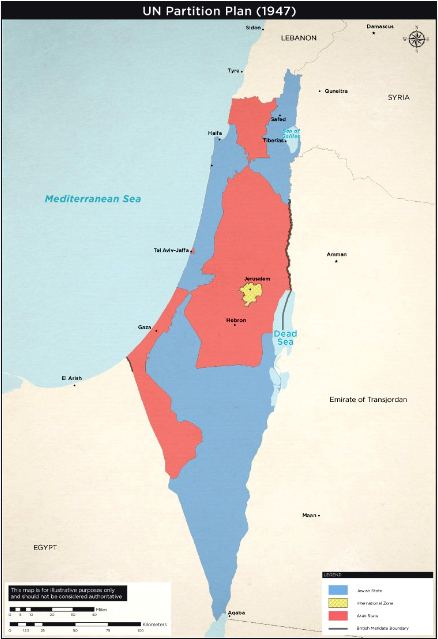
The state of Israel, as you may know, was established in 1948. Its creation was brought about by no less an international organization than the United Nations (an organization that unites sovereign political entities – countries, states – but, by Lord, not nations as such, but never mind the detail). The genesis (Genesis!) of Israel could not have been more legitimate, could it? The point is that the same United Nations Organization stipulated that also a Palestinian state was to be created along with the state of Israel. Now more than seventy years have passed and although we have had the state of Israel for these more than seventy years, the Palestinian state is nowhere to be seen. Supposedly American presidents have always wanted to have both Israel and Palestine as sovereign countries in the Middle East. Supposedly, because somehow the United States has never been able to convince, persuade, compel Israel to recognize Palestine as a separate, independent political entity, and to release the Palestinian lands that Israel has grabbed. How is that possible that the UN resolution was implemented half-way only? How is it possible that the big United States has not been able to make the small Jewish state comply with the ruling of the United Nations? Especially, if you consider that the ruling of the United Nations overlaps with Washington’s interests in the Middle East because these interests are STABILITY. You may say that the United States is no international bully and respects the sovereignty of even the smallest of states, so if Tel Aviv has for all these years refused to comply, the Hill has been helpless.

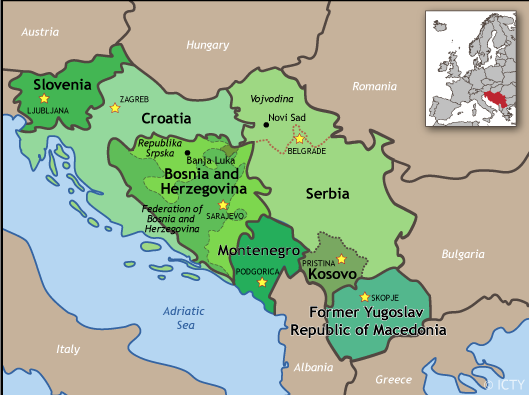
The claim that the United States has not been able to persuade or compel Israel to comply with the United Nations’ decision because Washington respects the sovereignty of even small states is – yes – laughable. Of the numerous examples showing unequivocally how the United States has enforced its will on other nations, let us choose Yugoslavia. What Israel is to Lebanon, Syria, Jordan, Palestine and Egypt so was Serbia to Croatia, Bosnia, Slovenia, Macedonia and Albanians in Kosovo. They all wanted to become independent of Belgrade, so – stepwise – they broke away from the Socialist Federal Republic of Yugoslavia and they were assisted in it by the United States. Whenever Serbia wanted to keep a republic inside the fold or claimed small pieces of a break-away republic’s territory, the United States would step in and by hook or by crook force Serbia to comply with “international” dictates. It did not take the United States seventy years to make the former Yugoslavian republic obey “international law”.

The comparison is even more to the point if we set our sights on Kosovo because Albanians in Kosovo invite a comparison with Palestinians in Gaza and the West Bank. Just as Serbia views its territory as comprising Kosovo with little regard for the fact that it is predominantly inhabited by Albanians, so, too, Tel Aviv would like to view Gaza and the West Bank as part of (the Greater) Israel with little regard that these territories are inhabited by Palestinians. Somehow, in the former case Washington (and America’s client states) was efficient in tearing Kosovo away from Serbia and establishing there a state that is recognized by a large number of countries. How much time did it take? A couple of years? Somehow, the same solution in reference to Palestine (i.e. Gaza and the West Bank) is hard to implement by the same United States, which is so efficient elsewhere in the world. Why? Is it because the Israelis don’t want such a solution and they have influential friends on the Potomac?

Why what was possible and relatively easy to enforce as a many-state solution in Yugoslavia (which was broken up into 1 Slovenia, 2 Croatia, 3 Bosnia and Herzegovina, 4 Serbia proper, 5 Republika Srpska, 6 Macedonia, 7 Montenegro, 8 Brčko District (look it up!) and 9 Kosovo) cannot be enforced in the Middle East? If we can have such a bizarre solution like that of having the sovereign state of Serbia (outside Bosnia and Herzegovina), the sovereign state of Bosnia and Herzegovina and that of Republika Srpska (not to be confused with Serbia proper!) inside Bosnia and Herzegovina (did you know about it?), why can’t we have a Palestinian state straddling Israel with its one part located in the West Bank and the other in Gaza? If we can have Brčko District, why can’t we have the City of Jerusalem turned into something similar i.e. a “self-governing administrative unit with a special status reflecting the multi-ethnic nature of the region” to quote Wikipedia’s words?

The Hamas attacks from October 7, 2023 and the ongoing war keep reminding politicians across the board about the necessity of creating a Palestinian state, but we may be sure that nothing whatsoever will be done, just as it has not be done for over seventy years.

It’s even worse than that. During the many fratricidal fights in the former Yugoslavia, the West (read: the United States) was quick to spot war crimes and to hold the “guilty” accountable for them by putting many (mainly Serbian) political and military leaders on trial. Why nothing of the kind is happening now or has been happening for the many years of the conflict between Palestinians and Israelis? It is somehow hard to imagine that Serbs committed many war crimes against Albanians (and Croats) within a few years whereas Israelis have not committed any atrocities within more than seventy years! It looks like Serbs had to be intimidated by show trials while Israelis do not.

No wonder then that if nations of the world see this partisan approach in the Middle East (and elsewhere), they resort to arms rather than to international organizations, and (like Palestinians nowadays) they prefer to fight rather than talk.