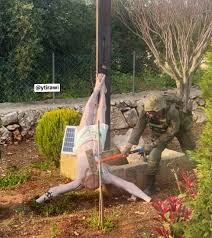
Jesus Christ was officially enthroned in Rome at the time when the Empire was on its slippery road to disintegration. The United States of America, today’s Rome, braces itself for the enthronement of Waheguru, a Sikh God. Sapienti sat.
This is not a one-time event in the Western world. What we are witnessing is a psychological change of epic dimensions. Ancient Rome was the superpower of the then world, at least the world around the Mediterranean, the world encompassing most of Europe, northern Africa and the Middle East. The area controlled by Rome covered in today’s political and administrative terms: (in Europe) England, France, Spain, Portugal, Italy, all former Yugoslav republics, Romania, Greece, (in Northern Africa) Algeria, Tunisia, Libya, Egypt, (in Asia) Israel, Palestine, Syria, Jordan, the Lebanon, Turkey, Iraq and Iran. A formidable empire.
It was an empire because it was aggressive. It was an empire because it was technologically and economically advanced. It was an empire because it believed in its mission and its exceptionalism – because it believed Romans were the chosen people – and last but not least because Romans believed in their history, in their heroes and in their gods. There were no real rivals to Rome’s power. Germanic or Slavic tribes? Iranian or Persian monarchs? Greek philosophers? Phoenician or Carthaginian merchants? They were all subjugated, vanquished or turned into servile clients of the Roman state, whether Rome was a republic or an empire.
We all know that this Rome, this empire, this superpower, this magnificent culture, efficient military machine, productive economy, functional administration, advanced technology, awe-inspiring arts and literature, all of this slowly but surely went under. Why? Rome was subverted from the inside: Rome’s power was successfully challenged by a small and alien religious sect that refused to bow to Rome’s gods and patiently and stubbornly imposed on Rome its own faith. These were – yes, you are right – Christians. The mechanism of change was simple: on the one hand Romans were losing their faith, their faith in their gods and their faith in their exceptional mission, while on the other Christians – very few at inception – clung to their faith firmly, ready to pay with their own life for it, and eager to proclaiming it whenever and wherever they could. It was a gradual religious – ideological – spiritual (take your pick) – psychological takeover. Rome collapsed because Romans stopped being Romans. Yes, there are a number of explanations why Rome fell, with economic factors usually coming to the fore, but economy is really second to the collective psyche: economy collapses when there is no spirit of entrepreneurship, when there is no work ethic, when pleasure seeking supplants the call of duty, where hedonism destroys the family. As a result, oikophobia, a psychological reversal of xenophobia, kicks in. Oikophobia means self-loathing. As such, oikophobia entails the denunciation of age-old values and an embrace of foreign cultures, with the most alien being regarded as the most attractive, as the most desirable.
The same is happening to today’s Rome, to the United States of America. The country was founded by white Christians and it continued as such for roughly two centuries. The whites were for the large part of Germanic origin (the English and Germans) while the Christians were of Protestant persuasion. It was a country of proud WASPs – White Anglo-Saxon Protestants – who excluded from among themselves Catholics (even though they were white) not to mention Blacks or Indians, Chinese or Jews, whose tiny communities made their way into the United States. The famous Ku Klux Klan was all about preserving the WASP culture, the WASP identity, the WASP exceptionalism and mission. The Irish, the Italians, the Poles as papists were looked down on although they were naturalized; Indians did not have American citizenship till 1924, while Blacks did not enjoy equal rights well into the 1960s. All this was about to change, just like in ancient Rome. There appeared factors, there emerged forces that gnawed at the the roots of American WASP identity. They gnawed at the roots and proved to be eventually successful. Americans began to lose their faith in their exceptionalism, in their mission, in their superiority, eventually and above all – in their God, in their Christian God. Other faiths have wormed their way onto American soil and have become to make inroads into American culture, subverting the dominant role of Christianity. Along the lines of the Overton window, Christian values were gradually eroded, ridiculed, relativized to eventually become void of their meaning. The change has swept across the board and engulfed even the Republican Party, which is viewed as right-wing, as the one that upholds traditional values. This party is a good example of the profound psychological change that is taking place inside the American nation.
Donald Trump claims to be a Christian, a protestant Christian. His third (and current wife) Melania (of Slovenian descent) was baptized a Catholic. So far so good. Yet, Donald Trump’s daughter married a Jew and converted to Judaism with the full approval of her father. She describes the conversion as the most exciting and beautiful adventure of her life. That’s how much Donald Trump and his family care about their Christian faith.
Donald Trump has selected his future vice president – J D Vance. What do we know about him in terms of his beliefs? We know that a few years earlier J D Vance converted to Catholicism, the faith old-time WASPs would have frowned upon to say the least. Still, it is a faith of the white man, still it is Christian, still it is a specifically European creed. So much, so good. J D Vance, however, has a Hindu wife, Usha Chilukuri. Their wedding ceremony included Christian and Hindu rites.
The encroachment of Hinduism on American culture does not stop here. Former (and maybe future) President Donald Trump and J D Vance have been attending political rallies in the run-up to the November 5, 2024 presidential election, and these rallies are enriched with… a Sikh blessing delivered by a republican politician, Harmeet Dhillon, who using such opportunities invokes Waheguru – Wonderful God (in Sikhism) – with all the (at least nominally Christian) WASPs obediently listening and letting the alien enchantments sink in. Such a ceremony wouldn’t have taken place in a genuinely Christian Europe a few centuries back when people were burnt at the stake for much less. Today…
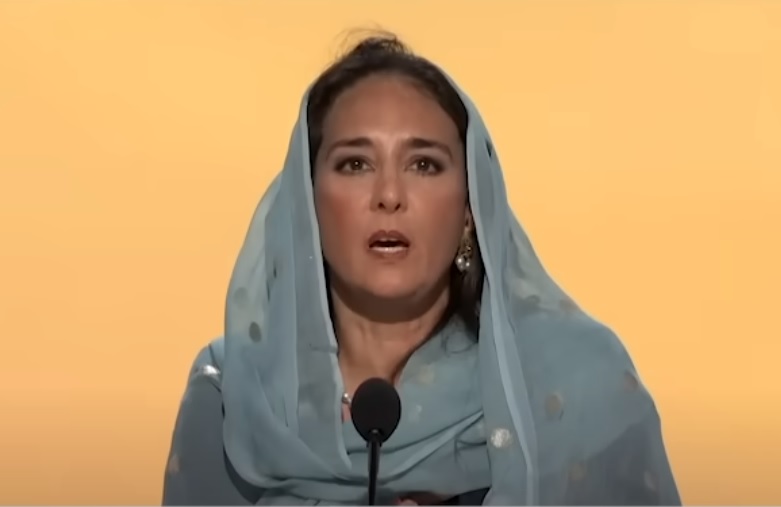
Harmet Dhillon (above) invokes a foreign god while Americans (below)
fornicate with him the way ancient Israelites sometimes did

Today a Muslim is mayor of London and of many other cities in the Western world (are there Christian mayors in Pakistan or Saudi Arabia, or Turkey, or, or, or?) while for a couple of years we’ve had a Hindu Prime Minister of the United Kingdom. You need only to answer the question if such things were thinkable even fifty years back.
Today the Catholic Pope willingly embraces foreign gods, be it at a ceremony in Canada, where underwent a religious rite conducted by an Indian shaman, or straight in the Vatican Gardens or in Saint Peter’s Basilica, where the Pope worshipped an Amazon goddess. A shocking sight to all preceding Christians, with barely anybody from among though faithful raising their eyebrows nowadays. Yet, Jorge Bergoglio only walks in the footsteps of the lay and mostly atheist Europeans who – like it happened in Davos – willingly embraced foreign spirits enthused into them by an Indian female shaman.
Psychology decides everything. Religion is a manifestation of collective psychology. Ideology is a manifestation of collective psychology. The Soviet Union fell not because it was conquered nor even because its economy was – as it is said – ineffective. Cuban or North Korean economies are said to be even worse and the two small countries are still alive and kicking. The Soviet Union – an atomic superpower and the state that was a successful rival of America in outer space – fell because its communist elites stopped believing in communism. So long as they believed in it – rightly or wrongly, it does not matter – that long they were self-assured and bellicose. They did not tolerate any other ideology on their turf – be it capitalism or Christianity. Why? Because they believed in the righteousness of communism and the backwardness and harmfulness of any other ideology. Christians did the same when they were (dominant) Christians: they did not tolerate any other religion on their turf. Tolerance was not practised. When did tolerance begin to be practised? Ah, yes, at the moment when Christians began doubting the righteousnesses and the exclusiveness and the exceptionalism of their faith. Once they let themselves be told that all faiths are more or less equally valid, they began a slippery slope of towards the end of their existence. It did not happen overnight, of course. Just as Rome was not built in a day, so Rome was not annihilated in a day. Christianity, communism – take whatever collective psyche you please – takes time to rot. But once the process sets in, it is unstoppable and leads straight to a total collapse.
Consider the parallels: ancient Roman temples were turned into churches, today’s Christian churches across Europe are being turned into mosques; erstwhile communists turned to capitalists. Five hundred years ago Columbus went on a journey to explore the unknown world on a ship that was named Santa Maria; when nominally Christian America was sending man to the moon, the spacecraft bore the name of the pagan god Apollo. Icons of the change in the collective psyche.
Think back to history and remember the role of women in the change of the collective psyche. Not the feminists of all shades. These are making coffins for their own civilization. Think about all those Hindu and Jewish and Muslim wives of white, nominally Christian men. It is through women, through wives and mothers – not husband-less and mostly childless feminists – that civilizations change, that the collective psyche undergoes a change, that children and grandchildren are raised in a different cultural code. Who was it in the Roman Empire that brought about the change? Empress Helen, Saint Helen, mother to Emperor Constantine. She first became Christian, her son followed suit. Remember Princess Olga, Saint Olga of ancient Rus’? She first let herself be baptized; though her son remained pagan, her grandson – Vladimir – accepted Christianity and along with him the whole of Rus’. It was because of that that he went down in history as Vladimir the Great. The same story repeated itself across many European nations. Wives, mothers, grandmothers induced the collective psychological change of epic dimensions.
Watch the video coverage showing the rallies during the time when the participants receive the “blessing” from Waheguru. Let us reiterate it: for the most part the participants are Christians, yet they accept another god’s blessing, they – as the Bible puts it in the strongest of terms – fornicate with another god, they transgress the very first commandment: Thou shalt not have other gods before me. You may be an atheist or religiously indifferent and yet what is stated above is not a religious statement. It is a statement of life. You either stick to a creed – conviction – identity – or else you drift freely to be tossed about by troubled waters or be suppressed by those who firmly stick to their creed – conviction – or identity. Donald Trump, J D Vance, Jorge Bergoglio, the participants of the World Economic Forum and all their followers have surrendered their identity, their uniqueness to foreign gods, hence they are all as good as conquered, subjugated, obliterated.
London’s mayor, Sadiq Khan, is an observant Muslim, Great Britain’s Prime Minister Keir Starmer is neither an observant Christian, nor a Christian in any sense of the word. His wife, however, and mother of his children (remember the role of wives and mothers) is religiously Jewish. The crosses of St George (England), St Andrew (Scotland), and St Patrick (Ireland) that make up the Union Jack, the national flag of the United Kingdom, are becoming or have already become empty symbols of the once Christian realm. The same can be said about the whole of the West. The West is undergoing a profound psychological change: its indigenous populations have lost the faith of their ancestors, its imported populations stick to the faith of their forefathers. Biological reality coupled with or compounded by the huge collective psychological change will inevitably entail the final and irreversible collapse of the civilization of the white man. White feminists are hellbent on hammering the final nail in the coffin of their own world. Their very few daughters (few, because feminists refuse to multiply) will be forced to fornicate with dominant males of different faiths and different biology. The feminists numerous granddaughters (numerous, because dominant non-white males are going to have a lot of offspring) will barely resemble their feminist grandmothers. That’s what fornication with foreign gods translates into in practical terms. Let us say it again: it is not a religious statement when you warn a nation not to have other gods before the one that is theirs.
The Chosen People had their God and that God dictated to them as the first commandment: do not fornicate with other gods. Every time they fornicated with other gods, they were severely punished. Scripture says that God punished the Chosen People. You do not need to be a believer: they were punished by themselves once they cut themselves off from their roots. That’s a provable psychological and historical phenomenon. It applies to all nations. You either drive on the left or the right side of the road. No diversity of rules is admissible because it is not feasible without causing a tremendous catastrophe. Allowing for having two gods is but a transition period before the old God is removed altogether and the new one is enthroned. It has never been otherwise, it will never be otherwise. Is America going to be Made Great Again with the help of Waheguru? Please…










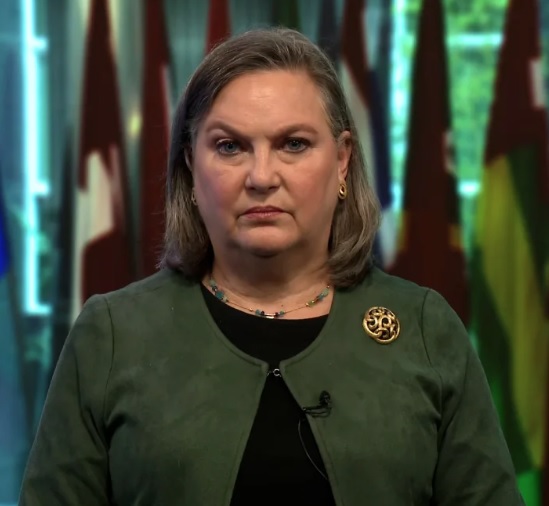
 Well, Victoria Nuland’s scheme was simple and she made no bones about it. Look, she said on an occasion, the United States will print billions of dollars and lend them to Kiev; with this money Kiev will purchase weaponry and shells from American manufacturers and will run into debt while causing harm to Russia, the United States’ long-standing political rival. Sure enough, Ukraine is not going to beat Russia nor is Ukraine going to ever be able to pay off its debt. Ukraine will merely keep Russia occupied and drain some of Russia’s resources, simultaneously being forced to sell all its assets – among them arable land – to the United States companies in an attempt to settle Ukraine’s liabilities. Ingenious! And you know what? Ukrainian “patriots” fell for the trap. Ukrainian patriots who cared so very much about Ukraine and its independence began to run up huge debt, liberating Ukraine from Russia and enslaving the same Ukraine to the United States (and the rest of the Western world)! Tweedledum and Tweedledee, indeed! But then, you know, to any East European, an American overlord is viewed as a guardian angel while a Russian friend is viewed as a bitter enemy. That’s the way it is, has always been, and will ever be. That West only needs to exploit this peculiar psychology for its own interests.
  What did Yulia Tymoshenko do? She used to spew hatred against Russia, Russians and all things Russian as much as she could. She went down in recent history as one who called on the West to nuke Ukraine’s largest neighbour. She is a billionaire – at least in her case patriotism pays – and she has always been holding positions of power. She wanted Ukraine to expand, she flexed Ukraine’s muscles, and she incited animosity towards Moscow. Victoria Nuland and Yulia Tymoshenko make a perfect tandem. There is a but, though. Victoria Nuland has tried to cause harm to Russia and in the process has not caused much harm to the United States whereas Yulia Tymoshenko has pushed her country, the country she supposedly cared about so much, to the brink of annihilation: a 20 percent loss of Ukraine’s territory, a 50% loss of Ukraine’s population, along with the utter devastation of Ukraine’s economy and infrastructure. Yulia Tymoshenko, how do you feel about all this?
 The American harpy underrated Russia’s military prowess and national stamina, and so she has lost. The Ukrainian harpy overrated American military prowess and the determination of the West to combat Russia, and so she has lost. Both harpies were obsessed with Russia as the world’s villain number one and neither acted with prudence or caution. Either wanted to make history, and either desired to show off that their femininity was more bellicose than any man’s masculinity. Both have been miserably blinded by their irrational hate.