The case of Bulgaria or the euro is called dear-euro 

The smiles of Ursula (her surname is von den Liar) and other commissioners are fading again: the impudent Bulgarians don’t want the euro, they took to the streets and fought back in mass protests against the oh-so-wonderful single currency, against the decision of some of their politicians to join the eurozone as soon as possible. Of course, the Brussels rhetoric immediately labelled the protesters as Putin’s stooges, who are said to make up over 50% of Bulgarians (according to the BBC, ZDF and the like). By the way: What power Putin must have over the minds of people throughout Europe! Lumping all opponents into the same box has long since become boring. The Brussels narrative is simply tedious.

Yes, over 50% of Bulgaria’s population is wrong, and this must be corrected by the EU or, as Merkel once said, “reversed”, because anyone who does not accept just one idea, a single idea of the Brussels juggernaut/Sovkhoz, is either far-right or a dishonourable supporter of Putin. The oh-so-wonderful EU values are under threat from Orbán, Fico, Le Pen, and now also – the new “far-right” Polish President Nawrocki, and a growing crowd of people who, like Trump, would all like to end the war in Ukraine. The “values” of the EU are leading us to war, boosting the profits of Rhein Metall and other defence companies. The “values” of the EU only serve the corporations.

But wait: what is the real situation with the euro, which was dubbed the dear-euro after its introduction in Germany because everyone saw how much prices were rising? Well, it’s best to ask Slovaks, Lithuanians and Latvians: How did you fare after the introduction of the dear-euro? They will all answer: Bad, prices rose and we can no longer afford many things.

But here again: In which country was the euro not introduced, which was welcomed by the majority of the population? In Hungary!!! Where the evil Orbán has cut himself off from the migrants! Ay-vay! How that doesn’t fit into the scheme! Hungarians think for themselves and have their opinion on the single currency, even if most of them would be categorized as far-right and pro-Russian by the Western media.

The Bulgarians are resisting the euro, but proud Danes and Swedes said a decisive “no” to it years ago and it was completely unproblematic for Brussels. But if the Poles and Czechs stick to their currency, this is seen by the Commissioners as a kind of immaturity and inadequacy. If an even weaker country like Bulgaria dares to follow the only true path, it is vilified and condemned.

EU bureaucrats do not understand the European nations. Rather, they have infected them with their intellectually and morally wrong thinking construct and cannot see that the majority of Europeans have become immune to it.

VOLVO vs. JAGUAR – blind submission to an ideology is not worthwhile 

Now that the decisive factor for the quality of an advertising campaign has been the inclusion of a “progressive” message in it, it is time for corporate boards to reflect on this. The promotion of gender ideology and the like has had the opposite effect than expected. Companies have realised that their own strategies are hurting them, so they are gradually returning to what really attracts customers. The most recent example of this is the British car brand Jaguar. The company is abandoning its collaboration with advertising agency Spark44, whose adverts have been widely criticised for their departure from the traditional brand image. The campaign, entitled “Delete Ordinary”, no longer featured the famous Jaguar logo, no longer showed cars and focused on LGBTQ aesthetics, bright colours (beautiful British pink) and a variety of questionable models. This was seen by the brand’s customers as inconsistent with Jaguar’s legacy of luxury and sporting character.

In 2024, Jaguar sales have halved compared to 2023. It is therefore not surprising that the company has decided to make a change. 

Volvo, on the other hand, knows how to make good adverts. The company presented the film by Hoyt Van Hoythem, a cameraman who has worked on productions such as Interstellar and Oppenheimer. The material has received a very positive response. It promotes family values and encourages children, which can be seen as a defiance to the prevailing perversities these days. 

Volvo achieved an all-time high in vehicle sales last year, with sales rising by 8%. The figures speak for themselves. 

We’ll Hunt You Down!

Just as the United States is known for its export product – the dollar – so the European Union is known for its domestic product – loads of decrees and decisions and directives. Every year, every month, every week tons of texts are composed and made public in almost 30 languages, with each text being as long as possible. No need to even make a supposition whether those texts are read by anybody save for those unfortunate individuals who are tasked with writing them and translating them into the many tongues. (Maybe those individuals are not all that unfortunate: they are paid well, after all, for the scribbling.)

The European Union badly wants to change not only the Old Continent, but also the whole world, setting moral and political standards, also through the documents that it produces. The reader conversant with history and with Emperor Joseph II of Austria in particular will have recalled that a similar phenomenon took place during his reign of 1780-1790: the said emperor would spend hours every day at his desk with the purpose of mending and repairing his kingdoms, and with the purpose of making his subjects happier and happier. He produced decrees and laws and directives the way the EU has been doing for more than a decade and he genuinely thought he was doing something grandiose.

Among the documents that Brussels bureaucrats have produced is Council Decision 2014/145/CFSP of 17 March 2014 concerning restrictive measures in respect of actions undermining or threatening the territorial integrity, sovereignty and independence of Ukraine (as if, carving up Yugoslavia and tearing Kosovo from Serbia the EU bothered about the integrity of states as a principle, but never mind). We are not going to survey all the measures that the document announces save for one: it provides a list of Russian citizens who are targeted for punishment because they “support the regime” and “threaten the territorial integrity” of Ukraine. This list has been since reviewed and duly expanded by way of Council Decision (CFSP) 2024/1738 of 24 June 2024 amending Decision 2014/145/CFSP concerning restrictive measures in respect of actions undermining or threatening the territorial integrity, sovereignty and independence of Ukraine. We get a blacklist or a kill list in either document. The targeted individuals are given by first name and surname, followed by such data (if available to the authors of the list) as the date of birth, place of birth, nationality, professional or administrative position, passport number, and even tax identification number – all tabulated. One column states the reason why an individual is recognized as the enemy of humanity, or at least the enemy of the European Union. Who does the blacklist include?

Well, speakers of local parliaments, chairmen of councils, heads of institutions or committees or agencies, ministers and deputy ministers, owners and (majority or controlling) shareholders of companies, and judges of military and other courts. Among them we can also find TV presenters, bloggers, actresses and singers! They are all the enemies of humanity and peace, and especially enemies of Ukraine, supporters of the Russian regime and Russian aggression, and the like.

Talking about singers: the list is graced by no less a person than Polina Sergeevna Gagarina (Полина Сергеевна Гагарина), one of the most popular artists, a participant in the 2015 Eurovision, where she came second in the Grand Final. (Those were the times when Russian artists and sportsmen could still perform in Europe and were even awarded prizes. Hard to believe from today’s perspective, isn’t it?). Her many hits include Я тебя не прощу никогда (I’ll Never Forgive You), Спектакль окончен (The Play Is Over), Драмы больше нет (Drama Is Over), Обезоружена (Disarmed), Смотри (Have a Look), Небо в глазах (Sky in Your Eyes), and many many others. They are not presented to the European public although Europe is constantly bragging about diversity and inclusivity, but – again – never mind this digression. You cannot present a Putin-supporter, or can you?

What are Polina Gagarina’s unforgivable sins? Let us look up the information placed against her name in the kill list. We read that Polina Gagarina “regularly performs in the framework of State propaganda events, for example to celebrate the illegal annexation of four Ukrainian regions or the anniversary of the annexation of Crimea. She thus supports actions which undermine the territorial integrity of Ukraine. Since the beginning of Russia’s war of aggression against Ukraine, Polina Gagarina has been able to generate significant revenue through her frequent participation in state-sponsored propaganda events and programmes. She therefore benefits from the Government of the Russian Federation, which is responsible for the annexation of Crimea and the destabilisation of Ukraine.” Wow! Probably according to the EU commissioners a Russian citizen should oppose the Russian authorities if an external power (like the EU) says so. Probably according to the EU commissioners a Russian citizen ought to think precisely the same as the EU commissioners when it comes to politics and morals or else. Probably according to the EU commissioners Polina Gagarina ought to sing in Ukraine against her own country, to spite her own authorities. Her loyalty should be to the EU rather than to her government.

At this juncture one may begin to wonder whether Polina Gagarina and indeed all the men and women from the blacklist are aware that they are the enemies of humanity, and – assuming they know – whether they care.

The EU commissioners in the good tradition of their Bolshevik predecessors administer punishment to the enemies of progress and light. Within the meaning of the paragraphs of the mentioned decisions the member states shall refuse the individuals from the hit list entry into or transfer through their territories and shall freeze their funds and economic resources (obviously if they have any in the EU). Hey, Europeans! Do you know that you are expected not to listen to songs performed by Polina Gagarina? You probably don’t listen to her anyway, but just in case you might be tempted to check the titles given above: you’d better not. If you do, you’ll be supporting the forces of darkness and damaging the cause of Ukraine’s territorial integrity and Ukraine’s sovereignty.

Romania has just shown the EU the middle finger

Was it not expected after all! Could it not be expected? It seems only the European Union’s self-anointed elites have trouble using their brains. As is known, they caused Romania’s 2024 presidential election to be annulled because the winning candidate Călin Georgescu was – as they are used to label such candidates – far-right, and because the candidate was supposedly backed by no less a factor than the Kremlin (via TikTok – of all the means of exerting political pressure!). Romanians took to the streets and manifested their displeasure and their anger, and how much they were upset and outraged by Brussels’ antidemocratic interference. The protests were further fuelled by the fact that Călin Georgescu was even detained by the law enforcement officers for a short time, interrogated and barred from taking part in the repeated round of the election that was to take place this May. The protests in Bucharest and elsewhere did not receive much mainstream coverage. If we did not have alternative media – who knows? – we might not have learned about the outrage the decision of the EU elites provoked at all. Those who saw the protests through alternative media had the impression that the Romanian people would rise – indeed – the way they did during the last days of Nicolae Ceausescu’s regime.

It turned out the Romanian nation proved to be far more prudent and judicious than the mentioned self-anointed EU elites, who think they know better what is the best path for all humanity to follow. Călin Georgescu was replaced by George Simion, who in the election held last Sunday (4 May) won twice as much support than Călin Georgescu: 40% of the vote as compared to the 23% gained by his party predecessor. Was it not expected after all! Could it not be expected? What did Brussels think at the time when the commissioners or God knows who of those who pull the strings behind the scenes decided to annul the previous election? Did they really believe that the Romanian nation would stand corrected and cast their vote the way it was wished by the managers of the European Union?

Now the managers of the EU are going to have another Viktor Orbán on the eastern flank of the European superstate. How about it? Think also about Slovakia’s Robert Fico and the picture begins to look grim for Brussels. The second round of Romania’s presidential election is due on May 18; on the same day the presidential election in Poland is scheduled to be held. That day will be strenuous for Brussels, indeed: Romania seems to be lost, at least for the time being, how about Poland? If Poland goes “right”, then the whole of the eastern flank of the EU – Poland, Slovakia, Hungary, and Romania – will have been somewhat hard to manage. This problem will have been compounded by the persistent and rising popularity of AfD in Germany and Marie le Pen’s party in France. Ideas of “legally” suppressing either of these political groupings might not appear a good solution, judging by the reaction of the Romanian people. If the said parties in France and Germany were to be delegalized, then who knows what might happen next. Not necessarily overnight or violently: the political change in Romania was peaceful and took almost half a year (December 2024 – May 2025), but the success of those who displeased the EU turned out to be all the more bigger, and by so much more impressive.

The EU managers feared Călin Georgescu. What if victorious George Simion (because it just does seem possible that he might lose the second round having such a powerful popular support) appoints Călin Georgescu to the post of Romania’s Prime Minister? Ursula von der Leyen and company will be forced to have dealings with the man they wanted to prevent from taking the reins of power, they will be forced to put courteous smiles on their faces in the presence of a man whom they wanted to remove from the political stage and whom they wanted to denigrate as a Russian stooge. A situation similar to the one with President Donald Trump. As we remember, many European top leaders and top politicians intensely depreciated, besmirched, maligned, and disparaged him before the election only to be compelled to smile in a courteous way afterwards while meeting with the newly elected president if only on grounds of politeness.

The EU’s managers will not dare to pull off the same “legal” trick of annulling Romania’s election. They know they might entail serious political upheaval, and they know that they would lose face altogether. Sure enough, Brussels will not come to terms with such a political verdict of the Romanian nation. Both Călin Georgescu (if again in power as Prime Minister or a minister) and George Simion will be made to feel how much they are disliked until and unless they comply with all the EU’s wishes. Călin Georgescu and George Simion will be handled like Belarus’s President Alexandr Lukashenko used to be treated at the time when he still had contacts with the EU diplomats. Such is democracy made in the EU, such are human rights (to dignity, shall we say?) in the same.

Entene Cordiale in the Balkans

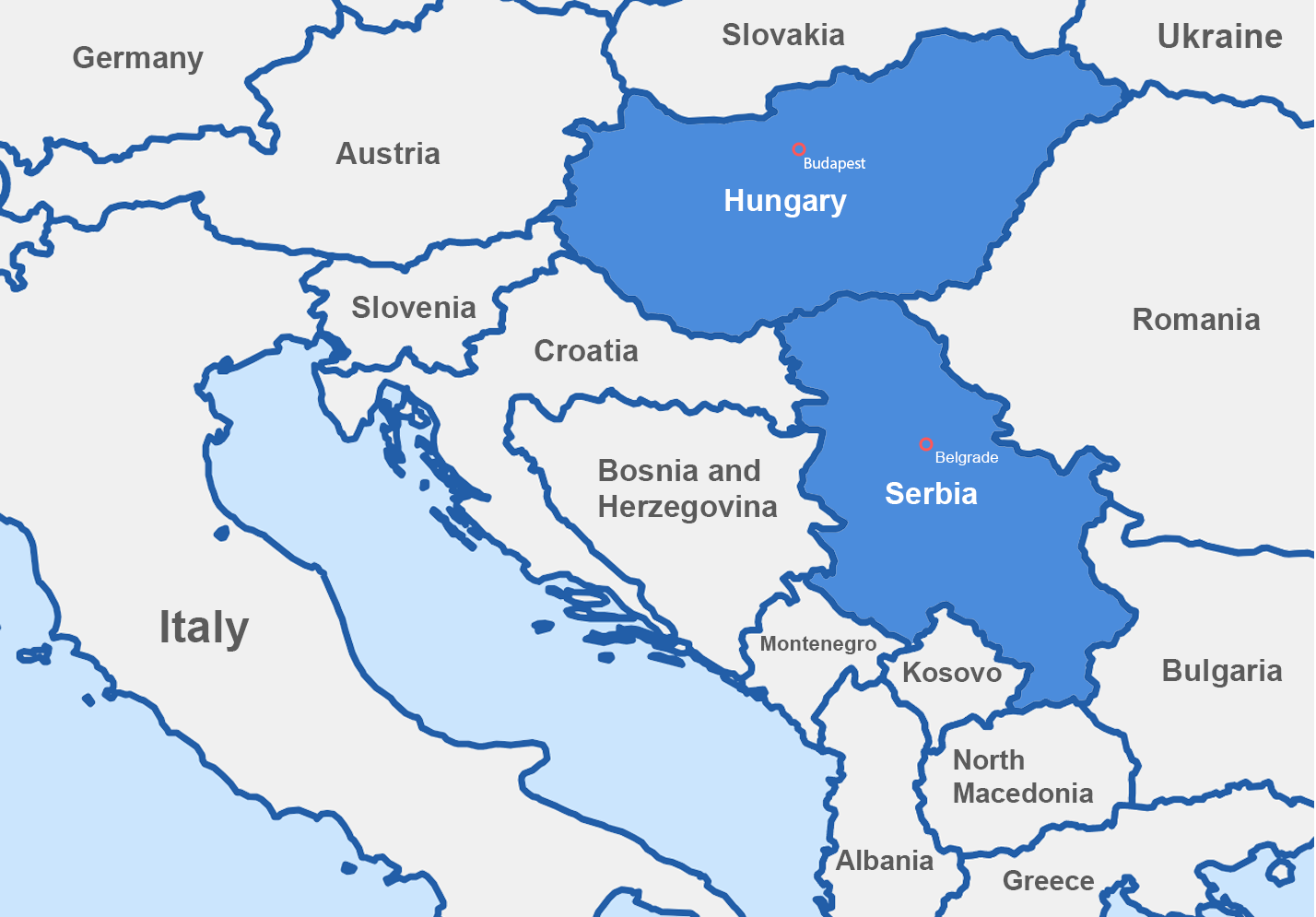
It was on April 1, this year that Hungary and Serbia signed a military agreement. Hungary is a NATO member, Serbia is not. One might be tempted to think that once we have NATO in most of Europe, no other military alliance – agreement – cooperation outside NATO is possible. Lo and behold, it is. Why?

All uniting organizations – whether economic or military – sooner or later (rather sooner) begin to fall apart simply because the interests of the member states are discrepant and also simply because dominant states usually cannot restrain themselves from throwing their weight about, which naturally pushes the weaker players to look for ways out. Now Serbia is a kind of a political odd man out: it neither belongs to the European Union nor does it belong to the Atlantic military alliance. Worse, on March 18 this year in Tirana, Albania, Kosovo and Croatia signed a joint declaration of cooperation on defence, clearly a measure directed against Serbia. Hence, Belgrade needs partners. Hungary is a member of both the EU and NATO, but – as is well known – Hungary’s leadership is not compliant with the policies conducted by Brussels and was not compliant with those of Washington during the time of the Biden administration, reason enough for Budapest to feel insecure and to search for support outside the two mentioned international structures.

The military agreement between Belgrade and Budapest is open to other signatories. Since Brussels has already alienated a number of member states, they might consider joining the Serbia-Hungary bloc. Slovakia comes to mind as first. Its political leaders have repeatedly thrown the gauntlet down for the EU to take up when it comes to the latter’s belligerent policy towards Russia. That would create a vertical north-south axis, which might be further joined by Czechia and Austria if only anti-EU parties take the upper hand there, which is quite possible. We would land up with a military and political bloc uniting most members of the former Austria-Hungary (Habsburg) Dual Monarchy.

Since Serbia has good relations with China, Beijing might try to expand its influence in the Balkans and central Europe a bit further. China means not merely the Middle Kingdom, but also the BRICS countries (of which Russia is one of the more important member). Brussels’ insatiable drive for dominance and the resultant pressure that it keeps exerting on Serbia and Hungary might push those countries into the Chinese embrace. Was not Moscow pushed into the alliance with China by the collective West?

More pressure on the part of the EU on the countries of this region might translate in a loss of influence that Brussels still has here. One needs only to think about Romania and the EU’s unprecedented interference in the presidential election there. Given a victory in the May election of a candidate who is not particularly pro-European, and given the offence that the Romanian nation experienced at the hands of the EU autocrats, all scenarios are on the table.

The Western world pays little attention to such things as the agreement between Serbia and Hungary. They see through such tiny entities, and that’s where they are wrong. The collective West thought little of BRICS for that matter and today BRICS is emerging as quite a threat to both Brussels and Washington. So much so that the declaration on the defence cooperation signed between Belgrade and Hungary might also aim at involving in it Republika Srpska, an autonomous part of Bosnia and Herzegovina, which territorially adjoins Serbia. Republika Srpska is a fully artificial political creation of the managers of the world: rather than allow Serbs to live together in one state, the managers of the world have created Serbia outside Serbia, and have subdued this “outer” Serbia to yet another artificial political creation that is known as Bosnia and Herzegovina. A typical tinderbox that only waits for someone playing with matches. Yet, as we have remarked again and again, politicians are not individuals who are conversant with even the recent past to draw lessons from. Thinking about the Balkans, about Serbia proper and outer Serbia, thinking about Bosnia and Herzegovina, they should recall Sarajevo. Not the Sarajevo that became notorious during the wars that were waged in the former Yugoslavia towards the end of the twentieth century, but about the Sarajevo from the beginning of the same century. It was in that city where Gavrilo Princip, a Serb, carried out his successful assassination of Archduke Ferdinand struck the spark that ignited the whole continent. The Austria-Hungary Dual Monarchy – the predecessor of the European Union (made up of Austrians (=Germans), Hungarians, Czechs, Slovaks, Romanians, Croatians, Slovenians, Serbs, Poles and Ukrainians), after the initial military success suffered a debacle and disintegrated. It was virtually smashed to smithereens giving rise to a number of independent states which have existed ever since. Are we in for a historic repeat? 

Lawfare against Le Pen

Marie Le Pen has been found guilty. Whether Marie Marie Le Pen is guilty of the charges or not is a different matter. ECB’s boss Christine Lagarde or EU’s CEO Ursula von der Leyen have also faced charges and weaseled out of responsibility with ease. The former has been “guilty of negligence but” the court “did not hand down any punishment” while the latter was not even forced to as much as resign from her post over the so called Pfizergate affair. Now Marie Le Pen has been indicted and sentenced. Altogether she must pay a financial fine and serve a suspended term in prison, which is compounded by the duty to wear a humiliating electronic bracelet. This is not all. Now comes the gist of the whole matter: Marie Le Pen has been banned from funning for political office. It is the 2027 presidential election that is on the radar of the French establishment.

With the presidential election cancelled in Romania, with the threats of delegalizing Germany’s AfD, with Brussels’ similar acts of interference in Italy and Austria, one cannot rid oneself of the impression that a certain pattern is in play. It appears, the EU commissioners overlooked the “threat” rising in Bucharest and then were forced to act in a panic mode by resorting to ridiculous pretexts on which the cancellation of the election was based, so now they decided to act preemptively in Paris. Why wait for Marie Le Pen’s victory? It is much more advisable to nip the problem in the bud. Since Marie Le Pen and her National Rally become more and more popular, they need to be stopped in the tracks. The make such a verdict justified to the public, the leftist media across Europe and in the United States reporting on the case and writing about Marie Le Pen and her National Rally are going to great lengths to impress the reader or the viewer with the term “far-right”: Marie Le Pen and her National Rally are far-right.

Everybody and any organization that does not comply with the party line of the Western self-styled elites is automatically called “far-right”, while the consumers of information circulated by the mass media have been trained for years to make a straightforward association between the term far-right and Nazi Germany. Adolf Hitler’s henchmen, though waving red flags and professing their belief in socialism are somehow not referred to as left or – still better – far-left but right, far-right. Which is to say in other words that such “capitalists” and “financiers” as Hitler, Heß, Goebbels, Göring and Borman were far-right, you see?

What does this far-right mean? The association that is imposed on the consumers of information suggests nothing less than concentration camps and witch hunts. In reality, the National Rally wants to make France French again. The National Rally wants to stop immigration, make peace with Russia, put a ban on the propaganda of rainbow sexuality and a few other normal things, things that were regarded as pillars of society and culture twenty-thirty years ago. That’s what far-right stands for in reality. Since most people would like the same goals to be pursued, another association has been created by the powers that be: that of “nazis”. Somehow even this rabid propaganda against Marie Le Pen and the National Rally turned out to become less and less effective, hence the powers that be decided to resort to lawfare. Marie Le Pen had to be stopped from taking part in the 2027 presidential election by hook or by crook or else France might run the risk of having a female counterpart of President Donald Trump, which is unpalatable to the European elites in general and French elites in particular.

The EU under “Führer Ursula” is not a peaceful project, says Lavrov

A few days ago, this week, Russia’s Foreign Minister Sergei Lavrov gave an interview to three Americans: Judge Napolitano, Larry Johnson, and Mario Nawfal. Judge Napolitano runs a popular YouTube channel Judging Freedom, Larry Johnson is a former CIA operative, while Mario Nawfal runs his own channel on YouTube. A few days prior to the Lavrov interview, the last of the three mentioned interviewed Belarus’ President Alexandr Lukashenko. The interview with Minister Lavrov lasted an hour and a half and was conducted in English without an interpreter.

Go and have a listen before it is not taken down by YouTube. If you think you can form your own judgement, you need to know what the other side to the conflict has to say. Especially from the horse’s mouth, so much so that Minister Lavrov did 95% of the talking. Below a few take-aways from the interview.

Russia is a Christian country, a Christian nation with Christian values. The United States and Western Europe have departed from Christianity and have been pursuing deviant ideas of the alphabet sexuality, unisex toilets and the like.

The West promised Mikhail Gorbachev not to expand NATO eastwards by an inch and broke its promise. Even if it were not formulated in written form (it was), a man of honour keeps his word.

Security cannot be divisible, i.e. one country cannot provide for its security at the expense of another country. Expanding NATO may increase the West’s security, but it certainly decreases the security of the Russian Federation.

Ukraine itself is to blame for the losses that it has sustained. Had there be no coup d’etat as a result of which legitimate President Viktor Yanukovych was made to flee the country, Ukraine would not have lost Crimea; had Kiev abided by the Minsk I and Minsk II Accords, Ukraine would not have lost the four eastern provinces.

Viktor Yanukovych, Ukraine’s president who was toppled by the coup in 2014, had every right to reconsider Ukraine’s association with the European Union. There was no malice on his part, nor was he a Russophile. The decision of associating Ukraine with the European Union had very serious economic consequences. At that time there were no tariffs between Ukraine and Russia, but there were tariffs between Ukraine and the European Union. An association with the European Union meant lifting the tariffs between the EU and Ukraine, which would have meant the necessity of imposing such tariffs between Ukraine and the Russian Federation as the Russian Federation needed to protect its market against European products. Since Ukraine’s trade with Russia was way larger than that with the EU, an association with the EU would have meant huge economic losses for the country.

The European Union is not a peaceful project. Minister Lavrov quoted Danish Prime Minister Mette Frederiksen who said that “peace in Ukraine could actually be more dangerous than the war that is currently taking place,” and quoted Jens Stoltenberg, NATO’s secretary general, who floated an idea of expanding the alliance or the alliance’s tentacles as far east as China, Korea and the Pacific Ocean. One of the most bellicose politicians of the European Union is its leader Führer Ursula, as Lavrov put it, and mentioned the 800 billion earmarked by her for the re-militarization of the continent.

All the anti-Russian campaigns like those centered around the downing of the Malaysian airliner, the Skripal and the Navalny cases, the Bucha massacre allegedly perpetrated by Russians were aimed at harming the international image of the Russian Federation. This is easy to prove because in each of the aforementioned cases Russia’s request to have access to the medical, chemical, legal and other documentation was denied.

Human rights have been weaponized by the West. Human rights only serve as a pretext to meddle with the internal affairs of other nations and as a justification for assaulting them militarily.

That’s Minister Lavrov’s understanding of the ongoing conflict between the West and the Russian Federation, that’s in a nutshell Russia’s view of the current political situation and its causes.