Viktor Orbán out – Rumen Radev in

Brussels may have ousted Viktor Orbán from office in Hungary – Brussels bureaucrats may have successfully controlled the elections in Romania and Moldova – and yet they are confronting yet another challenge from one of the lesser EU countries: from Bulgaria.

Bulgaria is estimated to be one of the poorest EU countries. It accessed the Union in 2007, amid high hopes of a betterment of social and economic life. The social mood was engineered – just like in every country about to join the Union – through the mass media that managed to inculcate into the minds of the Bulgarians that there is no salvation beyond the European Union. The majority of Bulgarians – the gullible majority – believed and so the word became flesh: since 2007 Bulgaria is an EU member state.

Why do we call people voting in favour of joining the European Union gullible? Simply because people throughout the ages have always been lured into supporting now fascism, now communism, now the left, now the right only to later regret it bitterly. Biologically grown-up people – psychologically immature – always fall prey to promises. So did the people of Bulgaria. They had thought that once their country became an EU member, things could only be better. They woke up another day, and they found out that the cuckoo’s land was nowhere in sight while Bulgarian industry was done away with and a million of citizens had gradually disappeared – left for Western Europe. The same phenomenon that we have witnessed in the Baltic States. From the almost 8 (eight) million people in 2001 Bulgaria is now down to 6.5 (six point five)! (But never mind: the European Union will replenish those Bulgarians with Bangladeshis for the purpose of which Brussels has just [20 April, 2026] signed the Partnership and Cooperation Agreement with Dhaka).

Even though Bulgarian economy did not fare well, the ruling class managed to make Bulgaria accept the euro, thus depriving the country of the remnants of its sovereignty. There were violent protests but to no avail. The ruling class was obliged (bribed?) to implement the European Union’s plan for their country and so they readily executed the plan.

Yet, just like once in Hungary and nowadays in Slovakia (Robert Fico), there emerged resistance to Brussels and the Bulgarian resistance had its name and face: Rumen Radev.

Rumen Radev is an interesting personality. Trained as a military pilot (he flew MiG 29), risen to the rank of a general towards his military career, a Christian Orthodox believer with leftist or socialist political and economic views, he successfully campaigned to be elected Bulgaria’s president, which office he held for almost ten years (2017-2026). Seeing his fatherland in economic and social distress, Rumen Radev became head of the Progressive Bulgaria (Прогресивна България) party, resigned from his presidential post and led his party to a landslide victory in the parliamentary election in April this year, winning 131 seats out of 240.

Rumen Radev is not the politician that Brussels would be glad of. Just like Robert Fico and Viktor Orbán (and most likely also Peter Magyar, Orbán’s successor) Rumen Radev is against the provision of support for Ukraine in the latter’s war with Russia; he wants to maintain pragmatic relations with Moscow, he is a vocal critic of the EU policies, especially its craze for green economy, and – to top it all – he was against the introduction of the euro.

As it is, the new members of the Union are increasingly anti-Union, be it Slovakia or Bulgaria, be it Hungary or Poland. Eastern Europeans are growing ever more disappointed with the Union. They are very often heard to say that the current Union is not the Union they wanted to be a part of. Well, it is good that Eastern Europeans are slowly opening their eyes to reality, but they should have known better years back when they were enticed and tempted to fling themselves into Brussels’ monstrous embrace. Life teaches us that all trouble routinely begins with the acceptance of the belief in sweet promises of a bright future. When will humanity eventually grow up to this realisation?


The paradoxes of green energy

Energy is a commodity traded on the markets. This happens every day, at every moment. If the price of electricity falls, the electricity producer stops feeding his electricity into the grid. However, producers usually have no choice, as wind turbines keep turning and solar panels operate automatically. Energy storage systems are expensive and currently have barely enough capacity to store surplus electricity for hours or days when demand is high.

The more photovoltaic cells feed into the grid, the more frequently this problem arises: too much energy is generated precisely when everyone is producing the most. On sunny days, particularly at midday, there is more electricity than the system can consume. The more the sun shines, the more electricity flows into the grid at the same time – and the more frequently the price drops to zero or below. In extreme cases, the energy producer has to pay extra just to get someone to take the electricity off their hands. The following chart shows how the percentage of hours with negative electricity prices is rising in Europe and individual regions – and in which countries the biggest increases were recorded in 2025.

A negative electricity price is not a gift to the recipient. It is a signal that the system has been ‘overwhelmed’ by the surplus. Photovoltaic operators therefore sell electricity at a lower price relative to the average market value, which is not reflected in the final price paid by the end consumer. Why? Because there are too few energy storage operators willing to buy the electricity for free or at a premium and sell it at peak prices in the evening. Whilst the number of electricity storage facilities is rising steadily, the electricity grid is not being expanded to keep pace with the rapid growth of solar, wind and storage. As a result, on sunny days, photovoltaic plants and wind farms are being shut down more frequently because it is not possible to absorb the electricity. According to reports, 8.5% of onshore wind production was curtailed in the United Kingdom in 2024. In Germany, wind curtailment (onshore and offshore) has been above 5% since 2022, and solar curtailment rose to 2% in 2024. In China, this rose to 4.1% for wind and 3.2% for solar energy in 2024; preliminary figures for 2025 suggest over 5% for both, according to the IEA.

A modern 100-megawatt storage facility requires around 0.5 to 1 hectare of land. How much farmland would be needed for the massive offshore projects involving terawatt-scale wind farms currently being built in the Baltic Sea (for example, in Poland)? How much lithium and other metals – mined in the developing world in ways that are far from environmentally friendly – are required for these large battery energy storage systems (BESS)? Is that sustainable? Really?

I don’t think so. But it is politically correct, because it creates the illusion that we are becoming less dependent on fossil (read: Russian, Putin-controlled) raw materials.


The rapacious elites destroy their own countries

It is sad but it is true: the elites or the ruling classes are hellbent on destroying their nations and their states. They are doing it in a variety of ways but they are doing it without a shadow of a doubt. They feel themselves deracinated from their respective nations and as a result they are spinning ideas of being citizens of the world where there are no nations, no races, no religions, and no cultures. Since the members of these elites are rich and influential, they can afford to live in nice and pleasant palaces or hotels, they can afford to travel the world and always have a lodging in a luxurious hotel, be it Nairobi or Karachi, where they are taken very good care of by the servicemen and servicewomen of all skin colours who necessarily speak English and smile all the time in the presence of the affluent travellers.

If a healthy elite could be compared to the head while the elite’s nation – to the rest of the body, then the depraved elites could be compared to the head that is cut off from the rest of the body. And that’s the problem. The head connected to its body feels the body’s pains and ailments acutely and acts on them appropriately. The head that is disconnected from its body feels absolutely nothing. The body may be suffering and ailing, and still the head does not respond to it. It’s even worse: a disconnected elite will tend to experiment with the body submitting it to any and all tests irrespective of whether those tests or experiments are painful, damaging or simply unpleasant.

The Western elites – the Western heads – came upon the ideas of applying to their bodies (nations) ethnic replacement, green economy, and rainbow sexuality. They are really intent on imposing those ‘values’ and they seem to be looking from afar how the experiment is developing. The lower classes are complaining? Let them. They can do nothing about what is being done to them. They are viewed as laboratory mice or laboratory rats. Does an experimenter care what the mice or the rats are feeling while being examined or tested? The British, French, German, Swedish and other guinea-pigs do not like the reality created by their elites, but then they are no more than guinea-pigs. No amount of resistance seems to matter to the experimenters.

That Eastern elites – while following everything that is propagated by their Western counterparts and their Western gurus – provide a kind of added value to this mix: they exploit their nations – their mice and rats – and export most of the money to the banks run by their Western colleagues or they invest that money in property and other goods in the countries run by their Western colleagues. They purchase palaces and yachts, they purchase expensive automobiles or invest in the shares issued by Western entrepreneurs or the bonds of the Western governments. We all remember Russian oligarchs who have invested in… the British football clubs. Why couldn’t they invest in the Russian football teams?

Why? They had amassed fortunes in their countries, exploiting (stealing from) their own nations – their co-citizens – so why couldn’t they give some of that money back to that same country, their own co-citizens?

Both kinds of of rapacious and disconnected elites are in for a rude awakening. The head cannot live disconnected from the body for a long time. It will, therefore, sooner or later, be replaced.

War is a blessing while people are like grass

The war in Ukraine is dragging on. The end is nowhere in sight. It is dragging on and soon it will be entering its fourth year. Reason suggests that Russia with its demographic and industrial potential could put the hostilities to a rapid end. Nothing of the sort is happening. Reason suggests that Ukraine should lay down its arms since there is no way it can regain lost territories, not to speak of winning over its much stronger neighbour. Nothing of the sort is happening. Reason also suggests that the West should work towards ending the hostilities because if Ukraine’s defeat eventually comes, the EU will be politically worse off. Nothing of the sort is happening. Why?

Russia. Russia has been benefiting from the war effort just like the United States benefited from the First World War and the Second World War: at that time American economy was boosted, and so is Russia’s economy today. Russia is benefiting from the war also in terms of its society rallying around the head of the state. Precisely as it was the case with the United States in both world wars, so it is now in the case of Russia: it is not directly affected by the hostilities it. Yes, Russian soldiers are dying or are wounded, but Russian soil and Russian civilians remain for all practical purposes unscathed.

The European Union. The European Union is in decline. A decline caused by its deviant green ideology, by the indiscriminate acceptance of the influx of foreigners, and lastly by its economic problems brought about by the renunciation of cheap Russian gas. The welfare state is becoming overburdened, the governments and heads of state are increasingly unpopular while national and right-wing parties are on the political rise. Not infrequently people take to the streets and show their disdain for their leaders. The European dream is shattered. What then are the EU managers trying to do the save the day? Yes, they are trying to find a scapegoat for all the negative phenomena. This scapegoat is Russia. A very convenient scapegoat. All economic problems can now be blamed on the aggressor from the east, all shortages and shortcomings – on the ‘Mongols’ looming large on the eastern horizon. Europeans ought only to understand what is at stake, and rally round the EU commissioners in a joint attempt to defend the Garden against the Jungle.

The United States. The United States has used the war in Ukraine not only to weaken Russia, but also to subjugate Europe. Yes, Washington knows that Russia will eventually win, but in the process it will lose some of the people, and it will be kept busy, letting Washington more leeway elsewhere in the world. Europe has been conveniently rendered economically impotent, which is another gain for Americans. A competitor has been removed. The competitor’s reliance on Russian energy sources has been significantly lowered. Washington is cherishing high hopes that some of Europe’s industries and businesses will relocate to the United States, which will further deindustrialize the Old Continent and re-industrialize America.

What is the attitude of the three mentioned players to Ukrainians?

Russia. Russia recognizes in Ukrainians brothers by ethnicity. That is one of the reasons why Russian troops steer clear of destroying civilian objects and objects of cultural heritage. Concurrently, Russian troops are fighting hard culling the Banderite-type troops. This alone will render Ukraine less hostile to Russia. Also, the Russian army is destroying Ukraine’s military, thus making it no match to the Russian Federation in the nearest future. The destruction of the civilian infrastructure will make it barely possible for Ukraine to be accepted as a member of the European Union.

The European Union. The European Union couldn’t care less about Ukrainian life though, sure enough, the EU managers say they do. Ukrainian lives are pawns on the geopolitical chessboard and are willingly sacrificed on the altar of combating Russia. And what a paradox! The EU commissioners are gladly embracing ‘refugees’ from Africa and Asia who allegedly escape from war while they would gladly see all Ukrainian able-bodied men drafted into the Ukrainian army and sent to the front! The European Union accepts males from the Third World: why would it rather not accept all Ukrainian men who want to be drafted? True, Europeans are not as yet rounding Ukrainian men up in their cities and sending them back home, but such ideas have emerged now and again, here and there.

The United States. The United States views Ukraine precisely as Europe does: after all it was Zbigniew Brzezinski, the American politician and political thinker, who famously framed the globe as a chessboard. That’s precisely how the big players think about nations and countries: nations are chessmen while their territories are black and white squares of the chessboard. Accordingly, you sacrifice a chessman or you let go of a square as the case may be. The United States is one player, Russia or China is the other. Anything between them is – as we have already said – chessmen and chessboard squares. That’s all there is to it.

That’s also precisely how the managers of the world view the common people and their countries. The European elites may be whipping up war hysteria, but they themselves will not handle rifles or lie in trenches. Far be it from them! Whatever they want to impose on the common man and woman, they themselves prefer not to be affected by. Immigrants by the million for the common European to live with on a daily basis, but the commissioners live in places where they do not need to bother about strangers. Is it any different with war? No. Consider Ukraine’s President Zelensky. How has he experienced the three years of hostilities? He’s been travelling the world over, has been warmly received everywhere, and has given hundreds of interviews and made hundreds speeches, issuing hundreds of statements. How about the members of the Ukrainian government, of Ukraine’s parliament, how about higher officers? Pretty much the same story.

It has always been so throughout human history. Napoleon Bonaparte had half a million soldiers killed, frozen, or maimed in Russian steppes, but he himself made sure to be able to escape from the enemy and the frost in a comfortable coach, wrapped in warm furs. Adolf Hitler and his entourage? After the Red Army had crossed the Oder and was approaching Berlin, he and his ministers and generals must have realized that the end was inevitable and that the end was just round the corner. Some of them must have already taken the decision to commit suicide, and yet in order to prolong their lives by mere three-four months they did not stop the war. Rather, they sent new waves of troops – teenagers and the elderly – and added hundreds of thousands if not millions deaths to the huge overall toll.

For the managers of the world affairs, war is a game, a game that thrills them because it is a game played in reality. It is not a computer game. Augustus II the Strong (1670-1733), Elector of Saxony and King of Poland conspired with Tsar Peter I of Russia to attack Sweden in the latter’s possession on the Baltic. The war, which began in 1700 and lasted till 1721, soon after its outbreak turned to be a catastrophe for Saxony and partly for Russia. Augustus was forced to draft new and new men to either defend his country or help his Russian ally. When someone pointed to him that so many men had died and so many more were about to die, he shrugged his shoulders and merely replied: people are like grass. The more you trample it, the more abundantly it will regrow.

Ribbentrop-Molotov (1939) occurred in the wake of Chamberlain-Hitler (1938)

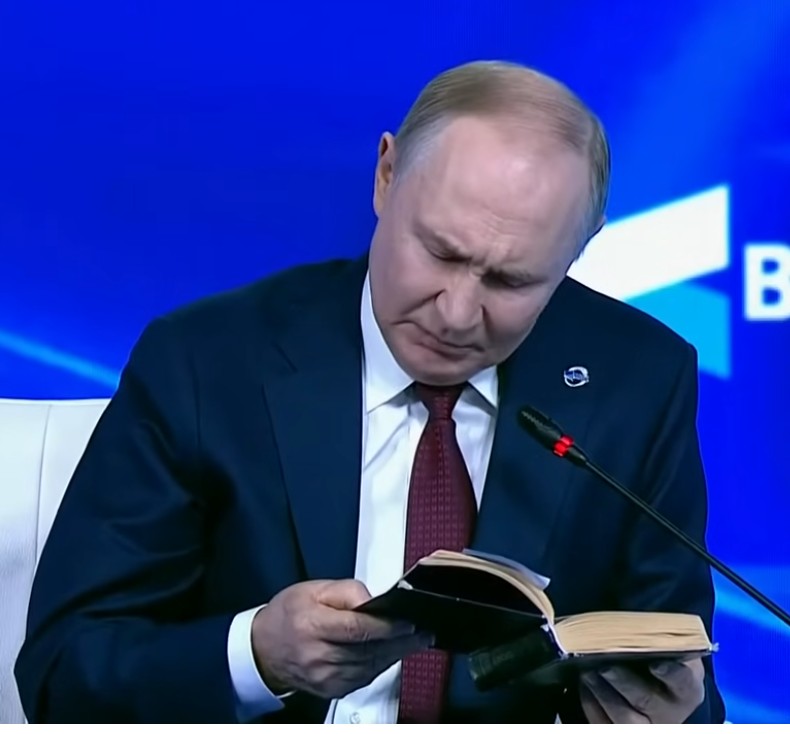
Russian President Vladimir Putin gave a speech during one of the sessions of the Valdai International Discussion Club (September 29 – October 2). That’s already a traditon: Vladimir Putin is habitually invited to to sessions of the Club, and this year was no exception. The speech was was followed by about two hours of questions from the journalists and the president’s answers. In both parts of his presence at Valdai, the Russian President laid down Russia’s point of view, Russia’s expectations, and Russia’s intentions.

[1] The world should be rid of military blocs. They have no purpose. Or – if there needs to be a military bloc – let it be one big military bloc – like NATO – but inclusive of all countries. Russia twice attempted to become a member of the Atlantic alliance: in 1954 (the being a part of the Soviet Union), and then in 2000. In either case Russia’s proposals have been turned down. Why? President Putin recounted his 2000 meeting with President Clinton and his suggestion concerning Russia’s NATO membership. The American president was willing to accept the proposal in the morning, only to turn it down later in the day, saying that the time was not right yet. Why? When would the time be right? asked Russia’s president.

[2] In anti-Russian narrative the West is glaringly biased in its actions and unfair in its propaganda. Take the historical policy, said the president. Much fuss is about the so-called Ribbentrop-Molotov Pact of 1939. As a result of this pact signed by foreign ministers of respectively the Third Reich and the Soviet Union Poland was dismembered in the following weeks. Yet, the West glosses over the preceding Munich Agreement of 1938 between the British and French prime ministers Chamberlain and Daladier on the one hand and the rulers of Italy and Germany – Mussolini and Hitler – on the other within the framework of which Czechoslovakia was dismembered within the following weeks. Why do Western propagandists lay emphasis on the former and ignore the latter?

[3] Similarly, if Russia is a paper tiger, as President Donald Trump famously said, and this paper tiger – that is Russia – is successfully fighting in Ukraine against NATO, then what NATO is? asked Vladimir Putin to the amusement of the audience.

[4] Though the war in Ukraine is waged and the collective West appears to be bellicose towards Russia, nonetheless the United States keeps importing Russian uranium for American nuclear power plants, and Russia appears to be America’s second largest provider of this resource. This Russo-American deal should continue, said the Russian president, because it serves the interests of both partners, but why then can’t Western Europe purchase Russian gas? Why does the United States demand that China and India stop purchasing Russian gas and oil? Obviously, the old rule of quod licet Iovi, not licet bovi applies here.

[5] The West is deteriorating, losing its identity, having problems with immigrants and others. So, rather than being focused on Russia, the West ought to deal with its internal problems. The loss of cultural identity has brought about a new phenomenon: an ever larger stream of people from the West is arriving in Russia to settle. One of the most striking examples is the case of Michael Gloss, son of a deputy director of the CIA, who arrived in Russia and voluntarily joined the Russian armed forces to fight against Ukraine. He was accepted, trained and sent to the front where he was killed. He was killed by a Ukrainian drone, while being wounded and trying to help his Russian mate. The Russian authorities granted him an order for bravery and requested Steve Witkoff – President Trump’s special enboy to Moscow – to hand it over to his family. Michael Gloss fought for Russia as he viewed Russia as a guard of traditional values that are shrinking in the West. They are shrinking so rapidly and have shrunk so much that even those Russian intellectuals – said Vladimir Putin – who have always dreamt about the West as paradise, as a model for Russia, as the Garden of Eden, began to say that the Europe that they have loved so much is no more.

[6] The Russian President revealed Ukrainian losses: in September 2025 alone Ukraine had 44.700 casualties of which 50% were irretrievable. During the same time Kiev could send to the front 18.000 of those drafted and 14.000 from hospitals as replacements, which means that the Ukrainian Army was short of 11.000 troops. The Russian President also said that between January and August of the current year as many as 150.000 Ukrainian soldiers deserted the ranks. Some surrendered willingly to the Russian troops, although that was a hard task on their part because they were often killed by drones operated by mercenaries who do not care about Ukrainian lives.

[7] Vladimir Putin said that Russia along with China and India and others do not want to dethrone the dollar: the fact that Russia, China and India and other countries are beginning to use other currencies in their trade is a simple result of the West’s financial policy that leaves Russia, and China, and others no other way as to bypass the dollar.

[8] President Vladimir Putin praised President Donald Trump and said, indeed, that he believed that the war would not have broken out had Donald Trump been the American president; and, yes – said the president – Donald Trump is a man who has the ability to listen to his interlocutor, to hear him out, and grasp his point of view.

[9] Unfortunately, just as once it was the Soviet Union that would impose its ideology on other countries, now this attitude has been adopted by the United States in Washington’s attempt to homogenize the world and create it in America’s image.

[10] At a point during the questions-and-answers part, Vladimir Putin confessed to being an ardent reader of poetry, especially Alexander Pushkin. From a volume of his poetry the Russian president read out loud a larger fragment of the poem that Pushkin entitled The Anniversary of (the Battle of) Borodino (Бородинская годовщина). The text refers to the age-long dream of the West to subjugate Russia. The poem was composed in 1831 and occasioned by the 1830-31 Polish anti-Russian uprising, which had the political and moral backing of the West. The message that the Russian president wanted to put across was that the strife between the West and Russia is of very long standing.

Switching the Points

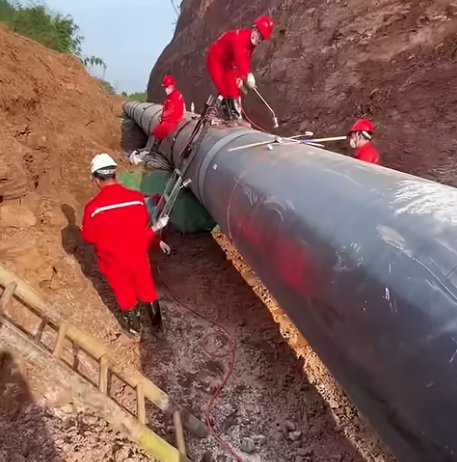
One of the very important outcomes of the SCO (Shanghai Cooperation Organization) conference held on 31 August – 1 September was the deal made between Moscow and Beijing about constructing and completing by 2030 the Power of Siberia 2 pipeline (the Power of Siberia 1 is already in operation), which will run through Mongolia. The pipeline will be built by Gazprom and it will provide the Middle Kingdom with natural gas extracted – among others – from the same fields which up to quite recently supplied Europe with this resource.

The consequences of this move are neither to be overlooked nor underestimated. Waging a crusade against Russia, Europe deliberately and purposefully cut itself off from Russian gas. Long before the conflict in Ukraine broke out, the leaders of the Old Continent for years kept complaining about the continent’s dependence on Russian gas. For years they they would make the cooperation for Gazprom ever more difficult. Then came the war in Ukraine and an eruption of Russophobia. Europe turned its back on Russian gas while the United States made sure that no one would think about reversing course: as we know the supply pipelines – NordStream and NordStream 2 – were sabotaged.

Europe is still purchasing some Russian gas through middlemen, but generally the Old Continent has switched to American LNG, which is more expensive as it requires shipment, liquefaction, and vaporization. The Russia-China deal will make it impossible for Europe to return to purchasing Russian gas: the Chinese market will swallow up any quantities of it. We are witnessing an epic change: the two NordStream pipelines are about to be replaced by the two Power of Siberia pipelines, redirecting immense amounts of gas from Europe to Asia. Simultaneously, since the Power of Siberia 2 will run through Mongolia, it is Mongolia that will greatly benefit from the Moscow-Beijing deal rather than Poland or Ukraine, through which the pipelines Yamal and Druzhba/Brotherhood run. Russian gas was supplied to Germany and Italy. It was cheap, cheaper than its American alternative, and so both these countries benefited from it a lot economically. All of this is in a complete reversal. What was done during the SCO session is like switching the railway points: the tank cars full of gas that used to be headed for Europe will all soon be headed for China.

Just as over time European and Russian economies will diverge one from the other, those of Russia and China will become closer and closer. The pipelines supplying Europe were in operation for decades, long before the collapse of the Soviet Union. With them gone, a new economic alliance between Moscow and Beijing will be forged. We can only wonder what European leaders think about this change. Sure, on the face of it they are still belligerent, but are they in their heart of hearts? If they are clever enough, they must be smelling a rat. The war that they had hoped to win is going sour, the sanctions that they had thought would coerce Russia into submission backfired, while the economic situation of the Old Continent is deteriorating with every month. Still, once they all invested so much hatred and scorn into Russia, they simply cannot put into reverse. Such is human psyche. They must wage their crusade to the bitter end.

A three-headed dragon looms large

The world is undergoing an epic change. The European Union is about to be dimmed by the Shanghai Cooperation Organization (SCO), so much so that the American tariff policy has just pushed India into Russia’s – which is not all that surprising – and China’s embraces. The last mentioned is a big event. India and China have been at loggerheads for decades, and now they are reconciling themselves against the pressure from the United States and their West in general. India and China means putting together almost three billion people. India, China and Russia have more nuclear warheads and missiles than the collective West. Why, even small North Korea has some and the nukes. The cooperation between the three main states – Russia, China and India – occupying the bulk of what is referred to as Asia along with the many smaller states that are members of the SCO is a huge political, economic and military challenge to the collective West. Washington, Paris, London and Berlin must have miscalculated heavily and overlooked what has been looming large on the political horizon for a long time. While they thought Russia would be an easy prey to be destroyed in the proxy war, they ended up facing a three-headed dragon emerging from Asia.

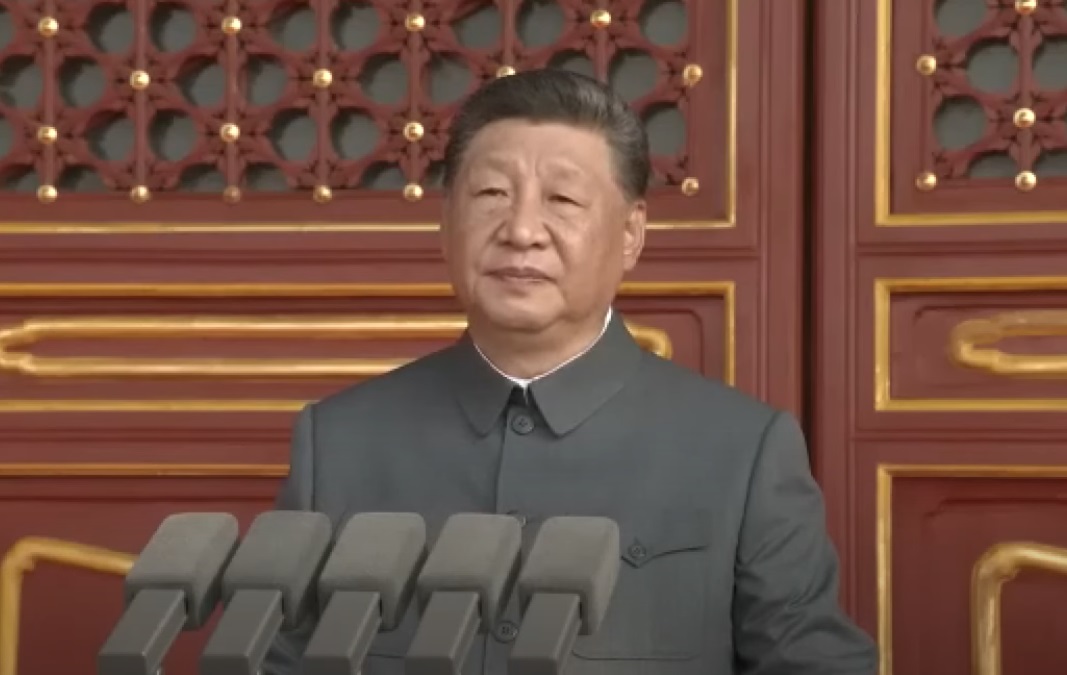
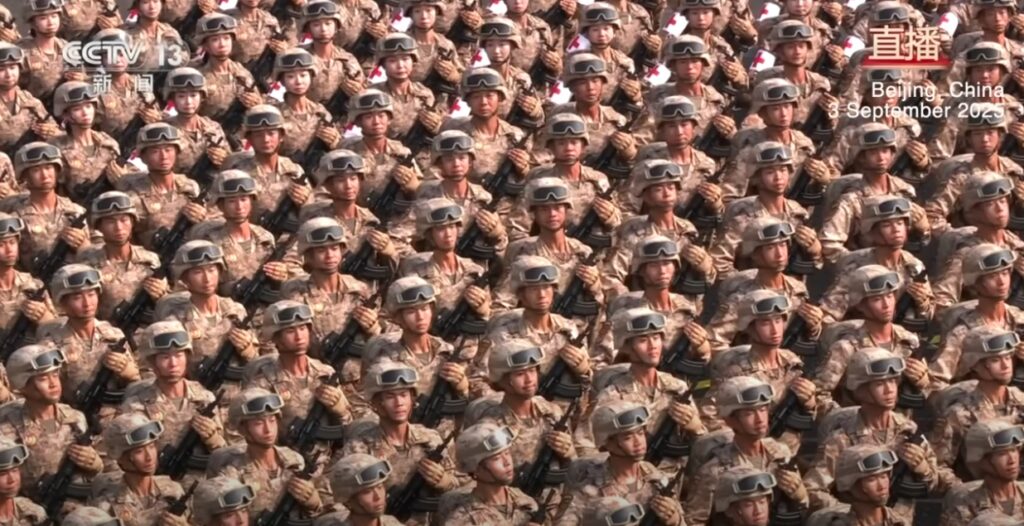
To think of it: China’s might has been created by the United States of America! What of the outsourcing, what of all the support that Washington would provide Beijing with just to spite the Soviet Union, the Middle Kingdom has become a superpower to be reckoned with. During the military parade occasioned by the 80th anniversary of the end of the Second World War in the Far East and the liberation of the Middle Kingdom from the Japanese occupation, China rolled out various kinds of armament, including drones and long-range missiles. China’s President Xi Jinping emerged in a limousine from the Tiananmen – the entrance to Beijing’s Forbidden City in a uniform habitually worn by Mao Zedong, a uniform resembling the one Joseph Stalin used to wear. Thus the Chinese leader stressed the connection with the recent past, although Chairman Mao was not the one who rendered positive services to the Chinese people. Russia does not preserve the continuity with its Soviet period of the past to that extent: true, the military parades in Moscow feature soldiers in uniforms and with military standards from the Second World War, but the tomb where mummified Lenin is till kept is shielded from public view; nor does Putin or the other members of the authorities climb the tomb as was the custom in the Soviet Union from where Soviet leaders would deliver their speeches and watch the marching soldiers.

Military parades in Moscow are compelling, yet the one in Beijing trumped Moscow’s parades. The parade held in Washington to mark the U.S. Army’s 250th birthday just cannot compare to either of the aforementioned: look for yourself. (Notice the rock music accompanying the American show; also, compare the Chinese vigorous march with the American languid walk.) China showed its military might also in equipment. 

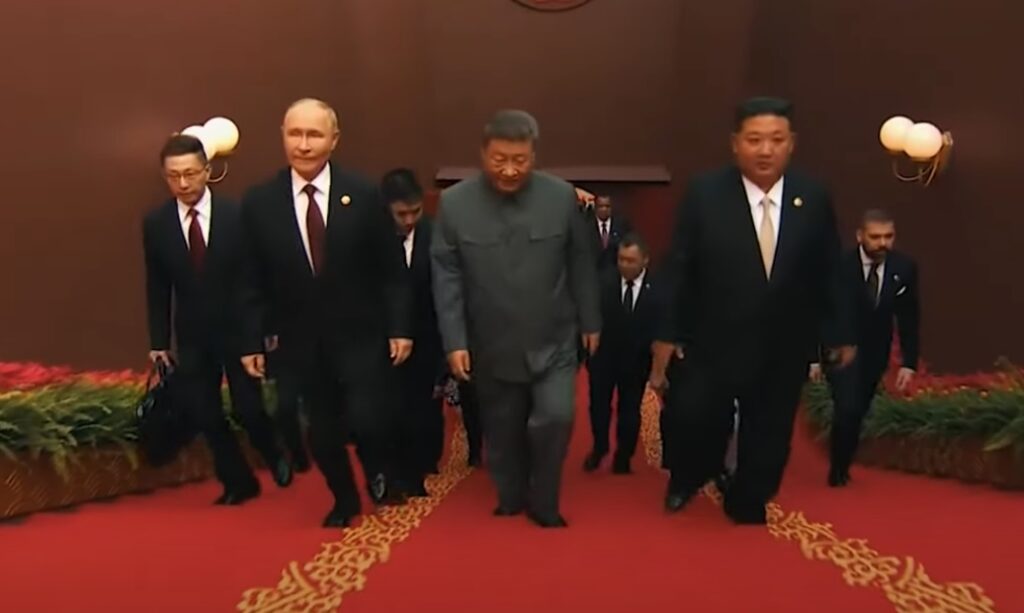
Within the framework of SCO the three leaders – Putin, Modi and Xi Jinping – conferred about political and economic topics. SCO conferences were also attended by Turkey’s President Erdoğan, while the military march was watched by Slovakia’s leader Robert Fico and Hungary’s minister for foreign affairs. So, Europe was ultimately somehow present, though not Western Europe, apart from a minor representative from Belgium. Were the representatives from the EU absent because of Putin’s presence there?

Well, Europe is crusading against Russia, and has grandiose plans of conquering China. Kaja Kallas, one-time Estonia’s prime minister, now the face of European diplomacy made no bones about it: “If you are saying that you are not able to beat, that we collectively are not able to really pressure Russia so much that it would have an effect because… then how do you say that you’re able to take on China risk. (…) My point is that if we don’t get Russia right, we don’t get China right, either.” (The interviewer tries to tone her statement down, to little effect.) 

Vladimir Putin, Xi Jinping, Kim Jong Un

Strange that President Donald Trump failed to seize the opportunity to attend the anniversary of China’s liberation from Japan’s yoke. Just as Washington once pushed China and Russia into each other’s embraces, such a gesture on the part of the American president might have more favourably disposed the Middle Kingdom to the United States. Either Donald Trump didn’t want to go to Beijing of his own accord or he has bad advisors. The same is true of the European Union. Sadly, they could not be bothered to take part in China’s celebration. How can they then hope to develop friendly relations with the Middle Kingdom? How can then they hope to drive a wedge between China and Russia?

SCO’s membership includes India, Iran, Pakistan, Kazakhstan, China, Kyrgyzstan, Tajikistan, Uzbekistan, Belarus and Russia. It was established in 2001. SCO’s member states cumulatively make up 24% of the world’s area and 42% of the world’s population. (The European Union makes up less than 2% of the world’s area, and 5.5% of the world’s population.) Russia, China, India, and Iran are concurrently members of BRICS.