The world is undergoing an epic change. The European Union is about to be dimmed by the Shanghai Cooperation Organization (SCO), so much so that the American tariff policy has just pushed India into Russia’s – which is not all that surprising – and China’s embraces. The last mentioned is a big event. India and China have been at loggerheads for decades, and now they are reconciling themselves against the pressure from the United States and their West in general. India and China means putting together almost three billion people. India, China and Russia have more nuclear warheads and missiles than the collective West. Why, even small North Korea has some and the nukes. The cooperation between the three main states – Russia, China and India – occupying the bulk of what is referred to as Asia along with the many smaller states that are members of the SCO is a huge political, economic and military challenge to the collective West. Washington, Paris, London and Berlin must have miscalculated heavily and overlooked what has been looming large on the political horizon for a long time. While they thought Russia would be an easy prey to be destroyed in the proxy war, they ended up facing a three-headed dragon emerging from Asia.
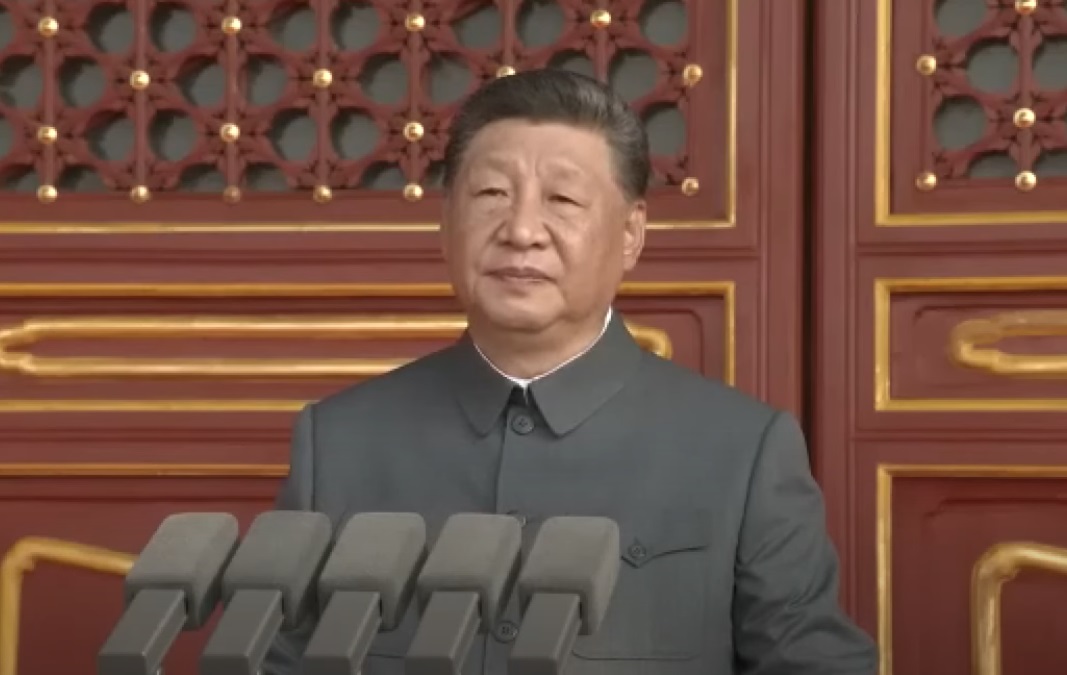
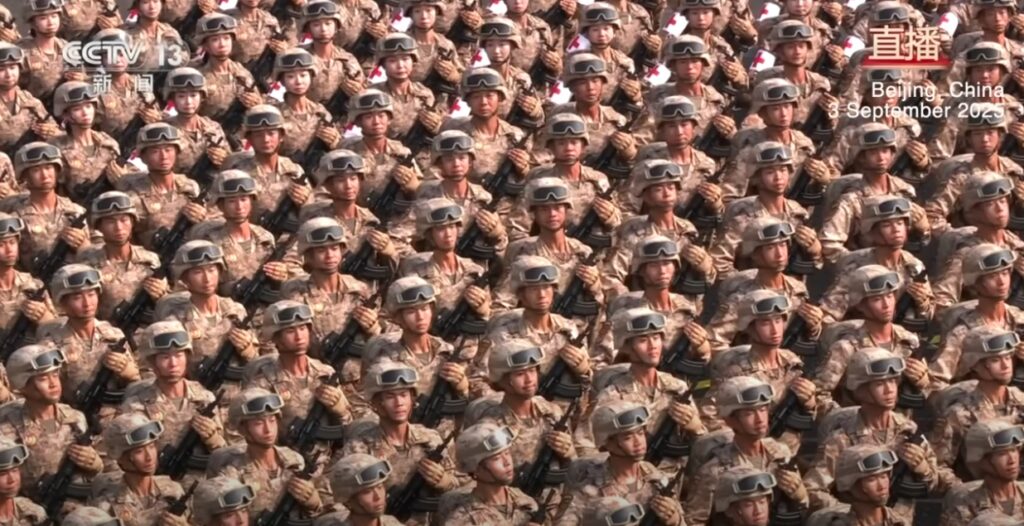
To think of it: China’s might has been created by the United States of America! What of the outsourcing, what of all the support that Washington would provide Beijing with just to spite the Soviet Union, the Middle Kingdom has become a superpower to be reckoned with. During the military parade occasioned by the 80th anniversary of the end of the Second World War in the Far East and the liberation of the Middle Kingdom from the Japanese occupation, China rolled out various kinds of armament, including drones and long-range missiles. China’s President Xi Jinping emerged in a limousine from the Tiananmen – the entrance to Beijing’s Forbidden City in a uniform habitually worn by Mao Zedong, a uniform resembling the one Joseph Stalin used to wear. Thus the Chinese leader stressed the connection with the recent past, although Chairman Mao was not the one who rendered positive services to the Chinese people. Russia does not preserve the continuity with its Soviet period of the past to that extent: true, the military parades in Moscow feature soldiers in uniforms and with military standards from the Second World War, but the tomb where mummified Lenin is till kept is shielded from public view; nor does Putin or the other members of the authorities climb the tomb as was the custom in the Soviet Union from where Soviet leaders would deliver their speeches and watch the marching soldiers.
Military parades in Moscow are compelling, yet the one in Beijing trumped Moscow’s parades. The parade held in Washington to mark the U.S. Army’s 250th birthday just cannot compare to either of the aforementioned: look for yourself. (Notice the rock music accompanying the American show; also, compare the Chinese vigorous march with the American languid walk.) China showed its military might also in equipment.
Within the framework of SCO the three leaders – Putin, Modi and Xi Jinping – conferred about political and economic topics. SCO conferences were also attended by Turkey’s President Erdoğan, while the military march was watched by Slovakia’s leader Robert Fico and Hungary’s minister for foreign affairs. So, Europe was ultimately somehow present, though not Western Europe, apart from a minor representative from Belgium. Were the representatives from the EU absent because of Putin’s presence there?
Well, Europe is crusading against Russia, and has grandiose plans of conquering China. Kaja Kallas, one-time Estonia’s prime minister, now the face of European diplomacy made no bones about it: “If you are saying that you are not able to beat, that we collectively are not able to really pressure Russia so much that it would have an effect because… then how do you say that you’re able to take on China risk. (…) My point is that if we don’t get Russia right, we don’t get China right, either.” (The interviewer tries to tone her statement down, to little effect.)
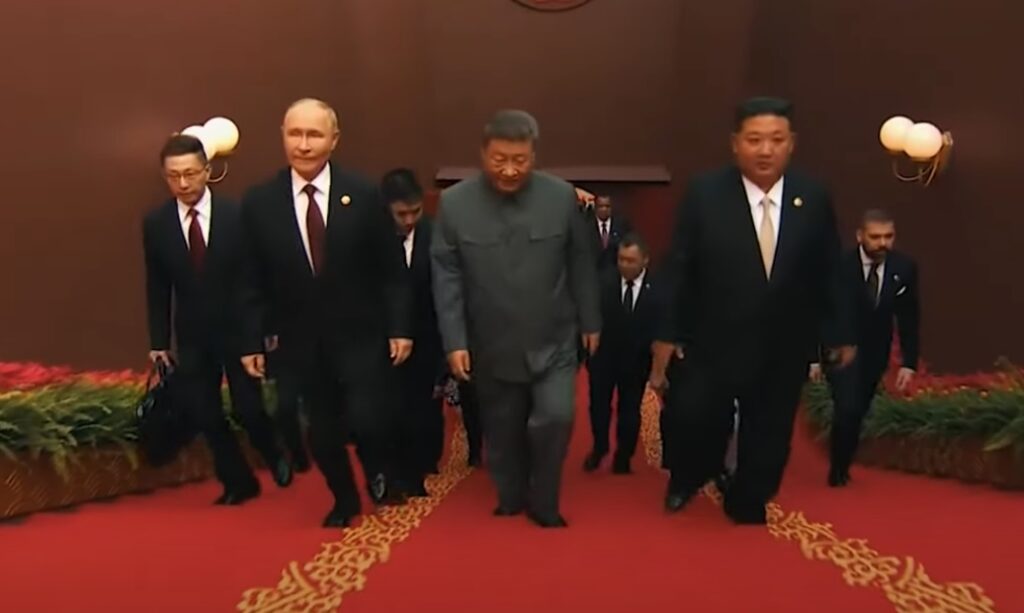
Vladimir Putin, Xi Jinping, Kim Jong Un
Strange that President Donald Trump failed to seize the opportunity to attend the anniversary of China’s liberation from Japan’s yoke. Just as Washington once pushed China and Russia into each other’s embraces, such a gesture on the part of the American president might have more favourably disposed the Middle Kingdom to the United States. Either Donald Trump didn’t want to go to Beijing of his own accord or he has bad advisors. The same is true of the European Union. Sadly, they could not be bothered to take part in China’s celebration. How can they then hope to develop friendly relations with the Middle Kingdom? How can then they hope to drive a wedge between China and Russia?
SCO’s membership includes India, Iran, Pakistan, Kazakhstan, China, Kyrgyzstan, Tajikistan, Uzbekistan, Belarus and Russia. It was established in 2001. SCO’s member states cumulatively make up 24% of the world’s area and 42% of the world’s population. (The European Union makes up less than 2% of the world’s area, and 5.5% of the world’s population.) Russia, China, India, and Iran are concurrently members of BRICS.