



Prime Minister Benjamin Netanyahu took his case to Europe to ask allies to join the United States in recognizing Jerusalem as Israel’s capital, but was met by a firm rebuff from EU foreign ministers who saw the move as a blow against the peace process. Source: Reuters
International Elite
Master of Pupets
The statement appeared followin President Trump’s decision to reconsider the status of Jerusalem and to begin preparations for the transfer of the US Embassy from Tel Aviv.
“We should call for and we should work on launching an intifada in the face of the Zionist enemy,” Hamas leader Haniyeh said. Source: Sputnik
The head of Germany’s Social Democrats, Martin Schulz, said on Monday he had been urged by French President Emmanuel Macron and other European leaders to join Chancellor Angela Merkel’s next government and push for EU reforms. Source: The Local
Turkish President Recep Tayyip Erdogan said Tuesday that US recognition of Jerusalem as Israel’s capital would be a “red line” for Muslims. He also warned such a step would force Ankara to cut diplomatic ties with the Jewish state. Source: RT
The Arab League chief said on Sunday a decision by US President Donald Trump to recognize Jerusalem as Israel’s capital would boost fanaticism and violence, and not serve the Israeli-Palestinian peace process. Source: Al Arabiya
The Arab League chief said on Sunday a decision by US President Donald Trump to recognize Jerusalem as Israel’s capital would boost fanaticism and violence, and not serve the Israeli-Palestinian peace process. Source: Al Arabiya
Tens of thousands of people have protested in Tel Aviv against what they say is corruption within the government and the slow pace of investigations against Prime Minister Benjamin Netanyahu. Source: Middle East Online
The last (relatively) sovereign state within the European Union has been eventually brought to toe the EU ideological line. Viktor Orban’s FIDESZ party has suffered a landslide defeat in Hungary. Viktor Orban, the incumbent prime minister, a man who would have visited Washington and Moscow within the same month, the man whom the European Union establishment hated viscerally (also referring to him as a dictator!) for sixteen long years has been toppled. The TISZA opposition party and its leader Peter Magiar won 138 seats in a 199-seat Hungarian parliament, which enables them to single-handedly change the constitution. The Brussels bureaucrats are gloating. How did it come about?
Democracy is the expression of the will of the people, as we know, but the will of the people is malleable. Long exposure to the intense anti-Orban propaganda that had been carried out for several years has had its effect. Add to this a couple of errors perpetrated by the Orban government, and you have the whole picture. What were the government’s errors? Corruption, the close liaison between the Hungarian authorities and President Donald Trump, who turned out to become a war-monger, the fact that Budapest backed up Israel in the latter’s conflict with Iran… Also, the European Union’s sanctions imposed on Hungary as punishment for Viktor Orban’s independence and the simple factor of Hungarians growing tired of having the same leader for so many years.
The overall result? The overall result will be that the European Union will be more monolithic than before. Viktor Orban was a beacon of independence and resistance to Brussels’ dictate. Sadly, the European Union’s steamroller has walked over the land of Magyars. Pity.
Pity because unanimity is a straight path to self-annihilation. Pity because unanimity petrifies and fossilises ideology – any ideology – and a petrified and fossilised ideology is suicidal even if it is an otherwise good ideology. Ever. Democracies pride themselves on having a system of checks and balances. Hungary was – even if small – such a check. Thanks to the veto right, this small country could effectively block some of the (more irrational) European Union initiatives. Now, all the European Union party-members will clap their leaders and execute their leaders’ orders. A divergent voice is what prevents a group or a system from going totally astray. This divergent voice of reason will be lacking in the years to come. Pity.
What is has always been, what is will always be. That’s what humanity noticed at the dawn of history. These observations have been collected and handed down from generation to generation, first, by word of mouth, then they were enshrined in holy scriptures of different peoples, of various faiths or simply in epic literature.
In ancient Greece it was Aesop, a storyteller or – most probably – a story collector, who encapsulated human knowledge in brief fables. Those fables refer not only to human character but also to the life of societies. They are a treasure trove of timeless wisdom.
Take the story about the lion and the farmer’s daughter. The lion fell in love with a farmer girl and wanted to marry her. His requests were turned down by the girl’s father again and again because the father was scared for his daughter if she were to be the lion’s wife. Simultaneously, he feared the lion. The farmer needed to turn down the lion’s requests in a diplomatic way. As the farmer was running out of excuses explaining why he withdrew his permission, he resorted to a trick. He demanded that the lion tear off all his claws because they were an obvious threat to his daughter’s safety if she were to become the lion’s wife. The king of animals complied. When he turned up to eventually receive permission from the girl’s father to marry her, the farmer – now fully confident that there was nothing he could fear once the lion had been defanged – said a final and resounding no. The lion could do nothing about it: he himself had deprived himself of his armament.
Now look for mirror reflections of this story in the history of the world, especially in current politics. The USSR desperately wanted to ingratiate itself with the West. The Soviet Union’s requests were met with demands, which Moscow was all too willing to comply with. Once the Soviet Union had disarmed itself – not merely militarily, but politically and economically – it became easy prey for the world’s powers that be.
China has understood the lesson and refused to follow the Soviet Union’s example. Beijing blazed its own trail out of communism to state capitalism, and it proved successful. Similarly, Iran was attentive at class and consequently has done its homework. The American and Israeli demands that Tehran disarm the country were declined, which eventually led to the war that we are witnessing at present.
Or the fable about the swallow, the flax, and the other birds. The swallow saw people sowing flax. The swallow was knowledgeable about what flax was used for. The swallow gathered the other birds and told them that people had sown flax in order to make cords for traps and nets with which to catch birds. The swallow strongly advised the birds to fly to the newly sown fields and peck out all the seed before it sprouts, before flax grows, before people make the nets and traps. Birds being birds, some did not believe the swallow, others were too lazy to be bothered, still others thought there was plenty of time so why be in a hurry. The birds did nothing. The people grew flax, processed it and made nets and traps, and began to catch birds.
Israel, among others, is like that swallow. Tel Aviv has for decades perceived Iran at first as a field sown with flax seed, then as a field with growing flax, an eventually as a manufacturer of nets and traps with which to entrap Israel: hence Tel Aviv’s insistence on attacking Iran in due time, hence the pressure exerted by Tel Aviv on the United States to strike Iran.
Also Russia viewed Ukraine as a field of flax where the Western countries had sown the seed, with a view to bracing themselves for entrapping Russia with the nets and traps produced from the flax which was to be harvested in the field. The Russian swallow positioned sufficiently high up in the Russian hierarchy to have an influence managed to convince the Russian ruling class (all the other birds) to see in Ukraine such a flax field with all the attendant threats. This time the other birds saw the impending danger and acted accordingly. They flew to the field (Ukraine) to peck out the flax seed and prevent future threat from materializing.
Two fables that reflect typical and hence forseeable political attitudes and the resultant actions. We have only adduced recent examples, but you can multiply them ad infinitum if you delve in the past of the nations and countries.
The similarity cannot go unnoticed. First Russia struck Ukraine because it felt threatened by it, now the United States has struck Iran because – well – because it felt threatened by it. Russia struck its neighbour, whereas the United States has struck a country thousands of miles away. Never mind, according to the Western political experts Moscow should not have felt threatened by neighbouring Ukraine, while the United States should feel threatened by a nation half a globe away.
The reverse phenomenon is also noticeable. While Ukraine is supported by the Western world and enjoys the inflow of mercenaries from many countries, including those located in South America, it is not Iran that is supported by the other countries but the United States: militarily by Israel, politically – by the Western world.
The similarity does not stop here. Russia attacked Ukraine out of fear that Kiev might join NATO and out of fear that Kiev might have its won nuclear weapon. Similarly, the official reason for attacking Iran is the possibility that Tehran is about to manufacture its own nuclear weapon.
And again a reverse phenomenon. Just as in the case of Ukraine the Western world claims to be defending itself from Russian aggression, so do Israel and the United States claim to be defending the peace in the region against Iran’s aggression.
In both cases oil and gas play a major role. Russia and Iran are some of the world’s largest suppliers of both fossil fuels. The hostilities in these two parts of the globe translate into raised prices of gas and oil, which in turn translates into difficulties in obtaining the fuels.
The Special Military Operation in Ukraine accelerated the outflow of people from Ukraine. Yes, it did not trigger but merely accelerated the outflow of people because Ukrainians had been fleeing their country for more than two decades prior to the outbreak of the hostilities. Now since Iran is effectively targeting industrial and military facilities in Israel and those Arab countries which support the United States, and since Iran itself is being hit by American and Israeli missiles, one can only expect another wave of refugees into Europe. Will the year 2015 be repeated? Will Chancellor Friedrich Merz follow in Angela Merkel’s footsteps and repeat after her ‘Wir schaffen das’?
During the four years of hostilities in Ukraine the West has desperately looked for acts of atrocities committed by the Russian soldiers so as to be able to present Russia as the heinous aggressor. They found none, or at least nothing particularly spectacular. The Western media attempted to turn the Bucha incident as a repulsive act of atrocity committed by Russians, but the case was flimsy, unfounded, and so it quickly died out. It is different in the case of the war in Iran. Almost at the start of it, American missiles hit a school and killed some 170 girls aged between 7 and 12. Nothing like that could have been pinned on Russians for the entirety of the four years.
Moscow had hoped to carry out the Military Special Operation within weeks and coerce Ukraine to sign a deal: no NATO membership. Now it seems that the United States and Israel had hoped for more or less the same: a few days of aerial combat, decapitation of the Iranian leadership, the resultant riots in Tehran, and the collapse of the regime – as they call the Iranian government – with the new authorities being all too willing to sign a deal with the United States, a deal turning Iran into an American colony. It looks like we are in for a protracted war.
Talking about the decapitation operation. Since Washington – in cahoots with Tel Aviv – tried to decapitate the Iranian leadership and was largely successful, Tehran has all the moral right to reciprocate the move. Who knows, it might be that an Iranian killer is already stalking the American president, lying in wait, and just about to pull the trigger. Or, an Iranian killer might be stalking Benjamin Netanyahu. If the Iranian leadership is a legitimate target, why should the American or Israeli leadership not be a legitimate target as well?
If Iranians pulled off something like that, there would be an outcry across the Western world: there is none if the Americans decapitate another country’s head of state. In the same vein, there is no outcry over the killing of 170 Iranian girls, but just imagine the uproar if it were the Iranians killing 170 Israeli girls!
The two wars reflect themselves in each other with similarities and dissimilarities. The judgement that is passed over the actors depends on political persuasion. Justice will not be rendered. We do not mean legal, international justice – we merely mean moral justice.
The 2022 energy crisis was an unprecedented shock for Europe. The sharp decline in Russian gas and oil supplies following the invasion of Ukraine, which resulted from irresponsible decisions by politicians in Brussels, led to record prices for energy sources and a rise in inflation. At its peak, gas on European exchanges cost ten times more than the average in previous years, and EU countries competed for every LNG delivery to avoid disruptions to energy supplies.
Before the outbreak of war in Ukraine in 2022, Russia supplied about 45% of all imported gas to the European Union. In the case of oil, Russia’s share was slightly lower, but still very high. In the years before the war, Russia supplied about 25 to 30% of the oil needed in the EU.
After abandoning Russian oil in 2022, Europe increased its imports of this raw material from the Middle East (Saudi Arabia, Iraq, United Arab Emirates, Kuwait). Currently, around 15 to 25% of the oil imported by Europe comes from the Gulf region. The vast majority of this oil has to be transported through Hormuz. This is a major dependency, but there are other suppliers for Europe: Norway, the US, West Africa and Brazil. Norway and the US together account for around 30% of EU oil imports, which is roughly the same amount that Russia was responsible for before 2022.
And what about gas? Following the reduction in supplies from Russia, the EU has increased its LNG imports, mainly from Qatar. However, the main supplier of LNG to Europe was the US, with a share of approximately 55%. Qatar has a significant but not dominant share (approximately 10-14%). The rest of LNG imports come from many smaller sources (e.g. Algeria, Norway or other countries). Therefore, dependence on the Middle East for oil and gas imports into the EU is currently much lower than dependence on Russia was before 2022.
Although Hormuz is mainly associated with oil and LNG, it is also an important trade route for many other types of raw materials. Plastics, ethylene, propylene and even fertilisers (urea, ammonia) travel through the strait. Therefore, disruptions in transport there can also lead to rising prices for plastics, packaging, car parts, fertilisers, etc. The UAE and Bahrain are among the major aluminium exporters (energy-intensive production based on cheap gas). In return, electronics and machinery pass through the ports of Dubai (Jebel Ali), Qatar and Saudi Arabia.
In summary, rising energy prices are inevitable and will affect both Europe and the rest of the world. However, Europe should not be as severely affected as it was in 2022, as the Old Continent’s energy independence has increased significantly. If the conflict escalates, Asian countries such as India and China will be most vulnerable to problems with energy availability.
Hormuz is also very important for countries in the Middle East because ships carrying agricultural raw materials arrive there. The Gulf states are heavily dependent on food imports because the climate (hot, dry, desert) limits local agricultural production. A protracted blockade is therefore unlikely.
So, the United States has attacked Iran. Some held it for impossible, others are not surprised at all. To be precise, it was not merely that United States, but the United States in cahoots with Israel that carried out the assult. Talk of the impending war with Iran has been present in the media for years, so the recent events are merely a self-fulfilling prophecy.
Two most spectacular events stand out: the intentional killing of Al Khamenei, the top spiritual leader of Shiite Muslims, and the (unintentional?) destruction of a school, where approximately 150 schoolgirls were killed. These two events are potent enough to enrage Iranians, and to upset the Muslim world.
Iran is striking back. How much the retaliation is effective is hard to say since the Western media will not report such data.
Picture to yourself a similar event launched by Russia… Yes, there would be a deafening howl across the Western world, while Putin would be called another Hitler. As it is, the American president justifies the assault on Iran, saying, that the United States had to defend itself because it felt threatened by Tehran… Weird. When Russia says it feels threatened by Western military presence in Ukraine, then such a claim is dismissed as unfounded; when, however, it is the United States that claims to be threatened by Iran, a country located thousands of miles away from America, then such a claim is legitimate.
One might tend to think that even the blind can see the hypocrisy, but rest assured: there are many who do not see it. As the saying goes: no one is as blind as the one who won’t see.
Why did the United States attack Iran? The answers are many. One is that Iran posed a threat to Israel, America’s most important and influential ally. Another is that that West wants to lay hold on Iranian oil and gas reserves. Still some others hold forth that it is the almost sixty-million strong Christian-Zionist community in America that did all in its power to necessitate the war. Christian Zionists identify more with Judaism than with Christianity, and since some of their members are the influential politicians and billionaires, they have much political leverage. President Donald Trump is believed to share the religious convictions of the Christian Zionists. After all, his daughter Ivanka converted to Judaism after she had married a Jewish man.
Sure enough, it is not only money that makes politicians act. Ideologies and religions are equally potent. The medieval Crusaders were motivated by religious principles; Montezuma, the ruler of the Aztec state in Mexico, rather than resisting the Spanish incursion, gave in to them, being convinced that the Spaniards were God’s messengers. American Christian Zionists are doing the same. Their loyalties lie with the state of Israel in the first place. Split loyalties is a phenomenon testified by history many a time. Religious minorities very often did not feel the ethnic ties with their compatriots. Rather, they felt and acted in unison with other ethnicities against their own so long as the other ethnicity shared the same creed. The same was true of ideologies.
Now what was the purpose of killing Ayatollah Al Khamenei? This act can only stiffen Iran’s resistance. The murder of a spiritual – religious – leader sets the war in a different dimension. Add to this the murder of the 150 schoolgirls: Iranians of whatever ethnicity will rather rally around the government than betray it. While the school event might be understood as a miscalculation, the killing of the Ayatollah was beyond a shadow of a doubt purposeful.
Despite what the Americans and the Israelis had expected, Iran has not disintegrated nor has it collapsed. Iranian did not take to the streets, so regime change is nowhere in sight. What can be envisaged is a protracted war. Washington had not reckoned with it, or did it?
The world is asking the question whether the United States will attack Iran. Some say it will, others say it won’t. Time will tell. Neither are we going to predict the future. Someone wise said once that although God created man in his image, he reserved exclusively for himself three things: to be able to make something out of nothing, to judge human conscience, and to know the future. Neither we nor any pundit knows the future, and all the prophets – religious or non-religious – are useless. The stuff that they impart is such that you and me can create similar prophecies because all the prophecies go something like this: somewhere, sometimes, someone will do something if something somewhere sometime performs something or fails to perform something. The only prophecy that comes true is the timetable showing the arrivals and departures of trains, buses and planes. Even if reality diverges from what the timetable says, it diverges but a little and only sometimes. In comparison to religious or non-religious (the famed Nostradamus) prophecies, timetable prophecies exhibit pinpoint accuracy and are 99% reliable.
Having said which, we are not going to predict the future, viewing such business as pointless. We are more into the whys and the wherefores of the mounting conflict between the United States and Iran. But facts first.
It is not the United States against Iran, but rather the United States and Israel on the one hand, and Iran on the other. Or, to be more precise: the conflict is between Israel and Iran, with the United States acting as a battering ram for the Jewish state.
Tel Aviv wishes to weaken Iran because Tel Aviv views Iran as its greatest enemy. Israel fears Tehran as such, but it will fear it even more if Tehran manufactures its own nuclear weapons. Though Israel is separated from Iran by Jordan or Syria and Iraq, Tel Aviv fears that Iran, once it produces its own nukes, will be capable of delivering a deadly strike by means of long-range missiles.
Now, does Iran want to strike Israel? According to Tel Aviv it does. Is that claim substantiated? Hardly.
Does Israel have nuclear weapons of its own? The whole world knows it does. If it does have nuclear weapons, then why should Iran or any other state, indeed, also have such weapons? Israel’s claim that it fears Iran, especially a nuclear-armed Iran, can be easily flipped to say that Iran fears nuclear-armed Israel. Whose fear is (more) legitimate? Tel Aviv claims it has peaceful intentions while Tehran has bellicose plans. Again, Tehran might flip the argumentation and say precisely the same about Tel Aviv. Such arguments and counterarguments just don’t make sense. It is obvious that if one country has weapons of mass destruction, the other feels threatened; and it is all too obvious that to allow one country (Israel) to have nukes while denying it another country (Iran) is simply an example of gross injustice.
The picture can be broadened. Why should France and the United Kingdom have weapons of mass destruction and not Italy or Spain? Why should Pakistan or India have such weapons, but God forbid that Indonesia or Vietnam should have them?
Iraq, Libya and Syria have been politically incapacitated by the actions of the United States and Israel. It is now Iran’s turn to be incapacitated. But why should Iranians toe the line drawn by Tel Aviv and Washington? Why should they swallow their national pride, why should they convert into Washington’s and Tel Aviv’s vassals? Sure enough, Tel Aviv would like to see Iran fragmented into a number of smaller states, but why should Tehran oblige Tel Aviv? Iran’s authorities know it all too well that once they deprive themselves of the possibility of manufacturing the weapons of mass destruction, once they cave in to American (Israeli) demands, they are going to slide into crisis and chaos and final disintegration. Once they lose the military leverage – even if potential as at present – they will be viewed as fair game.
Iranian leaders are fully aware of what happened to Russia once it had followed the West’s lead: it became weak and as such incapable of defending its most basic national interests. Both Gorbachev and Yeltsin acted in good faith towards the West, but this good faith was mercilessly exploited. Think of the economic crisis that Russia fell into and was stuck in throughout 1990s, think of the expansion of NATO that began to strangle Russia. Should Iran give in an inch, the same fate will surely haunt it as well. Already at present, Tehran has experienced US-controlled street riots and a twelve-day war that erupted on June 13, 2025, and was conducted while the US-Iranian talks were in full swing! Consider this perfidy.
Does this perfidy not remind you of the perfidy perpetrated by the Europeans who – having signed the Minsk I and Minsk II Accords between Ukraine and Russia – violated them on the following day? You will have remembered that both President Hollande and Chancellor Merkel bragged about it that they only signed those accords in order to play for time and lull the opponent. Why should Tehran believe Washington and Tel Aviv? Russia believed and lost on more than one occasion.
While Iraq, Yugoslavia, Libya and Syria were isolated at the time when they were being attacked by the West, Iran is not. It can count on the support of Russia and China. The Middle Kingdom purchases much oil from Iran (between 13% and 20% of its oil imports) and certainly does not wish to lose such a trade partner or to have this partner under US dominance.
Why should pressurizing Iran into submission be viewed as a justified action? What if the roles were inverted? What if Israel were pressurized into a similar submission? Or the United Kingdom? Or France?
Gone are the days when the world watched, with bated breath, the many talks between the United States and the Soviet Union on reduction and control of nuclear arms development. Gone are the headlines announcing the beginning, continuation and completion of the SALT or START talks. The world has changed.
Now it is the United States – as before – Russia – a replacement for the Soviet Union – and… China! When the SALT and START talks were conducted, no one paid any attention to the Middle Kingdom. Now China is a power to reckon with, not merely economically but also militarily. China is estimated to have some 350 strategic missile launching pads as opposed to some 480 American. That’s hard on America’s heels. Now what negotiations on nuclear arms control and arms limitation can be conducted between the United States and the Russian Federation without taking into the equation the Middle Kingdom?
The problem is that Moscow says it has nothing to do with China: China is not Russia’s military ally, though Washington perceives it as such. Contrarily, Russia views France and the United Kingdom as America’s closest allies, and rightly so: all the three countries belong to NATO. Hence, Russia’s demand that both France and Great Britain be included in the talks is legitimate.
On the other hand, Washington is legitimately concerned about China: under the current circumstances Beijing can certainly be viewed as Russia’s ally rather than that of America. (Just to think of it: China’s might have been created by the United States of which we’ll make a reminder later in the text.) Neither does the Middle Kingdom want to be included in the trilateral talks with the Russian Federation: why should it? It is an independent power – superpower – and it can act at the negotiating table on its own. So much so that Beijing has something to win from Washington: ok, the Chinese may say, we could reduce our military development if you lift the sanctions on China and the countries that wish to trade with the Middle Kingdom. How about that? Nuclear might is always a fine bargaining chip, is it not?
It is even true of tiny North Korea as well: not that North Korea is so powerful as to be considered for joint talks. No. But Korean nuclear potential is a sufficient deterrent even for such a superpower as the United States. And there is something more to the nuclear potential: it is the determination of the Korean leadership to actually use the missiles if push comes to shove. It is not Venezuela, whose president can be adducted in broad daylight without the perpetrator of the abduction fearing any retaliation, but we are digressing.
The balance of forces has changed since the year in which the Soviet Union disintegrated. For maybe as many as two decades the United States dominated the globe and felt so self-assured that Washington began to dictate to the whole globe. This, however, has changed. Russia has reasserted herself while China has risen to the status of a(n almost) superpower.
Which by the way is good for humanity. One superpower with no rival to fear would soon become corrupted and degenerated. All the other countries would have felt intimidated with no alternative anywhere in sight. Fortunately, a world emerges where there are three or maybe four (if we include India) big players, which allows for the smaller entities to have a political alternative, and which keeps each superpower in check.
A new arrangement needs to be made – no one power wants the prospect of a nuclear shootout. Talks are not going to be easy, because it is now three big entities, not two.
Political persistent rumour has it that Adolf Hitler was the creation of the Western elites who wished to rebuild Germany and direct its power against the Bolshevik Soviet Union. That is why London and Paris did not react when Germany began to arm itself, when Germany incorporated Austria and annexed Czechia; that explains why they did not react when Poland was attacked. The Western elites wanted Germany to expand, grow stronger, and come into physical contact with the Soviet Union. Now Adolf Hitler – assuming he was the darling of the Western elites – stopped playing by their script and turned against them when he attacked Denmark and Norway, the Low Countries and eventually France. It came as a shock: he was supposed to attack the Soviet Union!
Isn’t history repeating itself? The Middle Kingdom was supported by the United States for the express purpose to turn it against the Soviet Union. Washington would have rubbed its hands in glee if Beijing and Moscow started a real hot war! Decades have passed and – due to clumsy American policy-making – Moscow was pushed into Beijing’s embrace while Beijing was pushed in Moscow’s. Now they are – though not formally – economic and military allies. But again, the Kremlin may repeat: we have nothing to do with it. Had not Washington acted the way it did, there would have been no war in Ukraine, no sanctions on Russia and China, and consequently no Russo-Chinese cooperation.
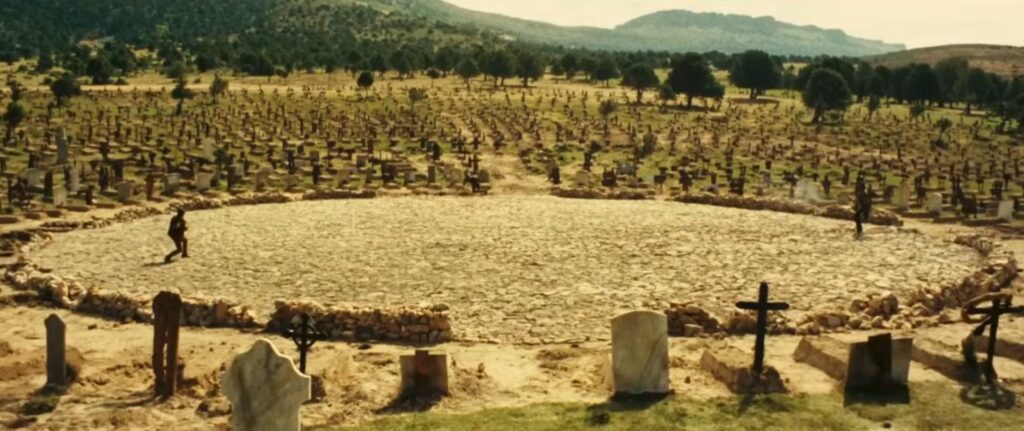
The three gunslingers have a hard nut to crack. Certainly, none wants a nuclear exchange, yet each wants to get the upper hand. They are observing each other attentively, not knowing in which direction to level their guns. It reminds one of the cultic cemetery scene from the 1966 The Good, the Bad and the Ugly classic movie. Do you recall it? Good Blondie (Clint Eastwood), bad Angel Eyes (Lee Van Cleef), and ugly Tuco (Eli Wallach) are facing each other – graves and crosses around them, their hands over their holsters, their eyes darting from face to face, their minds calculating. That’s the United States, that’s the Russian Federation, and that’s the People’s Republic of China facing each other (who is the good, the bad or the ugly is a matter of your political persuasion). In the graveyard scene only one emerges victorious. How will things play out in political reality at beginning of the 21 century?
After the notorious Klaus Schwab, founder of the World Economic Forum, resigned following allegations of financial and ethical misconduct, the forum took on a new dynamic. Whereas speeches used to be an expression of blind faith in mainstream ideology such as globalisation, green transition, climate change, sustainable development, human and LGBT rights, today they feel like a breath of fresh air. Take, for example, US Secretary of Commerce Howard Lutnick, who said:
“We are in Davos at the World Economic Forum and the Trump administration and myself, we are here to make a very clear point. Globalization has failed the West and the United States of America. It’s a failed policy. It is what the W has stood for which is export offshore farshore find the cheapest labor in the world and the world is a better place for it. The fact is it has left America behind. It has left the American workers behind and what we are here to say is that America first is a different model. one that we encourage other countries to consider, which is that our workers come first. We can have policies that impact our workers. Sovereignty is your borders. You’re entitled to have borders. You shouldn’t offshore your medicine. You shouldn’t offshore your semiconductors. You shouldn’t offshore your entire industrial base and have it be hollowed out beneath you. You should not be dependent for that which is fundamental to your sovereignty on any other nation. And if you’re going to be dependent on someone, it darn well better be your best allies. Okay? And so that is a different way of thinking. It is completely different than the WEF” (Video)
Oh dear! It’s a good thing Klaus Schwab can’t hear that, otherwise he’d have a heart attack.
Canadian Prime Minister Carney also pointed out in Davos that “the existing world order is collapsing.” He also highlighted the plight of small and medium-sized countries, which now have to cope with pressure from the largest ones. The Canadian Prime Minister said that these states should join forces so as “not to be crushed by the rivalry of the superpowers.” It seems that these words refer most to the countries of the European Union, which in recent months have pursued a different policy as a group from what Donald Trump is trying to do.
Due to the many controversial actions of the US president, we are gradually reaching a situation where simply showing resistance to him is enough to gain popularity. Previously, Justin Trudeau’s popularity grew because of such a conflict (it was Trump’s fault, not Trudeau’s merit), and now Carney also received a lot of praise after his speech, although as a former banker, he is more reminiscent of Macron in terms of credibility.
Among other important statements from Davos, the following are also worth mentioning:
[1] Larry Fink (CEO of Blackrock) stated that tokenising assets is the only sensible decision and that next-generation financial markets should already be based on tokenised shares or bonds.
This proves that the elites have not given up the fight against cash.
[2] Christine Lagarde (head of the ECB) drew attention to the problem of wealth inequality. And indeed, this problem does exist, but Ms Lagarde has probably forgotten who fuelled this problem over the last decade through massive money printing and intervention in the financial markets.
[3] Javier Milei (President of Argentina) reminded us that the West could still have a bright future ahead of it, but that it needs to turn towards freedom. These words were probably directed at the United Kingdom, Belarus and Germany, where freedom of expression is being fiercely opposed. (See also: Article in Gefira)
At the peak of its development, the Roman Empire ruled over all the countries that were located around the Mediterranean. Carthage had been destroyed, Greece had been subjugated, even Egypt had been conquered. Gaul and Spain had been turned into Roman provinces as were the coastal regions of the Adriatic Sea. Hence the proud Romans could declare that all the waters in between Europe and Africa and Asia were Mare Nostrum or Our Sea. All merchantmen were controlled by Rome as were all the ports. No one could travel freely without Rome’s permission. The Romans did not need to bother about tolls or tariffs or whatever. (Sometimes they were bothered by pirates, but that problem would be swiftly solved by Rome’s military might.)
The Baltic Sea is five times smaller than the Mediterranean (approximately 0.5 million square kilometres against 2.5 million square kilometres), but it is an important and – in many cases – the only sea route for many European countries to the high seas, to the Atlantic Ocean. These countries include (clockwise, starting from the north) Sweden, Finland, Russia, Estonia, Latvia, Lithuania, Russia again (the Kaliningrad oblast), Poland, Germany, and Denmark. Since Sweden and Finland have recently joined NATO, the Baltic Sea had become a sea that is surrounded by NATO member countries with the exception of Russia. But Russia has a very narrow access through the Finnish Gulf (that’s where St Petersburg is located) and through the Kaliningrad oblast, which in turn is cut off from Russia proper by territories that belong to Poland and Lithuania. Having in mind the two narrow slips of land where Russia has access to the Baltic Sea, we can say that the Baltic has become NATO’s Mare Nostrum.
Considering the enmity that reigns supreme between the Western bloc and the Russian Federation, we can easily imagine the temptation on the part of the Western countries to view the Baltic Sea as a stranglehold on Russia. The leaders of these countries might choose to block Russia from sending its ships via the Baltic to the Atlantic Ocean or they might at least want to make life miserable for the Russian fleet. Let us not forget that Russia might access the Atlantic Ocean also through the Black Sea and the Mediterranean, but then, again, the access looks like a narrow throttle – especially in the place called the Bosporus Straight. It is controlled by Turkey, and although the 1936 Montreux Convention makes the Straight passable internationally, Turkey is a NATO member.
As it is, Russia can easily be cut off from the Atlantic Ocean irrespective of whether she chooses to access the ocean through the Baltic or through the Black and the Mediterranean Seas. Yet, being a nuclear superpower and finding itself in a mortal struggle with the West for sheer survival as an independent, sovereign state, the Russian Federation might be compelled to (aggressive? defensive? pre-emptive?) measures. Recall how the so-called Polish Corridor – a strip of land that cut off East Prussia from Germany proper during the time of 1918-1939 sparked the war between Germany and Poland, and consequently the Second World War. At that time Germany did not fight for its survival, certainly not against Poland, which did not threaten Germany’s existence, and still Berlin decided that Germany could not do without the corridor. Now Russia as a superpower needs access to the high seas or else. The Russian Federation is the largest country by territory, but its location is somewhat infelicitous. While the United States has unrestricted access to both the Atlantic and the Pacific Oceans, Russia only has direct access to the Pacific Ocean. The problem is that while the United States’ eastern and western seaboards are equally well economically developed, Russia’s far east is not. The other point is that Russia’s far east is far flung from the European part of Russia. The distance between the western- and easternmost parts of the Russian Federation is much longer than that between America’s western and eastern seaboard. Moscow must, therefore, fight for access to the high seas cost it what it may. What may we expect?
If any one or all of the Baltic states (Lithuania, Latvia, Estonia) choose to alienate Russia, to deny its access to the Baltic, then they might fall prey to Russia’s military intervention. Will the said Baltic states risk such policy? In all probability, they will. Why? Because already we can see how bellicose they are in their dealings with the Russian Federation, and how their leaders bend over backwards to oblige their Western overlords. They might choose to take over the role which has been played by Ukraine for the last several years. Taking such steps, they will force Russia to step in militarily. Once Russia intervenes in the Baltic states, she might choose to either incorporate them, or install there governments that will be Russia friendly. Bear in mind that Lithuania, Latvia, and Estonia used to be parts of imperial Russia (where they had no autonomy) and then of the Soviet Union (where they enjoyed the status of union republics with their governments, constitutions and the like; a status similar to that that they have now within the framework of the European Union).
If Finland chooses to thwart Russia’s access to the Baltic Sea, it might expose itself to a repeat of the Winter War of 30 November 1939 – 13 March 1940. That war cost it territorial losses. Finland, too, used to be part of the Russian empire as an autonomous grand duchy (1809-1917) with its own parliament. If push comes to shove, Finland may again lose some of its territory or become an autonomous part of the Russian Federation.
I hear you say NATO will never allow that kind of land grab! If you think so, then, please, think again. If the scenario that we are presenting materializes, the ruling classes of the Baltic states and Finland will swiftly and comfortably run away (that’s the usual behaviour of the ruling classes), while the common Lithuanians, Latvians, Estonians and Finns will remain, as is usually the case with the common people.
The Baltic as Mare Nostrum is a powerful geostrategic instrument in the hands of the managers of the Western world, but concurrently – a curse for the common people of small nations who matter to the managers of the world about as much as the pawns on the chessboard.
It was not executed in broad daylight – rather, in the dead of night – but still it was disrespectful as disrespectful can be. A head of state of a sovereign nation was abducted as if he were a criminal. Handcuffs were put on his hands, he was blindfolded and transported – together with his wife – from his own country to the United States. What a show! For all to see. For all leaders to take notice. For all top politicians to be on their guard. That happened on January 3. We all know it, the whole world knows it – the whole world observed it with bated breath.
A head of a relatively large country was captured like he was a street ruffian. Apart from his personal security detail that attempted to put up a fight there was no resistance in the true sense of the word. American aircraft hovered over Caracas the way they might hover over their own turf. There were casualties to be sure but no appreciable resistance of the country as such. Pundits draw conclusions that Nicolás Maduro’s closest associates – generals, ministers – had betrayed him, had let themselves be bribed, and abandoned him in the critical moment. Word has it that only Cuban bodyguards stood up for Nicolás Maduro, as a result of which some of them were killed.
The warrant for the action? The drug trafficking into the United States that allegedly had been sponsored by Caracas and the president himself. Sure enough that is the declared objective, not the genuine one. We’ll talk about the genuine objective later in the text. Here let us make an assumption that it was drug trafficking that triggered the US action, and that Nicolás Maduro really sponsored it. If that were the case then a couple of questions arise.
For at least four years during the Biden administration the American southern border was not merely porous: it was wide open for all to come. Arrivals from South America were flocking across the border and they were not even vetted! Sure enough, drug traffickers may have been among them. Why should Venezuela be punished for that? The drugs are distributed in American cities – does anybody forces the purchase of them at gun point? Last but not least, why are the American police not effective enough? Why must the American army step in? If particular countries were to be blamed for particular sorts of crime that is perpetrated on American soil, then the US army should be intervening around the globe twenty-four seven. But then, if you do not want to have drug traffickers, why have borders open wide for all to cross them?
The event of January 3rd compels one to draw a comparison between the intervention of the US Army in Venezuela and the intervention of the armed forces of the Russian Federation in Ukraine. How alike they are and at the same time how different! Americans claim that Venezuela posed a security threat to the United States; Russia claims that Ukraine posed a security threat to the Russian Federation. Washington says it is protecting its citizens from drug trafficking cartels; Russia maintains it is protecting its citizens from Banderite fascist ideology and the military bases complete with ballistic missiles to be installed in Ukraine once Kiev joins NATO. Washington feels threatened by a country that is three-four thousand kilometers away from America’s coastline; Russia feels threatened by a neighbouring country, a country that is adjacent to Russia, a country that is not separated from the Russian Federation by a body of sea as the United States is separated from Venezuela.
Knowing all this full well, America’s allies go out of their way to either support politically the United States or keep their mouths shut; contrarily, they are beside themselves with outrage when it comes to the Russian intervention in Ukraine. Caracas had diplomatic and economic ties with China and Russia – America’s rivals, but Kiev had ties with the United States and was planning to join NATO, a military alliance which is openly hostile to Russia. These are mirror events and yet they are adjudicated entirely differently. Why?
The United States has executed an action of decapitation which is just yet another one in the long string of such actions. Think about Iraq’s Saddam Hussein, Syria’s Bashar al-Assad, Serbia’s Slobodan Milošević, Libya’s Muammar Gaddafi, and many others. Leaders of sovereign states are put on trial (Slobodan Milošević, Nicolás Maduro) or killed (Muammar Gaddafi, Saddam Hussein, Slobodan Milošević) or chased away (Bashar al-Assad). Do you still remember the repulsive repugnant disgusting sickening abhorrent enunciation of one Hillary Clinton as she said – commenting on Gaddafi’s death and paraphrasing Julius Caesar – We came, we saw, he died! – and laughed heartily at that? Imagine Vladimir Putin saying something along these lines, commenting on the death of, say, Volodymyr Zelenskyy… What a howl would be raised in the the ‘free’ world! A statement like that would be interpreted as ultimate evidence of Putin’s wickedness.
Might is right, that’s all there is to it. So, America intervened in Venezuela because it saw it fit. All the justification that is being rolled out is either easily refutable or laughable. Isn’t it ridiculous to hear that the world’s dominant superpower needs to abduct the head of a small country located thousands of miles away across the sea because the superpower feels insecure? Isn’t it laughable to hear that the Russian Federation has no legitimate grounds for intervening in a neighbouring country that is about to join a military alliance which is openly hostile to Russia? And yet, millions of people do not seem to see it.
Now the genuine reasons for the American intervention in Venezuela. Venezuela holds the largest oil reserves than any other country, including Saudi Arabia. Venezuela also has other valuable resources. Control over them will provide the United States with enormous economic and – what follows – political leverage. We should not lose the sight of the fact that Saudi Arabia has not prolonged the agreement it once signed with Washington to only sell its oil for American dollars. That in itself is dangerous for the United States. It was the petrodollars that safeguarded American might and American development. All countries and any country wishing to buy oil – and they all need oil for a variety of purposes – needed to first have dollars. Dollars are issued by the United States, so ultimately all the world’s nations needed to directly or indirectly either sell to the United States their goods and services or borrow from the United States. Americans were growing rich by simply… printing dollars or transferring electronic impulses from their bank account to the bank account of a country which was in need of dollars.
The capture of the head of state and the installment of someone who might be willing to comply with American wishes is also a strike dealt against China. China has been spreading its tentacles to Africa and… South America. Beijing has been replacing European colonial powers on the Dark Continent and attempting to dislodge American influence from the Western hemisphere. Americans suddenly remembered the 1823 Monroe’s doctrine, which stated that both American continents are the sphere of influence of the United States alone. No one should dare to set foot anywhere south of the American border. The Chinese have financed the construction of the Port of Chancay in Peru as a part of the Belt and Road Initiative. Its task is to enable the exports to China from South American countries and imports from China to South America. The Middle Kingdom is setting foot where it should not dare, according to the Monroe doctrine.
With this intervention Americans have set yet another example – a warning sign – a mafioso-like manifestation what awaits those leaders who will not comply…
Be it as it may, what strikes the eye is pure hubris, the kind of hubris that has always been present throughout history and always will be. In 1939, the Third Reich and the Soviet Union signed a pact to divide Poland. That pact has been branded by the European Union as a conspiracy against peace; the leaders of the contracting states – Hitler and Stalin – were labeled warmongers who paved the way for the outbreak of the Second World War. Now almost a whole year earlier another pact had been signed, a pact between Germany, Italy, France and the United Kingdom, a pact that paved the way for the partitioning of Czechoslovakia. This pact – signed by Hitler, Mussolini, Daladier and Chamberlain – in Munich has not been branded by the European Union as outrageous, although it, too, led straight to the outbreak of the Second World War. You see? Very similar events, very different interpretations. Much the same is true of the current interventions in Venezuela and Ukraine: American intervention is regarded as the right one, Russian intervention as abominable. History is full of events mirroring each other and receiving discrepant exegeses.
In November, Donald Trump announced that he would approve the sale of F-35 Lightning II fighter jets, the most advanced V-generation aircraft equipped with AI sensors and other technological innovations. Even more important is who the buyer of these weapons is. It is, of course, Saudi Arabia, which will purchase more than 20 F-35s, 300 Abrams tanks, MQ-9 Reaper drones, air defence systems and a variety of missiles. Why do the Arabs need so many advanced weapon systems? Well, it’s obviously about superiority over Iran, but also (though this is not said out loud) over Qatar, which is not exactly a friend of the Saudis and is armed to the teeth.
This is a situation similar to that of the 1980s, when Ronald Reagan tried to emphasize the power of the alliance with the Arabs by providing them with the latest military technology. At that time, AWACS systems and F-15 aircraft were sold despite opposition from the United States’ most important ally in the region, Israel. At that time, it was a blow to the Soviet Union, and today Trump’s game is focused on China and Russia. The Americans had to somehow “consolidate” the Saudis in their camp, as they had recently been buying more and more weapons from China and Russia. The purchase of weapons such as the F-35 makes Arabia dependent on American technology and service.
On the other hand, the US had to use the “carrot and stick” approach to keep oil prices low, which is unlikely to please the Arabs and OPEC+ as a whole. This is an important issue for the United States, as cheap black gold keeps inflation low in the country, satisfies consumers, secures the voter base, and weakens the major exporters of this commodity, such as Russia and Iran. This shows that it is enough for the US to be present in this region through arms exports in order to remain a strategic player there.

Energy is a commodity traded on the markets. This happens every day, at every moment. If the price of electricity falls, the electricity producer stops feeding his electricity into the grid. However, producers usually have no choice, as wind turbines keep turning and solar panels operate automatically. Energy storage systems are expensive and currently have barely enough capacity to store surplus electricity for hours or days when demand is high.
The more photovoltaic cells feed into the grid, the more frequently this problem arises: too much energy is generated precisely when everyone is producing the most. On sunny days, particularly at midday, there is more electricity than the system can consume. The more the sun shines, the more electricity flows into the grid at the same time – and the more frequently the price drops to zero or below. In extreme cases, the energy producer has to pay extra just to get someone to take the electricity off their hands. The following chart shows how the percentage of hours with negative electricity prices is rising in Europe and individual regions – and in which countries the biggest increases were recorded in 2025.

A negative electricity price is not a gift to the recipient. It is a signal that the system has been ‘overwhelmed’ by the surplus. Photovoltaic operators therefore sell electricity at a lower price relative to the average market value, which is not reflected in the final price paid by the end consumer. Why? Because there are too few energy storage operators willing to buy the electricity for free or at a premium and sell it at peak prices in the evening. Whilst the number of electricity storage facilities is rising steadily, the electricity grid is not being expanded to keep pace with the rapid growth of solar, wind and storage. As a result, on sunny days, photovoltaic plants and wind farms are being shut down more frequently because it is not possible to absorb the electricity. According to reports, 8.5% of onshore wind production was curtailed in the United Kingdom in 2024. In Germany, wind curtailment (onshore and offshore) has been above 5% since 2022, and solar curtailment rose to 2% in 2024. In China, this rose to 4.1% for wind and 3.2% for solar energy in 2024; preliminary figures for 2025 suggest over 5% for both, according to the IEA.
A modern 100-megawatt storage facility requires around 0.5 to 1 hectare of land. How much farmland would be needed for the massive offshore projects involving terawatt-scale wind farms currently being built in the Baltic Sea (for example, in Poland)? How much lithium and other metals – mined in the developing world in ways that are far from environmentally friendly – are required for these large battery energy storage systems (BESS)? Is that sustainable? Really?
I don’t think so. But it is politically correct, because it creates the illusion that we are becoming less dependent on fossil (read: Russian, Putin-controlled) raw materials.
For those who follow the financial markets even a little, it is no secret that the race in the field of artificial intelligence is currently being fought out among the largest technology companies. However, AI is not a free revolution. To develop ever more efficient models, Big Tech needs hundreds of billions of dollars for data centres, servers, chips, cooling and energy. It is astonishing, but according to an analysis by the IEA (International Energy Agency), data centres are expected to consume around half of the electricity produced in the US between 2025 and 2030.
This is beginning to be reflected in the cash flow of the major companies in the AI sector. The chart below shows the growing gap between the capital expenditure (CapEx) of the Big 4 – namely Amazon, Alphabet, Meta and Microsoft – and their available cash (FCF – Free Cash Flow).

Capex of Amazon, Alphabet, Meta and Microsoft (dark blue) vs. their free cash flow (red) in billions of dollars, including forecasts for the coming years.
From 2023 onwards, these companies’ expenditure will rise steadily and, according to analysts, will be six times higher by 2030 than it was eight years ago. 2026 will be the first real test of this strategy. It is predicted that surplus cash will virtually disappear and debt will rise. In a year’s time, we will find out whether it was a brilliant gamble – or the most expensive mistake in the history of technology.
Another risk for Big Tech is competition. Although tests clearly show that Chinese models still lag far behind the American market leaders, whilst the US remains the leader where scale and computing power matter, the technological advantage is not yet a market advantage – especially when the cheaper Chinese alternative is good enough for most business applications.
On our fear, of course. Visions of the end of the world have always deeply unsettled people. Priests and rulers exploited this to control the masses. Perhaps only the fear of foreign enemies was sometimes greater – be it the Germanic tribes for the Romans, the Mongols for Eastern Europeans, or Putin for the West.
The Greens capitalise on our fear of the end of the world, which they claim is imminent because of our own fault. This fear is a form of self-blame and masochism.
One of the fathers of so-called climate change, which has caused us sleepless nights and turned our lives upside down, was Prof. James Hansen, who worked for NASA. On 23 June 1988, his speech to the US Senate marked the beginning of a new era. The myth that CO2 was the sole factor responsible for global warming began. Yet the fact that humanity’s enormous progress over the last 200 years would not have been possible without the burning of fossil fuels is often glossed over.
It was the baby-boomer generation that first fell into the trap of green ideology, as they were gripped by a fear of nuclear war instilled in them by the Cold War. They said ‘no’ to nuclear power and ‘no’ to fossil fuels. The baby-boomers equated nuclear power stations with nuclear weapons and shut down the former. Now even Hansen has recognised his errors in reasoning and, during a demonstration at the Brandenburg Gate, implored the Germans not to phase out nuclear power (03/11/21).
Just as disinformation about nuclear power was hammered into the minds of the baby boomers for decades, so younger generations are being led to believe that renewable energy sources are more sustainable. It is shocking how few people died as a result of the Chernobyl accident. It is shocking that no one died as a result of the Fukushima accident. But these were dramatic events that made it easy to instil fear.
It is shocking that the efficiency of offshore wind farms is 40% lower than theoretically assumed, which means it takes 14 years for the total costs to pay off. Furthermore, as the wind does not always blow, gas or coal-fired power stations must be on standby to feed electricity into the grid, meaning that, in practice, they operate continuously. If not, it ends up like it did in Spain in April 2025, where there were massive blackouts. Energy storage systems are said to be an alternative to gas-fired power stations, but in the case of a 1GW wind farm, they increase costs by €10 billion and extend the payback period to 29 years. Economic madness.
The same applies to solar power stations – they require 300 to 800 times more land than traditional ones. The same goes for electric cars: 24 kilograms of copper are needed to manufacture an electric motor. Friedrich Schmidt-Bleek, a professor of chemistry at the Wuppertal Institute for Climate Research, has calculated that 8 tonnes of natural resources (soil, water, oxygen, etc.) must be sacrificed for 24 kilos of copper. It’s madness!
The green transition is emptying Europeans’ pockets, and electricity prices are skyrocketing. The green transition is making us dependent on China; it is making us weak. It is destroying nature. Particularly in Africa, where cobalt (indispensable for electronics and electric cars) and other raw materials are mined in ways that devastate the environment.
The Green ideologues could have cited well-known philosophers and economists. They could have referred to Martin Heidegger, who warned against treating the world (including nature) solely as ‘stock’. They could have referred to Thomas Malthus, who became famous for the theory that population growth would outstrip food production, leading to catastrophe, and extended this theory to non-renewable energy sources. But they did not, because they rely on and draw their inspiration from terrorists who glue themselves to the tarmac in the middle of the city and from screaming girls like Greta who try to scare us. They rely on parasites who receive funding from the major corporations in the eco-industry for their “activities”.
This short article is intended for long-term investors who allow themselves to be distracted by Trump’s speeches and wars and are tempted by the mainstream trend of investing in AI, IT and weapons.
The so-called ‘utilities’ sector is a defensive sector of the economy that provides everyday goods and services. People can tighten their belts when it comes to spending on electronics, holidays or cars, but they cannot do without electricity, water or gas. This makes demand for these companies’ services relatively stable regardless of the economic cycle. During a recession, they usually fall less than the broader market, although in times of euphoria they tend to grow more slowly than technology or industrial companies. For a long-term investor, this is not a disadvantage but an advantage. Such a sector can, in fact, act as a portfolio stabiliser.
The second key element is the regulatory model. A significant proportion of revenue for companies in the utilities sector comes from tariffs approved by regulatory authorities. Whilst this limits the potential for very dynamic growth, it offers predictability in return. Many of these companies operate as local monopolies and therefore do not have to compete for customers in the same way as companies operating in highly competitive markets.
On the other hand, there are regulatory risks, as decisions made by public officials can affect a company’s profitability.
The third argument in favour of such companies is dividends. Utility companies are among the sectors that traditionally offer shareholders an attractive share of their profits. A stable cash flow enables such companies to distribute profits regularly, and for an investor focused on passive income, this is of the utmost importance.
However, one must not overlook the weaknesses of this sector. The construction and maintenance of energy, gas or water supply infrastructure require enormous capital expenditure. As a result, utility companies generally have high levels of debt. High debt levels are not unusual in the modern world, but they make the sector sensitive to changes in interest rates. As interest rates rise, so do the costs of servicing debt. Consequently, investors tend to view shares in companies in this sector somewhat like bonds. When bond yields rise, some capital flows away from these companies, which can put pressure on their share prices. However, this should not be interpreted as a deterioration in the quality of their business, but merely a shift in investor preferences.
Why might utilities be set for an extra boost to growth right now? In recent years, the utilities sector has gained a new and very strong case for investment: the development of artificial intelligence. AI does not operate in a vacuum. Behind every model, every data centre and every AI-based service lies a vast computing infrastructure that requires huge amounts of electricity. This means that the next industrial revolution driven by AI could increase energy demand in the coming years and, above all, have a positive impact on electricity supply companies. That is why the sector, which has been viewed as dull and uninteresting over the last few years, could now be one of the biggest beneficiaries of a changing world. In 2026, many market segments are performing poorly, particularly following the very strong growth of previous years. Some of the more defensive sectors are currently performing relatively well despite the war narrative, which shows that capital is once again seeking stability and predictable cash flow.
Looking for specific investment tips? Here you go. Here are a few companies that pay dividends regularly and increase them (US market): NextEra Energy, Atmos Energy, Essential Utilities, Eversource Energy, and Consolidated Edison.
The Hormuz blockade has turned sulphur into a black swan event in the mining industry. This is because a large proportion of the global sulphur trade passes through the Strait of Hormuz. Sulphur is the raw material from which sulphuric acid is produced, which is indispensable in mining, amongst other things. Consequently, a disruption to the availability of sulphuric acid on the world market could mean that the conflict in the Middle East affects a number of less obvious sectors, such as the uranium sector.
Sulphuric acid is mainly produced during the processing of oil and gas. Consequently, the situation in the Middle East affects the sulphuric acid market in two ways: firstly, less sulphur is entering the global market, leading to a reduced supply of sulphuric acid; secondly, the infrastructure for hydrocarbon processing – and thus the infrastructure in which sulphur is produced – is being destroyed. This means that even if the Strait of Hormuz is reopened, the supply of sulphur will remain limited for some time.
One of the world’s largest uranium producers – the Kazakh company Kazatomprom – will be particularly affected by this problem. The recent floods in the country meant that sulphuric acid supplies for uranium mining operations did not arrive on time, which restricted production and ultimately led to a decline in the expected supply of uranium on the market. It is all the more significant that Kazatomprom extracts uranium using the ISR (In-situ Recovery) method. This is a technology in which a chemical solution is injected into the uranium minerals to dissolve them, and sulphuric acid forms the basis of this solution. Furthermore, it turns out that more than 90% of the sulphur imported into Africa comes from the Middle East… and therefore flows through the Strait of Hormuz. New uranium exploration projects are currently underway on the African continent (for example, in Namibia), where sulphuric acid is urgently needed for operations. Traders are already struggling to secure any supplies. Consequently, sulphuric acid prices in Africa are rising significantly… and if the shortages last longer than three weeks (and there are many signs that, in our view, they will last much longer), then mining projects will have to be temporarily shut down because they are running out of acid.
The problem with sulphuric acid is therefore becoming a more global issue and will affect more companies, which, paradoxically, would significantly improve the long-term outlook for the price of uranium.
As for helium: Qatar is the world’s second-largest producer of helium and is set to account for around 33% of global production in 2025 – 63 million m³.
When the Ras Laffan plant, the world’s largest LNG export facility, was shut down due to the war with Iran, helium supplies were halted, as helium is produced as a by-product of natural gas processing. As a result, the market is currently losing around 5.2 million m³ of helium per month, with virtually no global reserves of this raw material – helium evaporates during storage and should reach consumers in around 45 days. The disruption has already doubled helium prices since the start of the war with Iran. The ships transporting this gas have stopped sailing through the Persian Gulf and the Red Sea. This is a serious problem, as a large proportion of the world’s helium supply is transported via this very route. Consequently, companies such as Samsung and SK Hynix, which account for 60% of global SSD production, have reported problems. Helium is, in fact, absolutely essential for the manufacture of semiconductors. It is used to cool and stabilise lithographic equipment, and there is no substitute for it. If the supply of helium is cut off for an extended period, chip factories will begin to scale back production within a matter of days. This will immediately trigger a domino effect: memory production for Nvidia will fall, Apple will be unable to assemble iPhones, Tesla will cut back on car production, and AI data centres will not receive enough GPUs. The entire semiconductor industry – worth more than $600 billion – could start to grind to a halt. Unlike the 2021 chip crisis, which was caused by the pandemic and factory downtime, the current problem is geopolitical in nature. The raw material is not reaching the factories because sea routes are blocked or too risky. And helium is just one of many critical gases whose absence could cripple global technology production.
Iran did not need to target a semiconductor factory with missiles. It was enough to jeopardise road safety to undermine the foundations of the modern digital economy and the energy supply.
Trump has no luck or talent when it comes to choosing people for his government or entourage. Yes, Melanie may be an exception, but when the president nominated Jerome Powell as chairman of the Fed in 2018, he immediately came into conflict with him. Trump wants complete control over the dollar and financial policy, which is not possible under the Fed’s mandate. Powell acted independently, saw the danger of a return to inflation and did not lower interest rates, which angered Trump, as he wanted to increase the competitiveness of the US economy through a cheaper dollar.
Now Powell’s term is slowly coming to an end, and Trump was looking for a suitable successor. At first, he wanted to nominate Kevin Hasset, the head of the National Economic Council (NEC), but then he realised that he wanted to keep his key adviser close by. So, he opted for the young but experienced Warsh. Will he disappoint him?
There are two camps among central bankers and members of the FOMC: doves, who advocate easing, and hawks, who favour higher interest rates. Warsh is currently pursuing a hybrid approach that combines elements of both camps:
- Easing Contrary to his former reputation as an inflation hardliner, Warsh currently advocates interest rate cuts. He argues that current monetary policy is too restrictive. His thesis: productivity gains (AI and deregulation) could enable the economy to grow faster without fuelling inflation, which would justify lower key interest rates.
- Tightening He remains a hardliner when it comes to the Fed’s balance sheet. He calls for a significant reduction in the central bank’s balance sheet (active quantitative tightening – QT) and less market intervention. He believes that a smaller balance sheet reduces market distortions and creates the scope for permanently lower short-term interest rates.
Yes, AI is a key argument in his logic. According to Warsh, it is responsible for the “performance miracle” that is essentially disinflationary. If companies can use AI to produce more goods and services at lower costs, this increases supply. The effect? It is assumed that a larger number of raw materials on the market at lower manufacturing costs naturally prevents price increases (inflation), even when the economy is growing rapidly. However, in this case, growth is not the result of printing empty currency, but the result of increased productivity. Warsh compares this situation to the internet revolution of the 1990s, when inflation remained low despite an economic boom.
However, this may be a misconception, as AI consumes enormous amounts of energy, chips and resources for data centres, which could increase the prices of these specific services and raw materials in the short term. The performance effect should only occur in a few years, which could trigger inflation before AI can suppress it. Many analysts are also critical of the reduction in the central bank’s balance sheet. Let’s see if the Senate will accept Warsh’s nomination. In any case, it could cause turmoil in the markets.
After the notorious Klaus Schwab, founder of the World Economic Forum, resigned following allegations of financial and ethical misconduct, the forum took on a new dynamic. Whereas speeches used to be an expression of blind faith in mainstream ideology such as globalisation, green transition, climate change, sustainable development, human and LGBT rights, today they feel like a breath of fresh air. Take, for example, US Secretary of Commerce Howard Lutnick, who said:
“We are in Davos at the World Economic Forum and the Trump administration and myself, we are here to make a very clear point. Globalization has failed the West and the United States of America. It’s a failed policy. It is what the W has stood for which is export offshore farshore find the cheapest labor in the world and the world is a better place for it. The fact is it has left America behind. It has left the American workers behind and what we are here to say is that America first is a different model. one that we encourage other countries to consider, which is that our workers come first. We can have policies that impact our workers. Sovereignty is your borders. You’re entitled to have borders. You shouldn’t offshore your medicine. You shouldn’t offshore your semiconductors. You shouldn’t offshore your entire industrial base and have it be hollowed out beneath you. You should not be dependent for that which is fundamental to your sovereignty on any other nation. And if you’re going to be dependent on someone, it darn well better be your best allies. Okay? And so that is a different way of thinking. It is completely different than the WEF” (Video)
Oh dear! It’s a good thing Klaus Schwab can’t hear that, otherwise he’d have a heart attack.
Canadian Prime Minister Carney also pointed out in Davos that “the existing world order is collapsing.” He also highlighted the plight of small and medium-sized countries, which now have to cope with pressure from the largest ones. The Canadian Prime Minister said that these states should join forces so as “not to be crushed by the rivalry of the superpowers.” It seems that these words refer most to the countries of the European Union, which in recent months have pursued a different policy as a group from what Donald Trump is trying to do.
Due to the many controversial actions of the US president, we are gradually reaching a situation where simply showing resistance to him is enough to gain popularity. Previously, Justin Trudeau’s popularity grew because of such a conflict (it was Trump’s fault, not Trudeau’s merit), and now Carney also received a lot of praise after his speech, although as a former banker, he is more reminiscent of Macron in terms of credibility.
Among other important statements from Davos, the following are also worth mentioning:
[1] Larry Fink (CEO of Blackrock) stated that tokenising assets is the only sensible decision and that next-generation financial markets should already be based on tokenised shares or bonds.
This proves that the elites have not given up the fight against cash.
[2] Christine Lagarde (head of the ECB) drew attention to the problem of wealth inequality. And indeed, this problem does exist, but Ms Lagarde has probably forgotten who fuelled this problem over the last decade through massive money printing and intervention in the financial markets.
[3] Javier Milei (President of Argentina) reminded us that the West could still have a bright future ahead of it, but that it needs to turn towards freedom. These words were probably directed at the United Kingdom, Belarus and Germany, where freedom of expression is being fiercely opposed. (See also: Article in Gefira)
I. The Magnificent Seven lose their cohesion
Analysts are beginning to divide the Magnificent 7 into smaller subgroups. They talk about the “Fab 4” or “Mag5” – that is, the 4 or 5 companies from the group that continue to drive the market upwards, while the rest have become a burden. Only Alphabet and Nvidia outperformed the S&P 500 in 2025. The gap between Mag7 share prices in the second half of 2025 was enormous.
Competition in the field of AI has become a wedge that divides the group. Amazon, Alphabet, Microsoft and Meta are spending hundreds of billions on AI infrastructure and data centres. Nvidia dominates the market for the chips needed to power these models. Apple and Tesla are lagging behind. Apple has been criticised for lower costs and slower AI development, while Tesla has suffered from slowing electric car sales. Nevertheless, the “magnificent seven” still have a huge impact on the market, accounting for about 36% of the S&P 500’s capitalisation.

Source: MSN
II. Withdrawal from defensive sectors
The defensive sectors of the US economy are currently the most undervalued relative to high-tech companies in history. Defensive sectors include companies whose services are in demand regardless of the state of the economy or consumer sentiment: healthcare, consumer staples, utilities, including electricity, water and gas companies, and the telecommunications industry. We observed similarly low valuations for defensive companies before the dot-com bubble burst in 2000. Investors were so obsessed with the internet craze that they forgot about the major sectors. The same is true today, with the difference that the above-mentioned glorious companies are benefiting from it.
III. Can precious metals continue to shine?
In 2025, the price of gold rose by 64% in dollar terms. Over the past 5 years, this growth has been 152%, and the price of gold is currently at its ATH (all-time high). Does gold have a chance for further growth? Let’s take the ratio of US stocks to gold. Every time gold reached its 1929 peak of 1.54 gold, it provided a solid foundation for growth in the gold market.

Factors that point to a further rise in GOLD prices include geopolitical tensions, interest rate cuts by central banks, mistrust of the bond market and the weakness of the US dollar. Another such factor is high demand from central banks. In 2025, after a hiatus of almost 30 years, central banks hold more gold than US bonds. However, we must remember the dangers. These include a possible recovery of the dollar, the return of investors (at least temporarily) to the bond market, and young investors choosing Bitcoin over gold. It should also be noted that gold has grown by an average of 11% per year since 2000.
2025 was also a phenomenal year for silver. The metal rose 146% in dollar terms. This growth had a solid foundation, as it was driven by demand for silver in the economy and the limited availability of the metal. Another important factor was that the US classified the metal as strategic and China (the world leader in silver processing) restricted its exports. Is silver expensive now? At over $90 per ounce, silver is at an all-time high. However, compared to M2 (a measure of money in circulation that takes into account funds in current and savings accounts), this value is well below its historical peak. If the price of silver had reached a level similar to that of 2011, given the growth in M2, the price would be $97. But if it were the same as in the 1980s, an ounce of silver would cost approximately $531!
Silver therefore has potential for further growth. This may be driven by increased demand from industry, the aforementioned export controls from China, or the fact that the silver market is relatively small and demand for silver is high. Since 2000, silver has grown by an average of 10.4%. The 146% growth projected for 2025 is a significant deviation from the norm. It is also worth noting that the gold-silver ratio, i.e. the ratio of how many ounces of silver we can buy for one ounce of gold, is currently at a low level of 50. This indicates that silver has become significantly more expensive compared to gold over the last 30 years. Speculators, industrial lobbies and politicians, who would benefit from a fall in the price of silver, could have a negative impact on the price of the metal.
IV. Refinanzierung von US-Schulden
The high price of precious metals is mainly due to capital migration from bonds. The US debt will have to be repaid in 2026. This problem will be solved through refinancing, i.e. issuing new bonds (taking on new debt) to repay bonds that are approaching maturity. The last two times we saw a similar situation – during the GFC, the global financial crisis, and the “Covid recession” – interest rates were at 0%. Currently, interest rates are at 3.75%. The higher the interest rates, the higher the borrowing costs and the burden on the government, which is already enormous. In the current fiscal year 2026 (since October 2025), the government spent $179 billion in just two months to service its debt. This is the second largest expenditure after social spending.
V. Die Globalisierung des Renminbis
The dollar’s share of global reserves (black line) is falling in favour of gold. The decline in confidence in the US financial system will not go unnoticed by its biggest competitor, China. Beijing is expanding its financial payments network and developing an alternative to the US-led Swift system. The Middle Kingdom is lending more and more money to developing countries and encouraging international companies to issue bonds denominated in Chinese currency. About half of cross-border transactions in China are currently denominated in its own currency, compared with almost zero yuan share in such transactions 15 years ago. As a former member of the Chinese central bank said, the government wants the yuan “to be seen as a strong currency that is used more globally”. The yuan currently accounts for 8.5% of global foreign exchange transactions. That is a small amount compared to the dollar, which accounts for 89% of this category. However, the message is clear: China will fight to strengthen the role of its currency in international trade. This is another area in which Beijing is challenging the United States.
Nowadays, it is central banks that steer economies, not governments. A central bank should act in the name and for the benefit of the people, but the policies of all central banks, starting with their abandonment of the gold standard, only lead to our currencies becoming increasingly worthless as purchasing power declines. This can be seen, for example, in the US, where consumers can now buy less and less due to the particularly weak dollar.
Currencies are just pieces of paper that we are supposed to trust. We are supposed to trust the notes issued by central banks, but it is all just an illusion. Jacques Delors’ famous quote, “Not all Germans believe in God, but they all believe in the Bundesbank,” may no longer apply since the introduction of the euro, because the euro is not the German mark and today’s dollar does not have the same purchasing power as it did in the 1960s.
Trust in central bankers is declining. Politicians are also less willing to cooperate with them. Trump’s dispute with Powell is well known. Less well known is the fact that the current head of Poland’s central bank is going against government policy. And the example of Italy shows that where the ECB has a say, there is no freedom of decision-making and no trust in this central bank.
At the end of November, Senator Lucio Malan of the Fratelli d’Italia (Brothers of Italy) party, the party of Prime Minister Georgia Meloni, proposed an amendment to the draft budget. It was to be added that the gold reserves of the Banca Italia belong to the nation. The proposed amendment aimed to establish once and for all that gold is a national asset held in trust by the central bank for the benefit of the country. Those affected at the ECB immediately began to protest, and instead of the entry about “national ownership,” the law only included a confirmation that gold remains on the balance sheet of the Italian bank, which manages it within the Eurosystem.
This was no insignificant event, as Italy’s gold reserves are the fourth largest in the world and represent 14% of GDP. By comparison, Germany’s reserves represent 10% of GDP and those of the US 4%. We are talking about 2,451 tons of gold, which has been placed under the heavy hand of the bankers in their tower in Frankfurt am Main. If a crisis were to occur, the gold reserves would be “managed within the framework of the Eurosystem.” Another argument for being Eurosceptic.
Trump may have stopped the left-wing revolution, but his achievements as a top manager in the top position remain miserable: the US is running a record deficit and DOGE is ceasing to exist.
The first year of Donald Trump’s second term will soon be over. In January, the public watched with interest as the new president made statements about restoring national finances. Elon Musk and his DOGE were supposed to reduce waste, fraud and bureaucracy and optimize the government’s work. New IT systems were to be introduced, useless jobs abolished, and unnecessary expenses reduced. Musk ran across the stage with a chainsaw accompanied by Javier Milea (the Argentine president), and Trump said that DOGE was a revolution and that they would find hundreds of billions in savings and reduce bureaucracy, including the federal administration. In short: America will be great again!
However, reality proved cruel. October marks the start of a new financial year in the US and thus a new budget. The budget deficit reached a record high of $284.3 billion this month, which is $300 million more than during the Covid-19 crisis, a time when the entire economy was shut down and the world was turned upside down. Never before in US history has there been such a high budget deficit at the start of the financial year.
However, it is important to note that an increasing proportion of this is attributable to the rising cost of servicing the debt. At present, it already accounts for 19% of all revenue, and forecasts indicate that expenditure on servicing US debt will exceed all social programmes and transfers within 10 years. Therefore, it can be argued that DOGE attempted to clean one room without realizing that the entire house is dirty and the owner is constantly walking around in dirty shoes. The savings should have amounted to more than $200 billion, while audits showed that this could be four times as much. This means that not only did loud statements come to little, but in the end there was still a record budget deficit. Ultimately, DOGE ceased to exist after 11 months, even though it was supposed to function until mid-2026.
Hopefully Mr Trump manages world affairs better on the military front than he does on the economic front in his own backyard, otherwise…
In 2006, the Bush administration passed the Pension Protection Act, which automated the American retirement plan, 401(k). Whereas Americans had previously been able to decide voluntarily whether or not to join the pension plan, after the new law was introduced, they had to explicitly state if they did not wish to do so. And since most people hardly ever check their contributions, participation in the program rose from 20% to 70%—an enormous cash injection for the stock market. Since in most cases 401(k) is a passive investment concept, i.e., the image of an index is purchased rather than stocks carefully selected through fundamental or technical analysis, the US stock market rose and continues to rise exorbitantly.
The danger is that if, for demographic reasons (declining US population, aging society) or economic reasons (higher unemployment), less money is thrown into the market, the market will begin to decline at a rapid pace as exorbitant sales are made.
Yes, there are numerous sellers of financial products who are currently dazzling us with their positive attitude toward the US economy. However, the stock market is completely overheated, especially in the US. At the moment, it is reminiscent of the dot-com bubble of 2000, especially since passive investment concepts now account for over 50% of the entire US stock market.
In addition, such concepts lead to large corporations being weighted more heavily due to automatic purchases. The best example was and is The Magnificent Seven, a stock index of seven large technology companies—Alphabet (parent company of Google), Amazon, Apple, Meta (Facebook), Microsoft, Nvidia, and Tesla—that have, or rather had, a dominant position, as Nvidia currently dominated them all. The market became narrow. If Nvidia falls, they all fall with it. In Europe, it is no better: in Germany, SAP, Siemens, and Airbus alone account for 30% of the weighting among the 40 DAX companies – which, incidentally, also facilitates manipulation of the DAX by large speculators.
One thing is certain: automated investment processes are stupid; they also mean that when a bubble bursts, there will be hardly any time to react accordingly.


