Gefira 77: Death of Truth

It has always been a dream of the rulers to have obedient subjects or citizens. At first, obedience was enforced by means of a sheer bludgeon. This, however, was not effective in the long run. The subjugated people knew they were subjugated and they only looked for opportunities to rebel. Besides, a ruler needed to maintain a policing force, which sapped the leader’s resources and posed a threat in and of itself: the praetorians or janissaries in all empires had the unpleasant habit of toppling current leaders and elevating others, who were more to their tastes.

Leaders being after all human beings have also had this peculiar psychological feature of wanting to be not only feared but first of all admired and… liked, if not downright loved! Now, admiration can to a certain extent be elicited by force (we tend to admire strength or will power), but love certainly cannot. If the feeling of love does not arise spontaneously, and you badly need to be loved, then what do you do? You turns to magic, to applying a love potion and the problem is solved.

No, we are not spinning fairy tales. Of course, we don’t mean a love potion as such: we mean stratagems that do the job of a love potion. We mean psychological methods and medical substances that impress human minds and make humans behave the way that is desired by those who apply those means. The best slave is the one who does not know that he is a slave!

To make things clear right from the start: exercising such a psychological impact is nothing specifically new, limited to the age of advanced science and technology! We all, individuals, even at an early age, quickly learn that people can be influenced and made to do what we wish them to do if only we select proper words, intonation, or facial expressions; if only we influence them at the right time, under the favourable circumstances; if only we skilfully exploit the other person’s (our victim’s) desires, drives, expectations, beliefs or superstition. We all learn this technique of bending the will of the people around us to our will. No doubt, some of us are better at it, others are worse, but we all know the game and its rules.

Why not utilize the same phenomena on a larger scale? Why not work out psychological mechanisms that influence the behaviour of groups of people, professional groups, societies, nations, mankind? Why not resort to substances that have the same effect? The prospects are tempting very much! Once you can have control over the thoughts, desires, wishes, dreams and consequently – the behaviour of people, you can remain at the helm with relative ease without fear of being toppled. Hence, rulers and powerful individuals of whatever kind have employed smart psychologists with whose aid they have hoped to extend their political, economic, financial power over the masses of people.

Gefira 77 is devoted especially to this phenomenon. We remind the reader of such smart psychologists and of whole institutes along with their programs that were aimed at analyzing human psyche and enslaving it. You may have heard about the Tavistock Institute or Edward Bernays; you may have read about non-consensual psychological and medical experiments whose subjects were living people; you my have been informed about lies that purport to be the truth, lies made on purpose by state organs or the big media. You might be aware that you, too, are targeted by the managers of the world. Perhaps Gefira 77 will sensitize you to these dangers even more and, consequently, arm you against such devilish attempts because – as we know – forewarned is forearmed.


Gefira Financial Bulletin #77 is available now

  • Death of Truth
  • MK ULTRA and mysterious sects
  • End of the Tavistock Clinic?
  • Recession is a fact

How are you, America?

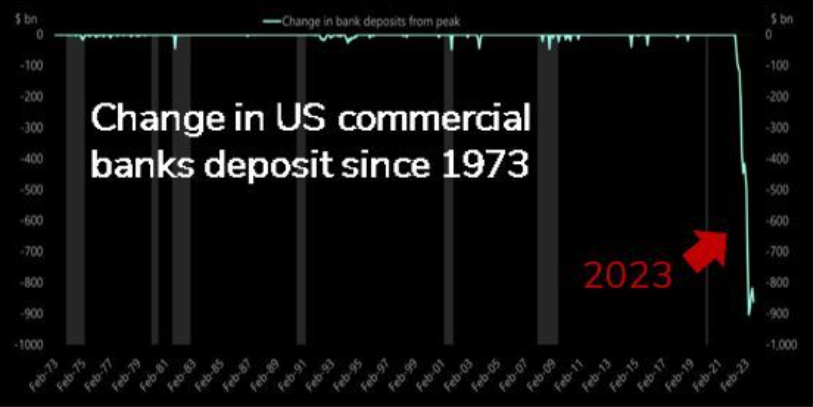
The leading media keep quiet about it, or only express it here and there in some comments by vigilant editors, that the economic situation in the U.S. is not at all as brilliant as the stock market indications (still) suggest. The yield on U.S. bonds is always climbing upward, and U.S. citizens are massively pulling their money out of the banks to invest in the government’s debt instruments. The scale of this process has reached unprecedented levels, threatening U.S. regional banks in particular with insolvency. 


Change in deposits at U.S. commercial banks since 1973. source: Apollo

At the same time, discontent is rising in American society, and not just because of what is arguably the most unpopular president in many decades, Joe Biden. How to explain the paradox that during Biden’s administration, 12 million new jobs have been created, unemployment is at 3.5%, and yet in 2023 a wave of strikes not seen in 20 years is sweeping the country? Something must be ticking not quite right in the economy and in society. 

The number of lost workdays this year is already in the millions.

We think that the global recession has already started; it is not yet becoming the central topic in the media. They are always talking about a possible “soft landing” of the economy after the current energy and inflation crisis since the recovery after the pandemic and the first wave of inflation. If you take a close look at such accumulating statements from the bright minds of television and compare them with other periods in history when economists have reassured us en masse, you can safely conclude against the tide: Recession is inevitable. 

The graph above shows that every time Wall Street Journal articles piled up about a “soft landing,” a crisis or recession came right after.

In our latest bulletin (October issue), we analyze, among other things, the state of the two of the world’s largest economies – that of the U.S. and that of China – and show other signals that may point to a world recession.

Turkey and the USSR or: the wages of good will and meekness is death

The text might as well be titled China and the USSR or India and the USSR or, or, or. You will soon know why.

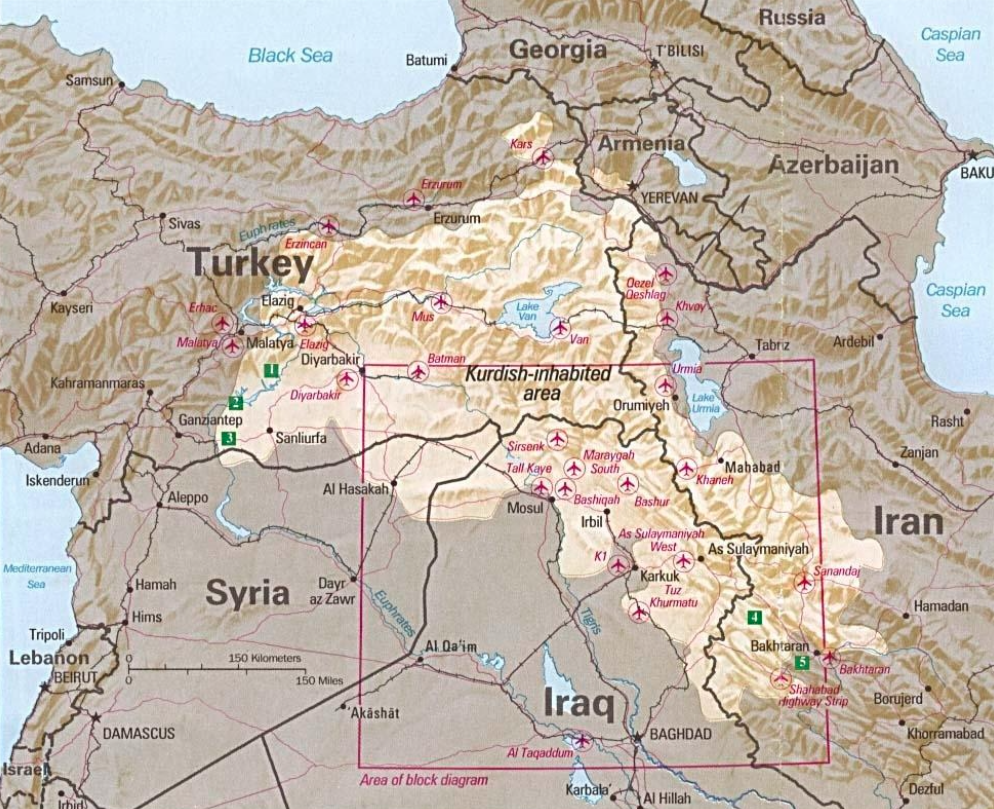
The nation of Kurds numbers some 40 million people of which an estimated 14-15 million live in Turkey (10 million – in Iran, 6 million – in Iraq and 2 million – in Syria). Turkey’s overall population amounts to 85 million, so Kurds make up a fifth of it. What’s even more important, they occupy an area in Turkey that is all-Kurdish (just as is the case in corresponding regions in neighbouring Iran, Iraq and Syria). Kurds, therefore, ought to have their own national state, an independent state, carved out of the pieces of territory inhabited by them in the four countries aforementioned. Why, the United Nations pursues the principle of the self-determination of nations (ha! ha! – when did you last hear about a dependent nation being able to win independence in keeping with this principle that is enshrined by the United Nations?) Understandably, none of the countries that have large Kurdish minorities has any intention to even theoretically consider ceding a part of their territory to the nation of Kurds and letting them have their own independent state. Why understandably? 

Kurdish-inhabited areas in the Middle East (Wikipedia)

Because in politics and generally among people it does not pay to be magnanimous, to be friendly, to be evangelically meek. If the meek shall possess the earth, then maybe in afterlife. Case in point? The USSR.

After four decades of the Cold War, the formidable Soviet Union, an empire that everyone reckoned with and respected if not feared, that empire surrendered to the West, its opponent, almost unconditionally, just like the Third Reich in 1945, with this significant difference, however, that the Soviet Union showed good will without being shelled into Stone Age and thus compelled to lay down its arms. The capitulation was complete:

[1] the military block of the USSR’s satellite states was dissolved;

[2] the economic union of the USSR’s satellite states was disbanded;

[3] the Marxist-Leninist ideology – the driving force behind Soviet policy-making – was abandoned entirely and condemned;

[4] the Union of the Soviet Socialist Republics was disunited, disassembled (though a referendum held prior to that event showed that the majority of the USSR citizens did not want it) and new independent states emerged;

[5] capitalism was invited to all former socialist countries and replaced socialist economy;

[6] the Soviet past was in the years to come savaged in the media, lambasted in the educational system and bad-mouthed in the entertainment;

[7] post-Soviet elites bent over backwards to please their Western partners;

[8] almost everything of value was privatized, which is another phrase to say: sold to Western companies.

Good will and meekness. Yet, to paraphrase Saint Paul, the wages of good will and meekness is death. In return for their good will and meekness the Russians received:

[1] economic chaos;

[2] domestic terrorism and wars with national minorities;

[3] the ever-growing expansion of NATO, encircling their territory;

[4] refusal to be accepted to NATO;

[5] refusal to be accepted as equal partners in a world united from Lisbon to Vladivostok, as proposed by Russia’s president;

[6] an inimical Ukraine (apart from the inimical Poland, the Baltic States, Romania and the ever belligerent Caucasus), a Ukraine which was reeducated to hate all things Russian, trained to fight a war against Russia, encouraged to kill Russians (the fourteen(!) thousand in the Donbass region in the years 2014-2022, the fifty or so incinerated in Sevastopol, to name just two cases);

[7] the ongoing proxy war with the West.

Consider the last point. Rather than holding the whole territory of Ukraine with its 50 million(!) people (such was Ukraine’s population in 1991), its agriculture and industry, now Russians must fight them or else the anaconda’s stranglehold around them would soon deprive them of their last breath.

Back to Turkey. Why should Turkey let go of its Kurds, China – of its Uyghurs? Why should India disintegrate into the many states that it is made up of? Why show good will and meekness? The wages of good will and meekness is death. Such must be the inference that the ruling elites of the said countries must have arrived at. Imagine China giving up on Tibet and Uyghurs or Turkey letting go of its Kurds and maybe Armenians… Beijing would soon have a proxy war in its backyard against Tibet or Uyghurs (both supported by the United States), while Turkey – a war against Kurds and Armenians (supported by Iran or Syria).

The West have taught everyone a good lesson: be strong and expand, never give up or else. And remember: the wages of good will and meekness is death.

The idea of one civilization for all is inhuman and preposterous

Putin’s Valdai speech of 5th October, 2023

On 5th October, 2023, Russia’s President Vladimir Putin delivered a speech during a conference of the the 20th convention of the International Discussion Club held in Sochi. His words dealt with the ongoing political events and trends, without however naming names or making a reference to Ukraine. Russia’s president made a pronouncement concerning the West’s ideology and Russia’s stance on it or Russia’s response. The speech may be divided into the part criticizing the West and the part that lays down Moscow’s view of the world politics.

Here’s the anti-Western content:

The Western world, the notion that for all intents and purposes amounts to the Anglophere, in the opinion of the Russian leader and most likely of the Russian ruling elites has a track record of always seeking to dominate the globe, of always wanting to run the show by means of imposing on the other countries rules and principles that they are expected to abide by or else those rules and principles are brought to them with a bludgeon.

The West is always in need of an enemy, a foe, a rogue state because an external enemy serves the purpose of explaining to the populace the internal problems, and because an external, formidable enemy rallies the citizens of a country around their leader or leaders.

The West is run by the elites that do not pursue the interests of their nations; rather, in their self-aggrandizement they are ready to risk the welfare of their nations in an attempt to win dominance in this or other point on the globe.

The West defines an enemy as anyone – a state, country, nation, leader, political entity – who does not wish to follow the West’s dictate, who is not submissive enough, who does not acquiesce to being bossed around, who does not sign on to the idea that there is one global central power and global values to be observed. 

President Vladimir Putin then went on to expound the world view represented by the Russian authorities.

First, there is no one civilization engulfing the globe: rather, there are many civilizations, none of them better or worse than the others, and they all deserve to be recognized and respected. Consequently, there are no universal rules to be observed by all humanity, nor can there be a political concept of a global world.

Second, international problems ought not to be solved by a selected group of political dominant entities; nor should they be approached and tackled by all nations: rather, they ought to be discussed and solved by those concerned.

Third, nations should break with this idea imposed by the West of pursuing bloc politics. Nations have their own, individual, separate interests. There are no bloc interests or the so-called bloc interests boil down to being the interests of the bloc’s hegemon.

Fourth. Russia seeks no territorial expansion (that was the only direct reference – although without naming the country – in the speech to the ongoing war in Ukraine); Russia is the largest country on planet earth and for years to come will be busy developing and managing the vast swaths of land in Siberia.

The three greatest threats to the Netherlands

I. Demography

The indigenous population of the Netherlands is in steep decline. The droves of migrants brought here do not fill the employment offices; rather, they fill the pockets of the gangs and the developers who build government-funded housing developments for the migrants. Gigantic social transfers for migrants are supposed to encourage them not to work and to have many children so that the demographic gap of the Netherlands is filled. Even so, the demographic gap should rather be replaced with working professionals and not with the educationally disadvantaged newcomers from the Third World who only cash in and produce nothing. People who work at ASML, for example, did not come to the Netherlands on rubber dinghies through the Mediterranean to Rotterdam. They are often foreigners, but they have to go through a tough application process and are specifically chosen.

As our editorial colleague and his team once calculated with the help of Cerberus 2.0 software, the Dutch will be a minority in their country by 2070 at the latest. We have illustrated the demographic developments in a short video.

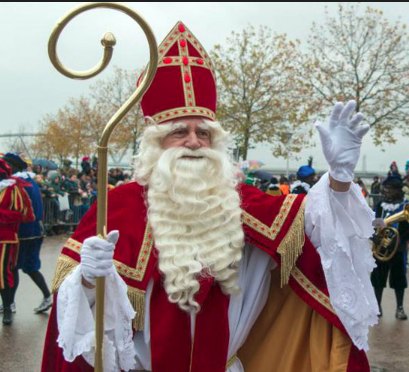
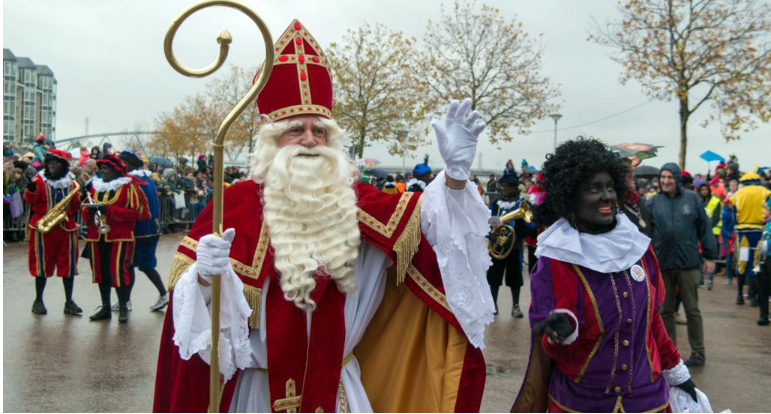
In the beautiful Netherlands of the future, everything will be different. Festivals will be celebrated very differently, for example December 5. Black Peter (Zwarte Piet) will wear the white beard of St. Nicholas and white St. Nicholas will serve him. This is how it should be in the new beautiful world without racism.

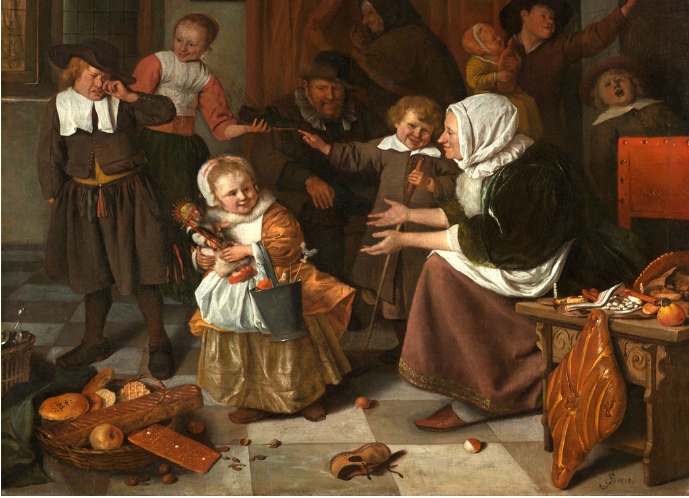
St. Nicholas Day (Pakjesavend) has not changed since 1664, when Jan Stehen painted his “Het Sint Nicolaasfeest” (Rijksmuseum, Amsterdam).

II. The Euro

The Dutch are hard-working and will not be able to retire until 67 in a moment. How is this compatible with Italy and France, the countries in the common euro zone, where the retirement age is 62?

Not everyone in the Dutch elites is blind. Former Finance Minister Hans Hoogervorst has long maintained that the euro is no longer sustainable. In an interview with the daily De Telegraaf, the economist said, “If the Netherlands were to join the eurozone now and adopt the single currency, that would be madness (De Telegraaf).”

Hoogervorst did not spare the European Central Bank (ECB), which has been financing the debts of weak eurozone countries for years. “Because of the ECB’s policies in indebted countries like Italy, it was thought that all the brakes could be released.”

Former DNB head Professor Lex Hoogduin is also critical of the single currency:

“The eurozone has ignored almost all the rules agreed in the 1990s and is now taking on the characteristics of a Latin (Southern European or French-Italian) monetary union. Such a Latin monetary union has, among other things, high inflation and low interest rates, and in such an environment a capital-based pension system is unsustainable,” Hoogduin said. “The Netherlands is the only one of the 19 eurozone countries that has such a capital-based pension system. The savings of pensioners in such a capital-based system melt away with high inflation and low interest rates.” Hoogduin agrees with then-VVD chairman Frits Bolkestein, who warned before the turn of the millennium that the Dutch pension system would prove unsustainable in the eurozone (Wynias Week).

III. The eco-terror

It seems that the days of centrally planned economies are a thing of the past in the Eastern Bloc, but when you look at all sorts of limitations, limits, emission fees of the EU, you could say that socialism and Lenin live on in the West. Ecological totalitarianism seems to be taking a heavy toll, especially in the Netherlands.

A year ago, the Netherlands’ central planners decided to limit nitrogen and ammonia emissions by 2030. The goal was to cut emissions by 50 percent by 2030, and by as much as 70 percent in some areas of the country, which would mean reducing agricultural production by a third. How surprised were Mark Rutte’s cronies, the old “liberal” revolutionaries, when farmers took to the streets and the land around the house of the minister responsible for ecoreform was thickly sprinkled with fresh manure. The green revolutionaries intervened in the style of the red guards: at Heerenveen, the protesters were shot at sharply because Rutte’s government was in the pocket of the construction sector and industrial lobby: such a radical plan to reduce nitrogen oxide and ammonia emissions was just a pretext for expropriation or conversion of agricultural land into industrial land or settlements for migrants, which, by the way, would in practice lead to more pollution in general and air pollution in particular.

The farmers, who represent the key sector of the Dutch economy (agricultural exports alone are worth 105 billion euros), got together and formed their own party – BBB. Since March 15 of this year, when the BBB won the election, every prime minister in Europe should think five times before announcing a climate crusade. As one of the 2022 demonstrators said to a reporter from radio station BNR, “Climate freaks have to eat, too.”

But the battle against the freaks from Brussels will not be won so easily. They will continue to do their evil because they believe in their ideology. It is actually their religion.

Russia threatens to use nuclear weapons once again!

What does that statement – Russia threatens to use nuclear weapons once again – make you think of? Surely, that Russia has already used nuclear weapons. Then, of course, if you are a little bit knowledgeable about the history of the latest 100 years, you begin to raise your eyebrows and search your memory for the event in which Russia used a nuclear weapon.

Russia threatens to use nuclear weapons again – that statement was made by Ursula von der Leyen during her laudation at the 2023 Atlantic Council Awards on September 20. In all likelihood very few people paid attention to the speech. After all, such speeches do not attract many listeners: they are like peas in a pod: the usual clap-trap about democracy, human rights accompanied by attacks levelled at the “political rogues” that is right extremists (somehow never left extremists) and selected states and their leaders: Russia, China, Syria, Iran, North Korea and some others. In her laudation occasioned by the awarding of Japanese Prime Minister Fumio Kishida, Ursula von der Leyen took exception to – how otherwise! – Russia. She used the fact that the Japanese prime minister was born in Hiroshima and, briefly recalling the bombing of that city – she constructed a sleight of hand of mendacity: she said that the remembrance of the bombing of Hiroshima was a warning, “especially at a time when Russia threatens to use nuclear weapons once again (emphasis added). She really said it in public and you can read the script of her speech on the official site of the European Commission.

And you know what? Her face did not even go red once she told this glaring lie! See for yourself (6:33 into the clip)! Nor did her nose become longer! She said the sentence matter-of-factly like she was making small talk about the weather.

Sure, she could not let the occasion slip without reminding the listeners of the “butchery in (the Ukrainian town of) Bucha” of a few months ago, which is just another sleight of hand, a phonetic pun. If you happened to believe in the veracity of the reports about Bucha, then von der Leyen’s downright lie about “Russia once again using nuclear weapons” should make you wise up. Whatever we are told by them – the managers of the world, the commissioners, the presidents and prime ministers – are such sleights of hand. 

Could it be that also the Jews dislike Russia more than they like themselves?

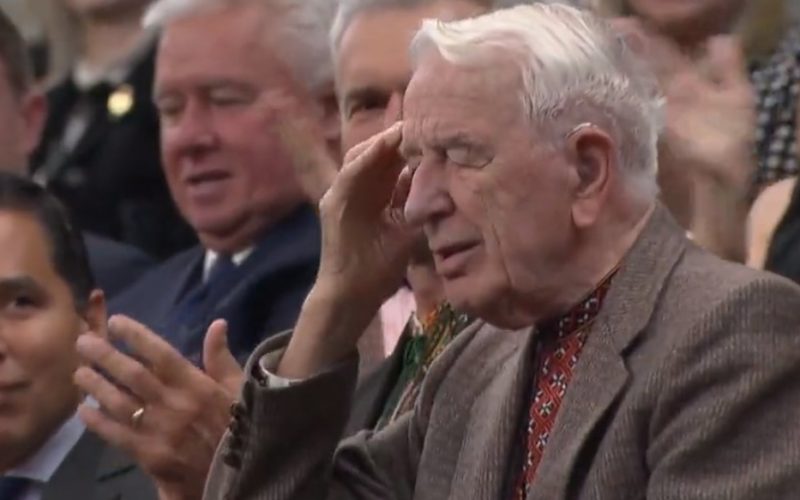
The shots taken in Canada’s parliament showing how the assembly gives a standing ovation to one Yaroslav Hunko, a former member of the SS-Galizien, who was touted by the speaker and the journalists as a fighter for Ukraine’s liberation from the Russian yoke has been doing the rounds around the globe. It was only now that some Jewish organizations have raised their eyebrows. What a surprise! As if Yaroslav Hunko was the only and exceptional case of celebrating a neo-nazi or antisemite! Yaroslav Hunko is a Ukrainian naturalized in Canada, and during World War Two he was active in ethnic cleansing in the territories that Ukrainians regarded and continue to regard as their own. The same ideology has not died out: it re-emerged in present-day Ukraine and it is only now that an uproar has been raised. Up till that event Jews around the world did not seem to care about neo-Nazis in Ukraine and have generally sided with Ukrainians in their conflict with Russia. how did this all come about?


Yaroslav Hunko celebrated in Canadian parliament

A short historical aside. As in any nation, so in Poland, among patriotic political movements, it has always been possible to identify broadly two attitudes of action: one guided by emotion and the other guided by reason. More than a century ago, when Poland was occupied by Prussia, Austria-Hungary and Russia, the greatest animosity of Poles was directed against the Russians. This animosity very often obscured the real good of the people and the country. The more enlightened national activists, who proposed to pursue a sensible policy that would maximize profits and minimize losses, appealed in vain not to take steps that would worsen the plight of the nation. The main point here was not to spark armed uprisings, since the previous ones had not only been suppressed, but also resulted in some citizens being killed, some going to prison and some leaving the country, generally forever, while the occupier restricted or eliminated those political freedoms that had existed before the uprising. These sensible activists pointed to the Grand Duchy of Finland, which was also under the rule of the Russian Empire, (since the Congress of Vienna), and whose inhabitants did not revolt, which allowed them to enjoy wide autonomy. Unfortunately, most Polish patriots preferred to explode in anger like a meteorite and die out just as quickly, succumbing to the overwhelming force of the Russians. Such conspirators, insurgents or revolutionaries found satisfaction in the fact that they could give vent to their anger and their rage, that they could kill a few Cossacks, rob a state-owned Russian bank or make an assassination attempt on one or another representative of the occupying power. They cared little for the fact that harsh repressions were visited on their compatriots for such actions and life in Poland became even more unpleasant. The most important thing was to harm the “Russkies”! In such circumstances, sensible activists of the Polish national movement coined an apt saying that among Poles there are very many who hate Russia more than they love Poland.

Such an attitude toward Russia still persists in Poland. Surprisingly, this attitude seems to be shared by other European countries (except Hungary) as well as the United States and Canada. Could it be that they have all become infected from Poland? They all want to harm Russia regardless of the costs sustained: economic, financial, political, or those of prestige. We can observe this self-defeating attitude by looking at Germany and its deteriorating economic statistics; we can see this attitude by looking at the rest of the European Union as well. All of this could be understood to some extent: man does not happen to be a rational being. Man also acts emotionally and follows blindly his beliefs: religion or ideology. Be it as it may, there is a nation in which such an attitude towards Russia is particularly astonishing, incomprehensible and – dare we say it – bizarre. What nation?

It is the Jews: those living in the state of Israel, those living in Ukraine, and finally those scattered throughout the Western world, especially in the United States. Almost all of them – starting with Ukrainian oligarch Igor Kolomoyskyi (and his ilk), through Victoria Nuland or Antony Blinken (people partly responsible for creating American foreign policy), and ending with the Israeli authorities – support Ukraine in the latter’s war against Russia. they don’t seem to have noticed that for years Ukraine has been reviving and paying homage to the memory of Stepan Bandera, that Ukraine has been identifying with the Ukrainian nationalist movement, which both yesterday and today was and remains strongly anti-Semitic. To an ordinary person who knows how sensitive Jews are to the memory of the countless Jewish victims who had been deprived of their lives during World War II not only at the hands of the Germans, but also at the hands of Ukrainians, such an attitude is simply beyond belief! Jewish-Ukrainian oligarch Igor Kolomoyskyi even financed the infamous Azov Battalion, whose members had swastikas tattooed on their bodies; President Zelensky, an ethnic Jew, is completely unperturbed by the cult of Stepan Bandera nurtured in Ukraine; nor are his American sponsors of Jewish origin bothered by this cult. How is this possible? In many Western countries, Jewish communities have led to the enactment of laws that prosecute and mete out punishment for so-called historical revisionism: in this case, statements or publications that claim that Jewish victims during World War II were fewer or that they died in a different way as reported. Lo and behold, mysteriously Jews turn a blind eye to the overt and militant anti-Semitism that currently exists in Ukraine, and they support Ukraine regardless of its Nazi ideology, as long as it does harm to Russia. Could it also be that also Jews (like Poles) dislike Russia more than they like themselves?

Another historical digression. In the 1990s about a million Jews left the crumbling Soviet Union. Was it because they were persecuted there (and now have an aversion to Russia)? No. They emigrated because of the worsening economic conditions. Where did the Jews come from in the Soviet Union in the first place? Jews found themselves in the Soviet Union because they had previously been residents of tsarist Russia. And how did they become residents of tsarist Russia? For the most part, they came from the eastern territories of Poland, which Russia, in cahoots with Prussia and Austria (see above), had conquered and incorporated into their states. The sudden appearance of several million Jews in the Russian state became a sociological problem to be solved. The tsarist authorities feared the domination of the mostly educated Jews, who were primarily engaged in trade and who as a rule ran village inns, over the Russian illiterate peasants. In order to prevent this domination, Jews were restricted to live in the area of the so-called Pale of Settlement (roughly, the lands of the Polish state that had been incorporated into Russia). A ghetto, as it were, was created, with this huge difference to other ghettos that this one had an area larger than any state in Europe, stretching from the Baltic Sea to the Black Sea. Such a restriction (from which there were various exceptions) plus a numerus clausus in universities could have made Jews hostile to the Russian state. This hostility found expression in the fact that they fed the Russian revolutionary movement in disproportionate numbers compared to ethnic Russians. This revolutionary movement eventually led to a change in the political system, the creation of Soviet Russia, in which Jews were no longer restricted. Rather, they occupied important positions in government, industry and the arts. Why then the anger at Russia?

On the contrary, anti-Semitism was revived in Ukraine when it was occupied by Third Reich troops. Ukrainian soldiers or policemen from the Ukrainian national movement (created by Stepan Bandera) proceeded to crack down on Jews (and Poles, and Russians, and Belorussians), committing mass murder. Ukrainians formed a separate division, SS-Galizien, which ruthlessly fought the resistance movement in Ukraine and beyond. From Ukrainians were recruited guards in many a concentration camp, whose inmates were precisely Jews. And today, when three generations have passed since those events, today, when Stepan Bandera and his (anti-Semitic) political thoughts are being honoured as openly and officially as possible in Ukraine, leading representatives of the Jewish community throughout the Western world are supporting Ukraine against Russia! It even came to the point that – as mentioned above – in the Canadian parliament, on the day of the biggest Jewish holiday, Yom Kippur, tribute was paid to 98-year-old Yaroslav Hunko, a former member of the SS-Galizien. Although a weak outcry was raised immediately after the event by Jewish organizations (and even by the Polish ambassador and authorities who support Kiev in its fight against Moscow unconditionally), this does not mean that Jews, both those in the state of Israel and those in the United States or Canada, will stop supporting Ukraine in its war against Russia.

Here we have two issues that are difficult to understand. Why such hatred of Russia and why such a willingness to turn a blind eye to the historical revisionism practised in Ukraine? Could it be – to repeat it a third time – that the Jews dislike Russia more than they like themselves?