If you’ve ever been exposed to Marxist agitprop, you recognize the instances immediately, however disguised they may be. BlackRock’s agitprop is no different: it fits the picture perfectly. In 2022, BlackRock released its Global Diversity, Equity and Inclusion Annual Report. I urge everyone to read through it. You’re guaranteed to be bored stiff. The blah blah of “creating an environment where everyone feels included and safe” (Larry Fink Founder, Chairman and CEO of BlackRock) and the stringing together of words and phrases that just repeating them makes you sick to your stomach, and the constant hammering of the same message page after page after page are really the extreme! Read it if you can stomach it!
“At BlackRock, Diversity, Equity and Inclusion (DEI) is a business imperative,” and I naively thought BlackRock was about money! No, BlackRock is all about DEI. That’s what makes them tick, that’s what they are after, that’s how they accumulate wealth. Didn’t you know?
BlackRock’s Manish Mehta, Head of BlackRock Global Markets, tells you that “earning and maintaining the trust of our people every day is what creates the sense of belonging and engagement that allows each of us at BlackRock to thrive.” The word belonging along with a string of other agitprop words like equity, inclusion, diversity, stakeholder etc. keep popping up in the document on and on and on. If BlackRock really had a good psychologist on its pay, a good marketing strategist or simply common sense, its managers would refrain from regurgitating their readers with the nauseating repetition of the same maudlin phrases. But so they have no experts in this respect, or the experts they have are what they are.
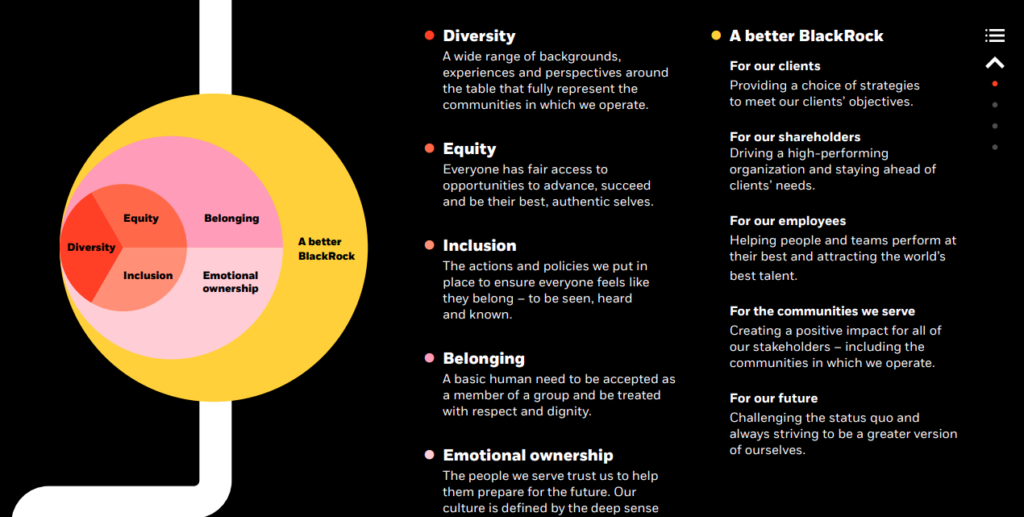
The authors of the annual report are not even capable of simple reasoning. They equate inclusion with belonging, and I challenge you to see the difference. According to BlackRock, the former means “the actions and policies we put in place to ensure everyone feels like they belong – to be seen, heard and known” while the latter is to be understood as “a basic human need to be accepted as a member of a group and be treated with respect and dignity.” Now, apart from the difference in the wording of the two “definitions” what the heck is the difference? If you belong, you are included and the other way round.
In the case of the two terms – inclusion and belonging – at least an attempt is made to define them. How about shareholders and stakeholders, two other terms that they use throughout the document? No explanation is offered. The same is true of equity (a buzzword in the minds of the powers that be) and equality. The BlackRock brochure that we are adducing says that equity means that “everyone has fair access to opportunities to advance, succeed and be their best, authentic selves.” Is that not the definition of equality? But who cares? The gullible readership of the BlackRock document will buy into everything it offers so long as it is cloaked in magic words like equity, diversity, inclusion and belonging and so long as it panders to their inflated ego.
As the clickety-clack of “unwavering support and a steadfast dedication to DEI” and “being committed to accelerating progress and promoting a culture of belonging and inclusion” (Michelle Gadsden-Williams, Co-Chair , Global DEI Steering Committee; Global Head of Diversity, Equity and Inclusion) continues page after page, we learn that BlackRock intends to increase senior female representation to over 30% by 2024, and increase the number of Black and Latinx (what’s that?) senior leaders in the US by 30% by 2024. To put it in plain English: they will be bounty hunting for biological sex and the color of skin: if sex and the color of skin are decisive – as they obviously are – then why talk about promoting talent? The mendacity of BlackRock’s language is certainly not obvious to people raised in today’s environment of the craziness that has taken hold of the Western mind.
Humanity has always been shaken by collective psychological phenomena that have had nothing to do with common sense let alone reasonable reflection of the mind. If you wanted to “belong” in the 18th century, you needed to become a Freemason; if you wanted to “belong” in the 19th century, you needed to join one of the socialist movements; if you need to “belong” nowadays, you need to subscribe to the globalist ideology of DEI. That’s how simple it is. This madness, too, will pass away…. only to be replaced by another collective psychiatric disease of humanity.
The pages of the brochure devoted to representation and hiring repeatedly address the same issue: how to hire more women and more people of color other than white. To reiterate, it should be clear to a reasonable reader that BlackRock is not about talent, not about skills, education or experience, but about gender and race par excellence. We have seen exactly the same thing in the countries with Marxist ideology, in countries like the Soviet Union, Poland, Czechoslovakia, East Germany, Hungary, Romania or Bulgaria. The difference was in the category of people who were put in the responsible positions. The communist parties in the above-mentioned countries made it their business to fill important posts with workers and peasants, or at least with children of workers and peasants. That is why we call the BlackRock annual report Marxist (or Trotskyist, if you will) agitprop.
BlackRock is fixated on employing women and non-whites, period. Funny that a white man is the CEO of BlackRock. Why is that, really? But then, that’s nothing new under the sun. The socialists and communists who ruled in the aforementioned countries were mostly members of the intelligentsia, i.e. educated people who came from the aristocracy. It was they who were eager to recruit and surround themselves with representatives of the working class or the peasantry. Competence was not required for this. The social classes of workers and peasants were elevated to key positions in the state, government and society, while children across the country were taught that the working class was the leading or driving force of the nation and paved the way for a bright future. How much this resembles BlackRock! Take a look:
“We […] advance racial equity by investing in future leaders. [We] provide leadership programming to Black, Latinx and Asian professionals […]. This year, we continued to engage Black professionals in the U.S., and we expanded our participation to Latinx and Asian professionals in the U.S. and Black heritage colleagues in the UK,”
As long as you’re black or Latinx or Asian, you’re qualified. But wait a minute: Why should black, Latinx or Asian people be supported if they really have talent? Wouldn’t they be able to move up the social ladder without this extensive support? I dare say they could, but there you have it. Just like in the former communist countries: Back then, centuries of exploitation and social prejudice were cited as explanations for why the sons and daughters of workers and peasants couldn’t manage on their own and needed the state’s help; today, racism (which inevitably goes with the adjective systemic!) and the slavery that existed two centuries ago are cited as explanations for why people of color must be forcibly promoted, and sexism and patriarchy – to promote women.
Mr. Larry Fink: Why are you, of all people, the CEO of BlackRock? You’re white and male. Yikes. Make room for a black woman. What are you waiting for?
In the same brochure, BlackRock boasts about launching the Count-Me-In campaign “designed to raise awareness about self-identification” in terms of “gender identity, sexual orientation, race and ethnicity, disability and military/veteran status, socioeconomic background and local cultural identity.” What does any company need that information for? Well, if I employ a plumber or a teacher or a doctor, I look for professional qualifications and possibly recommendation from people who have already relied and the job of the professional. That’s about all. Why should I be interested in someone’s “gender identity, sexual orientation, race and ethnicity, disability and military/veteran status, socioeconomic background and local cultural identity”? How does that relate to looking for talent and equality and all that clap-trap? If I do not select a person on the basis of his skills, attainment and reputation but take into account ““gender identity, sexual orientation, race and ethnicity, disability and military/veteran status, socioeconomic background and local cultural identity,” then obviously I am not interested in talent and competence at all! Can’t the readers of such agitprop not discern it?
Leafing through the report we come across the idea of “equitable compensation,” which is laid down in a very obscure and vague language of “conducting annual global compensation reviews to assess pay outcomes for fairness and equity, including, but not limited to, reviewing outcomes by gender and race/ethnicity.” What the heck might that be? The old Robin Hood’s principle of robbing Peter to pay Paul? What one can infer from this extremely obscure language is that the moment BlackRock discovers that a woman, a black or a homosexual gets less money than a white heterosexual male, BlackRock steps in and makes up for the loss. Hm… Again, precisely the same was practised in former communist countries. Workers and peasants were lavished with all sorts of compensation for being workers and peasants. Slowly they all ate away their communist state. The same fate awaits BlackRock.
Further, BlackRock reveals what it all comes down to: the company “offers health and voluntary benefits to same-sex domestic partners and spouses. Where permitted, our plans include transgender-inclusive health benefits. Our family medical leave and bereavement leave policies cover same-sex partners and spouses.” This is coupled with being “committed to advancing the role and contributions of Black women in asset management.” Homosexuals and black women are the priority. Again, they are not chosen for their merits, talents, abilities, skills and experience, but for biological characteristics. That is the only thing that matters. Do a thought experiment: what will BlackRock do if it cannot find a talented, qualified, experienced, capable homosexual or black woman? BlackRock will hire one anyway! You see, they have set quotas that say that by the year of this and that, the number of blacks or homosexuals or women must be such and such. Clearly, you can’t plan for the emergence of talent, which means that the top positions at BlackRock will be given to homosexuals, women and blacks, no matter what the cost. Pure pernicious and foolish ideology.
Consider another thought experiment. Let’s play racism as practiced by BlackRock (against whites) in reverse (against blacks). As we know, the United States fields black runners in international sporting events, and they very often win the races. What about diversity here? Why not field a few white runners and a few Asian runners? Just along the lines of diversity. Never mind that runners of Asian or European descent can’t compete with their counterparts of African descent! We will include them on the U.S. national team (inclusion!) and let them compete in international sporting events. Never mind that the number of gold, silver or bronze medals will decrease. We will have achieved the greatest goal of all: diversity.
This is where another question comes into play. I’m just wondering, Mr. Larry Fink, if you’re playing the diversity card just for fun or to drive others out of the market, or if you really believe in all of this. If you’re doing it for fun, then – well – you can probably afford it. If you’re doing it to drive competitors out of the market – competing companies won’t be able to hire unqualified, incompetent people based on their gender or skin color and survive – then you’re employing a strategy that’s as legitimate as any other. But if you truly believe in this ideology and you suffer financial losses, then what? Will you reverse course or drive BlackRock over the cliff?
Another BlackRock flagship program is Listening Circles, which are “small group conversations between employees and local BlackRock leadership to share their perspectives and personal experience.” In former Marxist countries, the same thing existed: it was called a collective. Employees were brought in droves to have supposedly free discussions with managers and party leaders about everything from professional to personal issues. People were made to feel liked and accepted by the collective, and they were constantly made to feel the presence of the collective, which everyone could rely on, identify with, and depend on. This is exactly the same phenomenon.

The lovey-dovey world à la BlackRock
Hey, BlackRock! What about people who don’t fit into your brave new world? I for one feel that I would never, ever belong to BalckRock, to that wishy-washy, Marxist-cum-Trotskyist claptrap, to that maudlin, sugar-coated, lovey-dovey, nauseating, stifling atmosphere where you embrace every single member with your tentacles of diversity, equality, inclusion, progress and whatnot. What are you going to do with people like me? Will you try to psychologically reprogram me? What if you fail? Will you try to reprogram me pharmacologically? Will you try to sideline me? But then what about your inclusivity? Or will you follow the Canadian government’s example and provide me with MAID?
Which time is it in human history when yet another daydreamer is trying to impose the vision of a conflict-free, love-filled world on people? Which time is it? And you still haven’t learned anything?
Just for the record. In the 2022 Annual Report on Diversity, Equity and Inclusion, titled “Our Way Forward,” the word “equity” appears 35 times, “inclusion/inclusivity” appears 63 times, and “diverse/diversity” appears 79 times on 97 PDF pages that are full of graphics. If we consider only the text, each of these three words appears at least once per page. This makes for very tedious reading! Once again, I would like to point out the obvious lack of good psychologists at BlackRock: such obnoxious repetitions are repulsive to say the least. For one thing, they give the impression that these ideas are being forced on you, and we know that good things don’t need to be forced on anyone.
Hey, BlackRock! I feel tempted to use Vladimir Bukovsky’s handy phrase and I will use it: I have lived in your future.